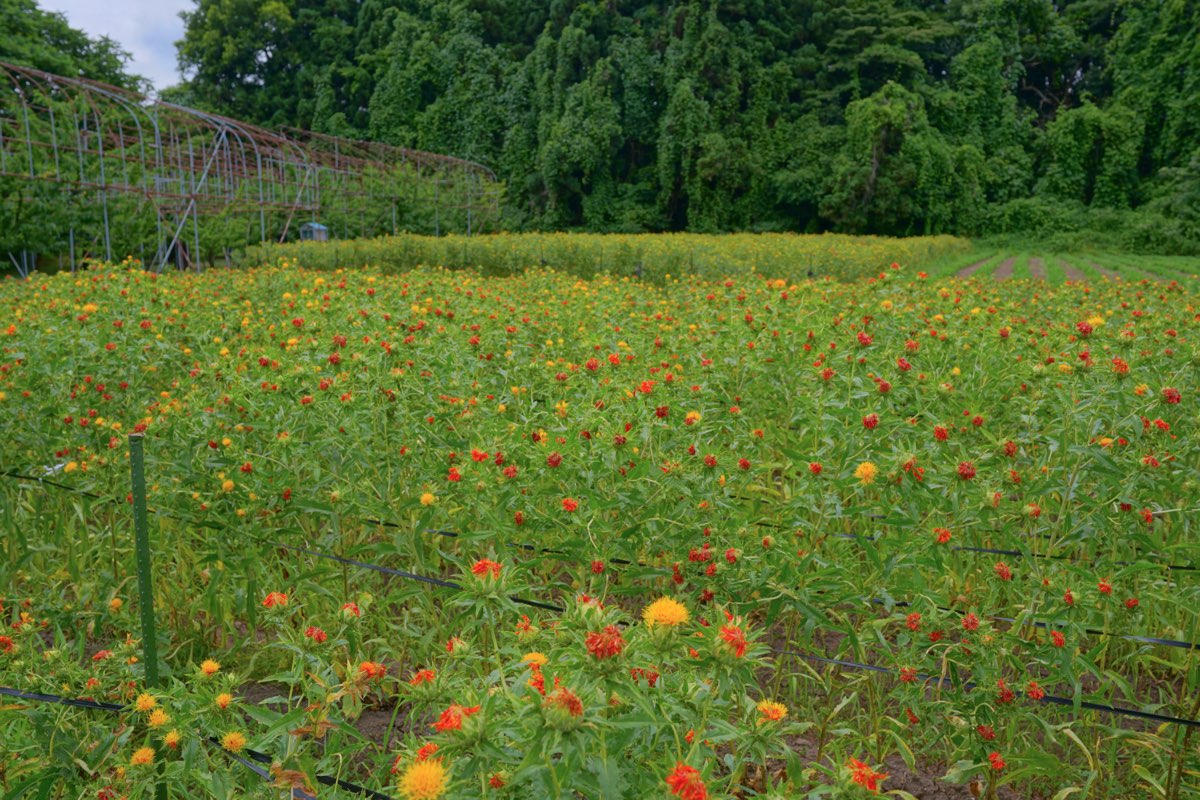
In the Edo period, a red dye made from safflower linked the inland basins of Yamagata with the great cities of Kyoto and Osaka. The flowers grew in fields along the Mogami River, were pressed into dye cakes, and traveled by river boat and coastal ship to western Japan. There they colored silk textiles and the rouge women wore on their lips.
The trade brought great wealth to Yamagata's farmers and merchants. It also brought goods and customs from Kyoto and Osaka back up the river, and many of them can still be seen in the region today.
Japan's leading safflower region
According to Yamagata Prefecture, safflower growing and the processing of the flowers for dye in the Mogami River basin have a history of about 450 years, going back to the late Muromachi period. Local tradition says safflower was brought to the area by Jikaku Daishi (Ennin), the monk said to have founded the temple Yamadera, or by his successor Annen.
The prefecture's Japan Heritage page says the Murayama region in central Yamagata was known in the Edo period as Japan's leading safflower producer. In the early Edo period it supplied 50 to 60 percent of the country's output, and it ranked first in both quality and quantity.
The same page explains why the land suited the crop. The Mogami River left fertile soil, and the climate often produced morning mist. Together they grew flowers rich in fine red pigment, and the misty conditions made the thorny plants easier to pick.
Growers today still work with these conditions. According to the prefecture, they rotate safflower with other crops and use organic materials to avoid the damage caused by planting the same crop year after year. They also carry on the skill of turning the harvested petals into a form suitable for dyeing.
From petals to "benimochi"
That form was the benimochi, or "red cake." According to the prefecture's Japan Heritage page, merchants called hanagai ("flower buyers") collected the petals from the villages. At the merchants' houses, many workers washed and dried the petals and shaped them into flat, round cakes like rice crackers.
Wrapped carefully in local paper and other materials, the cakes began a long journey west. In Kyoto and Osaka, safflower was turned into the colors of elaborate Nishijin silk and into cosmetic rouge. The Japanese phrase beni o sasu, "to apply rouge," derives from safflower.
The prefecture also says the dye was used for the costumes of traditional Shinto rituals. Safflower known as "Mogami safflower" could give shades from vermilion to deep crimson. It was said to be worth "a hundred times rice and ten times gold."
The poet Matsuo Bashō saw safflower fields on his way to Yamadera in 1689 and wrote haiku about the flower.
Down the Mogami River
The Mogami River made this trade possible, but it was not an easy route. According to Yamagata Prefecture, it is 229 kilometers long and flows only within the prefecture. Along its course it passes through five basins and five narrow gorges, and it is counted among Japan's three fastest-flowing rivers.
The prefecture notes that the gorges were dangerous places for boats. They also mark the boundaries between Yamagata's four regions, each with its own dialect and culture.
The river had carried people and goods since the Heian period, when it appears in a poem in the Kokinshū anthology. Its use grew after work to open the channel. According to the Ministry of Land, Infrastructure, Transport and Tourism, Mogami Yoshiaki, lord of Yamagata Castle in the early modern period, cut through the three places known as the river's three hazards: Goten, Sangase, and Hayabusa.
In the Genroku era, the ministry says, Nishimura Kyūzaemon of the Yonezawa domain cut a passage through the Iogawa gorge between the Murayama and Okitama regions. With the route open from the upper river to the river mouth, boat transport quickly became the main way to move goods.
A guide published by Yamagata Prefecture describes the result upstream. In the late seventeenth century the rocks at Kurotaki, which had blocked boats, were cut away. In the Genroku era a landing that small boats could reach was completed at Nagai, which grew into a merchant town known as the "port in the mountains."
Safflower did not always go by water the whole way. According to the prefecture's Japan Heritage page, the benimochi were carried overland to avoid the river's dangerous stretches and then loaded onto boats at the river port of Ōishida. Another prefectural page describes safflower dye cakes gathered by river from Yonezawa, far upstream, to Sakata.
At Sakata, at the river mouth, cargo was transferred to ships of the western sea route, the Kitamaebune, which carried it on to Kyoto and Osaka. Ōishida, a river port said to date from the Muromachi period, received a shogunate boat office in 1792. According to the ministry, it remained a center of Mogami River transport until the Meiji period.
Goods and culture coming home
The boats did not return empty. According to the ministry, until the early nineteenth century rice, safflower, and aoso fiber were shipped from the upper river toward Kyoto. Timber was rafted down to Sakata, and salt and cotton came back from western Japan.
Kitamaebune ships also brought Buddhist statues, temple bells, and stone objects. The influence of Kyoto's Gion festival can be seen in festivals in the prefecture.
Merchants from Ōmi (today's Shiga Prefecture) also came to the region. According to the prefecture, Yamadera's long ties with Mount Hiei attracted them, and Mogami Yoshiaki actively invited them to expand trade with western Japan. They opened shops in the center of Yamagata city and, together with local merchants, brought great wealth to the area through the safflower trade.
From the middle of the Edo period, safflower trade along the Ushū Kaidō highway also grew, bringing influences from Edo as well.
Wealthy farmers and merchants built large houses with white-walled storehouses. The prefecture says that the white walls show the influence of Kyoto and Osaka.
Hina dolls and safflower-dyed costumes that merchants bought on business trips to western Japan were handed down in these families. At the time of the Hinamatsuri doll festival, the dolls are still shown in homes and storehouses.
Even food carries memories of the trade. Imoni, a taro stew eaten outdoors by rivers in autumn, is said to have begun when boatmen cooked local taro with dried cod brought back as return cargo.
With the opening of railways in the Meiji period, including the Ōu Main Line and the Rikuu West Line, the ministry says Mogami River transport came to the end of its historic role. Today sightseeing boat trips are popular on the river.
Safflower growing continued. In 2019 the Minister of Agriculture, Forestry and Fisheries recognized Yamagata's "Mogami safflower" production and dye processing as Japanese Nationally Important Agricultural Heritage. In fiscal 2018 the story "Safflower Culture Supported by Yamadera" was recognized as Japan Heritage.
Visiting today
The Kahoku Town Safflower Museum occupies the former house of the Horigome family, village heads and safflower merchants in the Edo period. The town received the house in 1982 and opened it as a museum in 1984.
It displays how benimochi were made and the tools used, and it shows safflower-dyed costumes and hina dolls in special exhibitions. A safflower field on the grounds is at its best from late June to early July.
Along the river, the prefecture says, merchant houses and storehouses from the days of river transport are preserved in Nagai. The ministry notes that kura-style shops in Ōishida still recall its time as a river port.
Opening hours and seasons change, so check the official websites before you visit.
Sources
- 歴史と伝統がつなぐ山形の『最上紅花』Yamagata Prefecture
- 山寺が支えた紅花文化Yamagata Prefecture
- 最上川Yamagata Prefecture
- やまがた水の物語Yamagata Prefecture Okitama Office; edited by 西置賜地域課題解決研究会
- 日本の川 東北 最上川 「文化を運ぶ道」最上川の歴史Ministry of Land, Infrastructure, Transport and Tourism
- 河北町紅花資料館Kahoku Town Tourism and Products Association