In the middle of Yamagata Prefecture stand three sacred mountains known together as Dewa Sanzan: Mount Haguro, Mount Gassan, and Mount Yudono. Gassan, at 1,984 meters above sea level, is the main peak. Haguro, at 414 meters, is the lowest and closest to the villages below, and Yudono rises to about 1,500 meters.
For centuries, pilgrims have climbed these mountains in a particular order, as a symbolic passage through life, death, and rebirth. The journey is still made today, supported by mountain priests, shrine staff, and the community of lodging houses at the foot of Mount Haguro.
A founding told as tradition
Dewa Sanzan Shrine tells how the mountains were opened. According to the shrine, in 593, the first year of Empress Suiko's reign, Prince Hachiko, a son of Emperor Sushun, fled political conflict at court and came north by sea.
In the shrine's account, a three-legged crow guided him to Mount Haguro, where he practiced austerities and founded a shrine on the summit. He then opened Gassan and Yudono.
The shrine treats 593 as the year the mountains were founded and honors the prince as their founder. The shrine itself notes that there are several versions of the route he took. This account belongs to religious tradition; it is not an event that can be dated by independent evidence.
What the sources describe more securely is the kind of faith that grew here. Dewa Sanzan was a center of Shugendō. The Japan Heritage portal describes it as a form of mountain religion unique to Japan, born from nature worship mixed with Buddhism and esoteric Buddhism; the shrine adds elements of Taoism and Confucianism.
The shrine says that in the Kamakura period Mount Haguro was called a mountain where "eight schools" of Buddhism were studied together. Tsuruoka City's heritage plan states that it was then regarded as the guardian of thirty-three eastern provinces. The plan also says it counted as one of Japan's three great Shugendō centers, alongside Kumano and Hikosan.
Present, past, and future
In Haguro Shugendō, each mountain came to stand for a different time. Haguro, near the villages, was the mountain of the present, where people prayed for happiness in this life.
Gassan, tall and graceful, was the mountain of the past, where the spirits of ancestors rest and where people prayed for peace after death. Yudono, the mountain of the future, was where people prayed to be reborn.
According to the Japan Heritage story, this belief spread among ordinary people in the Edo period as the "journey of rebirth." Within Haguro Shugendō it is called the journey through "three barriers and three crossings." By visiting all three mountains, pilgrims hoped to renew their life while still living.
At Gassan, the local belief that ancestral spirits climb to high mountains shaped its role. Near the eighth station lies a wetland called Midagahara, named after the Pure Land. At the summit, Gassan Shrine is dedicated to Tsukuyomi, the deity who rules the night.
At Yudono, the object of worship is a great red rock from which hot water flows. Worshippers take off their shoes and touch it with bare feet. Its crumbling slopes of bare rock and many waterfalls are also used for demanding austerities, such as standing under a waterfall.
The Edo-period pilgrimage
Much of what pilgrims see on Mount Haguro today was shaped in the seventeenth century. According to Tsuruoka City's heritage plan, the monk Tenyū became the fiftieth administrator (bettō) of Mount Haguro in 1630. He unified the mountain, which had followed four Buddhist schools, under the Tendai school, around 1641.
Tenyū also had cedars planted along the approach and laid stone steps on the steep slope. The cedar avenue, about 1.7 kilometers long, was designated a Special Natural Monument in 1955. A survey in January 2022 counted 558 trees along it.
The same plan says that under Tenyū, districts for spreading the faith, called kasumi, were set up and pilgrim groups (kō) were organized. Such groups are still especially common in the Kanto and Tohoku regions. Visiting Dewa Sanzan came to be called the "eastern Oku-mairi," paired with the pilgrimage to Ise in the west.
The plan gives figures said to date from the Enkyō era (1744–1748): 33 temples of celibate practitioners on the mountain, 336 lodgings of married practitioners in the village of Tamuke at its foot, and 3,783 affiliated temples across many provinces. It also says that more than a hundred thousand pilgrims came each year.
Pilgrims came along the Rokujūri-goe road, which linked inland Yamagata with the coast, or by boat on the Mogami River. They began their climb at entrances known as the "eight directions and seven mouths." According to the Japan Heritage story, it is said that lines of pilgrims in sedge hats and white robes, the clothing of the dead, were so long that their hats seemed to ripple like waves.
In 1689 the poet Matsuo Bashō traveled down the Mogami River and came to Tamuke. He stayed at Minamidani on Mount Haguro, then visited Gassan and Yudono. On his return he wrote a haiku for each of the three mountains.
From temples to shrines
For most of their history, the mountains were run mainly by Buddhist institutions. Tsuruoka City's plan says that from the early Edo period Haguro and Gassan followed the Tendai school, while Yudono was served by the Shingon school. According to the shrine, this lasted until the policy separating Shinto and Buddhism was carried out in the first years of the Meiji era.
Under that policy, all three mountains became Shinto shrines. Today Dewa Sanzan Shrine serves them in the Shinto tradition. The shrine itself stresses that its festivals still strongly show the colors of Shugendō, with roots in Taoism, yin-yang thought, and esoteric Buddhism.
A living tradition and Japan Heritage
At Tamuke, lodgings run by yamabushi (mountain priests) still welcome pilgrims. The city's plan counts about thirty lodging houses today.
According to the Japan Heritage story, the yamabushi guide pilgrims on the mountains from spring to autumn. In winter they travel through eastern Japan to spread word of Dewa Sanzan's blessings, as they have done since the Edo period.
Many houses hang ropes from the Shōreisai festival under their eaves as charms against evil. In their youth, many men of Tamuke go through mine-iri, the training by which yamabushi are made. The vegetarian meals served at the lodgings use local mountain vegetables, and dishes carry the names of places connected with the faith of the three mountains.
In fiscal 2016 the Agency for Cultural Affairs recognized the "journey of rebirth" as Japan Heritage, a national program that recognizes stories about regional history and culture. The story spans Tsuruoka City and the towns of Nishikawa and Shōnai, and it includes 31 cultural properties.
In 2022 the Agency reviewed the nineteen stories recognized in 2016. It continued sixteen of them and chose three, including Dewa Sanzan, as "priority support areas" that can serve as models for other regions.
Visiting Dewa Sanzan
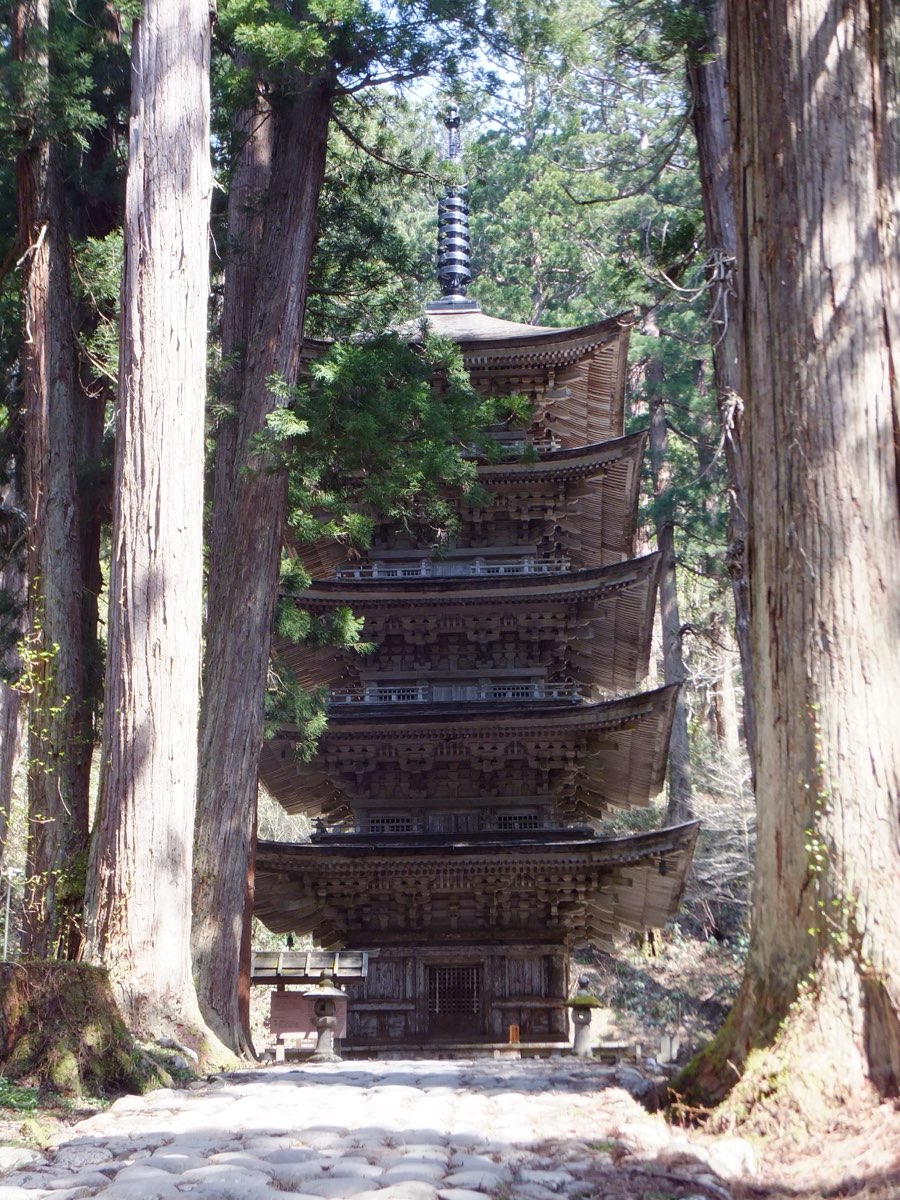
The journey usually begins at Mount Haguro. From the Zuishinmon gate, an approach of about two kilometers climbs 2,446 stone steps to the summit, lined with cedars 300 to 500 years old. Along the way stand the Jiji-sugi, a cedar said to be more than 1,000 years old, and the unpainted Five-Story Pagoda, a National Treasure.
The pagoda is said to date from around 1372 and was designated a National Treasure in 1966. On the summit, the Sanjin Gōsaiden hall has a thatched roof about two meters thick, and it was completed in 1818. Because Gassan and Yudono cannot be visited in winter, the deities of all three mountains are enshrined together in this hall.
Gassan and Yudono can only be visited during part of the year, because of deep snow. The shrine's website lists the opening seasons for each.
On Mount Haguro, the shrine runs the Saikan, a lodging and dining hall. According to the city's plan, it is the former Kezōin temple, rebuilt in 1697.
These are active places of worship, so visitors should respect the rituals they see. Opening seasons, bus services, and lodging arrangements change, so check the official websites of Dewa Sanzan Shrine and the Japan Heritage story before you go.
Sources
- 出羽三山の歴史Dewa Sanzan Shrine
- 鶴岡市歴史的風致維持向上計画Tsuruoka City
- 自然と信仰が息づく『生まれかわりの旅』Japan Heritage Portal
- 日本遺産Tsuruoka City
- 令和4年度における「日本遺産」の候補地域の認定審査及び総括評価・継続審査の結果の発表についてAgency for Cultural Affairs