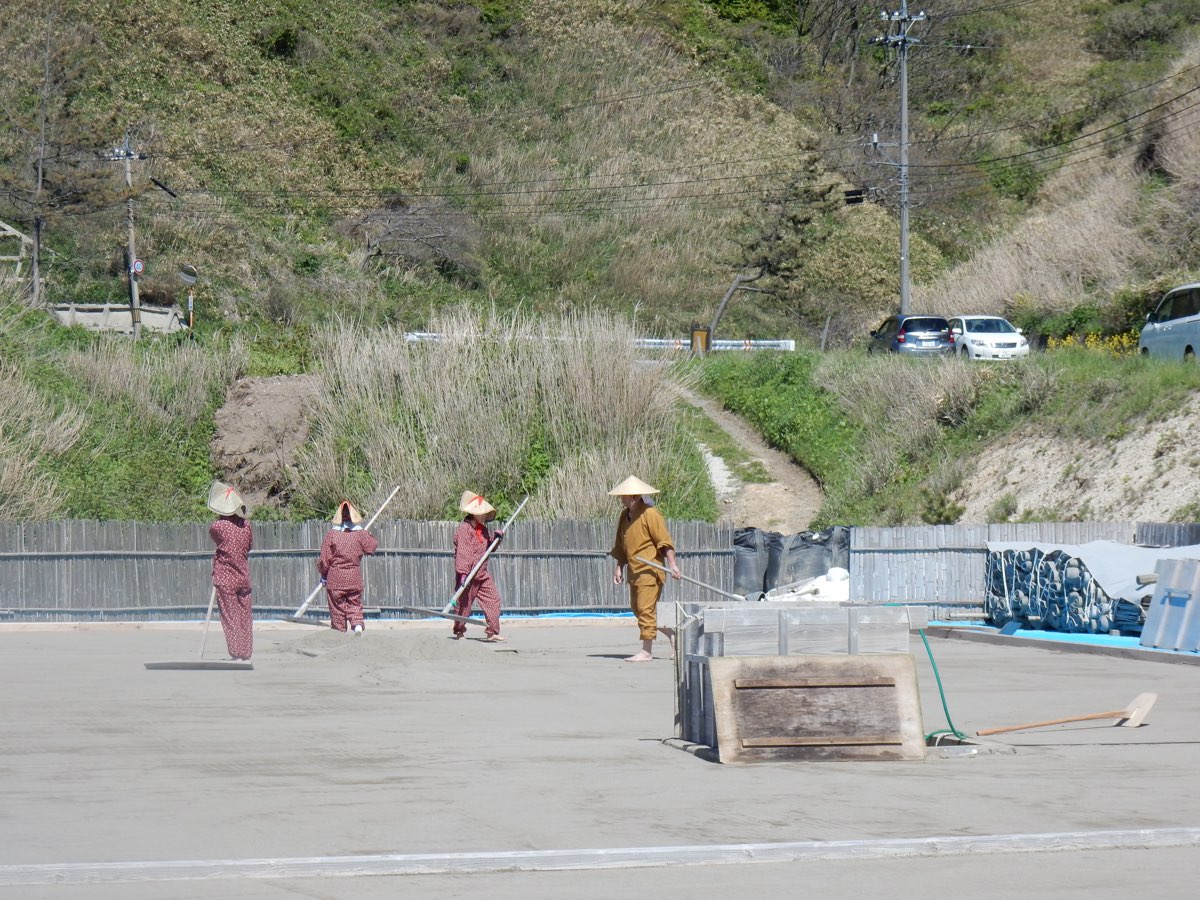
At the tip of the Noto Peninsula, in Suzu, salt has been made by carrying seawater up from the shore by hand, spreading it over a field of sand and boiling down the brine. The technique, known as agehama, is a nationally designated folk cultural property.
On 1 January 2024, a powerful earthquake struck the peninsula, followed in September by heavy rain. This article describes the salt making, its history under the Kaga domain and after, and the disasters, using official figures with their dates.
How agehama salt is made
According to Ishikawa Prefecture, in a description last updated in 2014, agehama salt making in Suzu takes place on salt fields called nurihama, artificial beds built with clay on ground higher than the sea. The work has two parts.
In the salt-field work, seawater is spread over the field, and sand coated with salt is gathered to draw off a concentrated brine (kansui). In the boiling-house (kamaya) work, the brine is boiled down in a pan until salt crystallizes.
The season begins with preparing the fields in early spring and peaks in the sunny summer. The prefecture notes a saying that it takes "three years to carry the seawater, ten years to spread it," and that the field work is done while forecasting the weather. In the boiling house, workers adjust the fire and skim off scum through the night.
The operator of the roadside station Suzu Enden-mura describes, on an undated page of its website, a working day of agehama salt making. Work starts at 5 a.m. with drawing seawater on the Nie coast in buckets of about 36 liters each.
About ten trips fill a large tub holding about 800 liters. About 600 liters are then spread evenly over one field of about 165 square meters, a task that takes some forty minutes.
After drying for about eight hours in the sun, the sand is gathered and packed into a wooden box called a tarefune. Seawater poured over it washes the salt from the sand into a brine. The brine is boiled for about six hours in a flat iron pan, left to cool for about a day, filtered, and then boiled again for about sixteen hours.
Under the Kaga domain
Ishikawa Prefecture says salt making in Noto developed in its own way in the early modern period because the Kaga domain encouraged it as a domain industry. Japan's Ministry of Agriculture, Forestry and Fisheries (MAFF) gives a date. In Kan'ei 4 (1627), it says, the third lord, Maeda Toshitsune, introduced a salt monopoly and other measures to secure revenue and a supply of salt for the domain and to relieve farmers, and encouraged agehama salt making across Noto.
Interpretations differ
How far back the method goes is less certain. MAFF says salt was made with earthenware on the shores of Nanao Bay from around the third century, and that agehama salt making is said to have begun in Noto around the fifth century. Elsewhere on the same page it calls agehama a technique continuing from the Nara period.
Decline and survival
In modern times the industry declined. Ishikawa Prefecture links this to the national salt monopoly.
MAFF describes several steps. In the Meiji period, new techniques and policies and the end of the domain's monopoly with the abolition of domains weakened traditional salt making in Noto.
In 1958, according to MAFF, the Temporary Salt Industry Measures Act prohibited the traditional method of making salt directly from seawater. All agehama makers closed except three houses in Suzu and Wajima, kept to preserve the technique and for tourism.
In 1961 two of these changed their business, leaving the Kakuhana family of Suzu as the only bearers. When the act was abolished in 1997, salt making by Noto's traditional method revived.
The prefecture says a preservation association was formed in Suzu around the Kakuhana family, who had long worked in salt making, and that, as of its 2014 description, it was handing the technique down. The prefecture calls it a rare surviving example of the agehama technique, and important for understanding how salt-making methods in Japan have changed.
The tools have also been recognized. In 1969, 166 tools used for agehama salt making in Noto, dating from the Edo period to the early Shōwa period, were designated a national Important Tangible Folk Cultural Property.
They include 116 items for the salt fields and 42 for the boiling house. In 2008 the technique itself was designated a national Important Intangible Folk Cultural Property.
MAFF adds that the technique was designated an intangible folk cultural property by Ishikawa Prefecture in 1992, and that "Noto's Satoyama and Satoumi" was recognized as a Globally Important Agricultural Heritage System in 2011.
The 2024 Noto Peninsula Earthquake
At 16:10 on 1 January 2024, an earthquake of magnitude 7.6 struck the Noto region of Ishikawa Prefecture at a depth of 16 kilometers. Shaking reached intensity 7 on the Japanese scale in Wajima and Shika, and upper 6 in Nanao, Suzu, Anamizu and Noto. An earthquake of magnitude 5.5 had struck about four minutes earlier.
The Japan Meteorological Agency (JMA) upgraded its warning for the Noto coast of Ishikawa to a major tsunami warning at 16:22, and tsunamis reached a wide area along the Sea of Japan. According to JMA, observations by the Geospatial Information Authority of Japan detected ground uplift of up to about 4 meters in western Wajima.
JMA named the event the "2024 Noto Peninsula Earthquake." It explains that the name covers not only the magnitude 7.6 earthquake but the whole series of earthquakes in the region since December 2020.
Counting the losses
Ishikawa Prefecture's report no. 233, as of 14:00 on 30 September 2026, counts 744 deaths in the prefecture from the earthquake. Of these, 516 are disaster-related deaths, and two people remain missing. It also records 401 people seriously injured and 876 slightly injured.
The prefecture defines a disaster-related death as death from the worsening of an injury caused by the disaster, or from illness caused by physical strain such as life in evacuation, that is recognized as caused by the disaster under the 1973 Act on the Payment of Disaster Condolence Grants.
The same report counts houses as 6,168 fully destroyed, 18,724 half destroyed, 91,621 partially damaged and 11 flooded, 116,524 in all. In Suzu alone it records 198 deaths, 101 of them disaster-related, and 1,757 houses fully destroyed.
In September 2024, the area was struck again, by what Ishikawa Prefecture calls the 2024 Oku-Noto Heavy Rain; the Disaster Relief Act was applied from 21 September in Suzu and five other municipalities. The prefecture counts this disaster separately. Its report no. 66, as of 14:00 on 31 July 2026, records 21 deaths, 5 of them disaster-related, including 4 deaths in Suzu.
These figures are official reports that the prefecture continues to update, and the latest numbers should be checked on its website.
Visiting today
The roadside station Suzu Enden-mura stands in Shimizu, Suzu. According to its operator's notice, checked in October 2026, the station reopened every day, including weekends, from 1 April 2025, while its salt museum remained closed. Suzu City announced that the station's shop, which had been operating only in part, fully reopened on 25 April 2026.
As of 1 October 2026, Suzu City still had evacuation orders in place for parts of the Ōtani, Nie and Shimizu districts. Before visiting, check the latest information from Suzu City and the official websites of the facilities.
Sources
- 能登の揚浜式製塩の用具Ishikawa Prefecture
- 揚浜式製塩の用具Ishikawa Prefecture
- 能登の塩(のとのしお)|にっぽん伝統食図鑑Ministry of Agriculture, Forestry and Fisheries (農林水産省)
- 揚げ浜式製塩の塩づくり(道の駅すず塩田村)Okunoto Enden-mura Co., Ltd. (株式会社奥能登塩田村, 道の駅すず塩田村)
- 令和6年能登半島地震Japan Meteorological Agency
- 令和6年能登半島地震に係る被害状況等について(令和8年3月31日16時00分現在)Cabinet Office, Government of Japan (非常災害対策本部)
- 令和6年能登半島地震による人的・建物被害の状況について(第233報 令和8年9月30日14時00分現在)Ishikawa Prefecture (防災対策課)
- 令和6年奥能登豪雨による被害等の状況について(第66報 令和8年7月31日14時00分現在)Ishikawa Prefecture (防災対策課)
- お知らせ|「道の駅」の営業を再開しています。Okunoto Enden-mura Co., Ltd. (株式会社奥能登塩田村, 道の駅すず塩田村)
- 道の駅すず塩田村 売店を全面営業再開しましたSuzu City (珠洲市観光交流課)
- 避難情報のお知らせ(避難指示【大谷町・仁江町・清水町】)Suzu City (珠洲市)