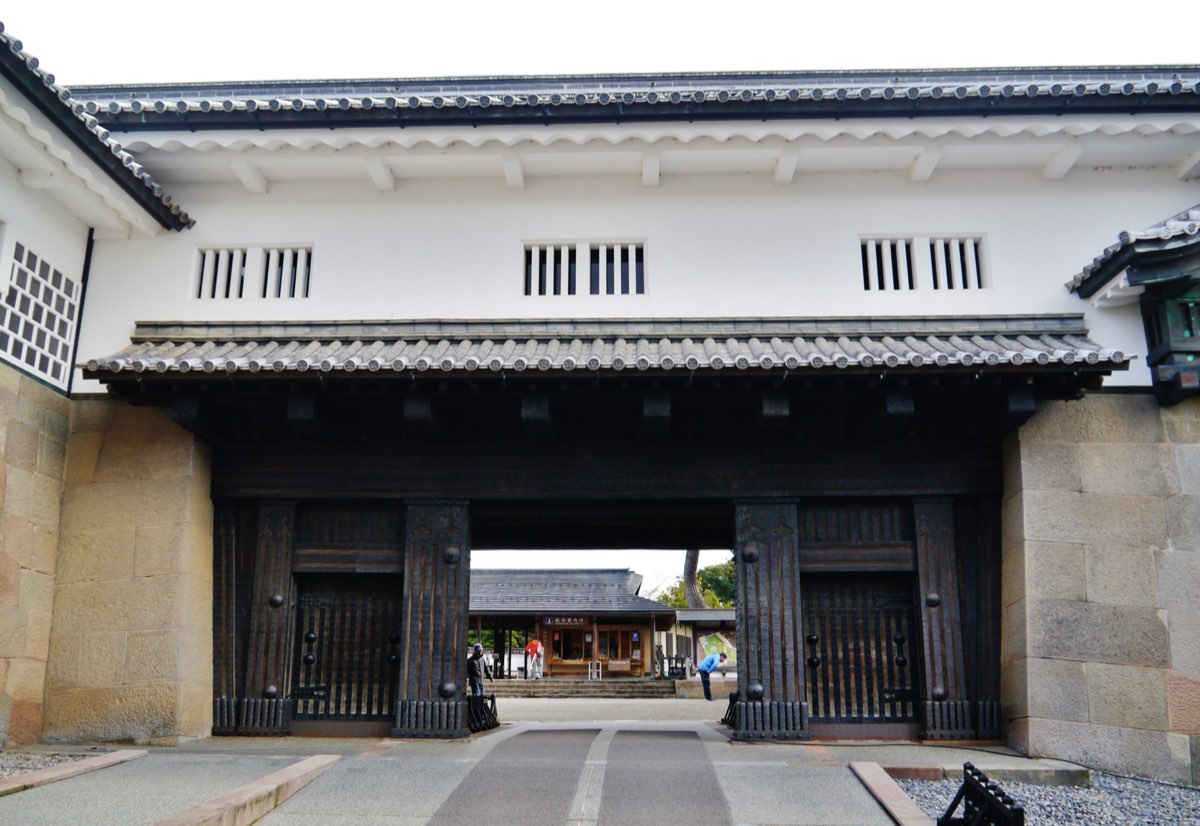
For almost three centuries, Kanazawa was the seat of the Maeda family, lords of the Kaga domain. The castle at its center burned and was rebuilt again and again, while the town around it grew into a place of temples, teahouse districts and workshops. This article follows the castle from 1583 to its restoration today, and crafts the domain fostered, such as metal inlay.
Before the Maeda
According to Ishikawa Prefecture, the castle site first appears in history as Kanazawa Midō, a branch temple of the Honganji said to have been founded here in Tenbun 15 (1546) by Shōnyo, the tenth head of the Osaka Honganji. A temple town formed around it, many people gathered there, and it became the center of faith for the Honganji followers of the Hokuriku region.
The prefecture names Sakuma Morimasa, from Tenshō 8 (1580), as the first lord of Kanazawa Castle. It says his works are thought to have relied mainly on earthen ramparts and moats, but their actual form is not known.
Maeda Toshiie arrives
In Tenshō 11 (1583), Maeda Toshiie was granted the two Kaga districts of Ishikawa and Kahoku. He moved from Nanao in Noto, which Oda Nobunaga had given him in 1581, to Kanazawa Castle.
Toshiie set about rebuilding the castle and the town. A keep was built around Tenshō 14 to 15 (1586–1587), high stone walls were raised around the main enclosure in Bunroku 1 (1592), and the main entrance was moved. Very few maps or documents of the early castle survive, but its layout is thought to have been quite different from the castle seen today.
According to a commentary by a regional heritage council, published in the Japan Tourism Agency's multilingual database, fourteen lords of the Maeda family governed Kaga from 1583 until domains were abolished in 1871. The same text says the domain was a rich farming region and that the family's income was second only to that of the shogunate itself.
A castle remade by fire
The keep caught fire after a lightning strike on the last day of the tenth month of Keichō 7 (1602) and was never rebuilt; a three-story turret that also served as a lookout was built in its place.
In Kan'ei 8 (1631), a great fire in the town destroyed the heart of the castle, including the palace in the main enclosure. After it, the third lord, Maeda Toshitsune, moved the castle's center to the second enclosure (ninomaru) and built a large new palace there. The prefecture says the castle's plan, centered on the ninomaru, was fixed by about this time and has come down to the present.
In Hōreki 9 (1759), an unprecedented fire swept the castle town. More than 10,000 samurai residences, temples and townhouses burned, and the main buildings of the castle's main, second and third enclosures were lost.
Rebuilding began the following year. The Ishikawa Gate, which still stands and is an Important Cultural Property, was rebuilt after this fire, in Tenmei 8 (1788).
About fifty years later, in Bunka 5 (1808), under the twelfth lord, Maeda Narinaga, a fire in the second enclosure again destroyed the palace and the Hishi Turret. Despite the domain's financial difficulties, they were rebuilt in about three years with money and materials offered by retainers and the domain's people.
The rebuilt palace followed the earlier design but was larger, with two noh stages and a great hall that had not been rebuilt after the fire of 1759. It survived until the domain was abolished.
According to the prefecture, this palace was the lord's residence and the seat of government, and the largest building in the castle. It covered about 3,200 tsubo and had more than sixty rooms. The prefecture concludes that, through repeated loss and rebuilding, the castle kept developing together with its town as the political and cultural center of the Kaga domain.
A workshop for the domain's crafts
The domain also had its own workshop. According to the Japan Tourism Agency commentary, it began as a place to manage and repair arms and armor. Toshiie ordered it kept in operation, and over time its members turned to more artistic work.
The same commentary says that under Toshitsune the workshop was formally established as the Osaikusho, employing skilled artisans of every kind. Techniques such as metal inlay (zōgan) and Kaga maki-e lacquer flourished, and artisans from all over Japan were drawn to the growing castle town.
The fifth lord, Maeda Tsunanori (1643–1724), had craft samples gathered from across the country into a large collection known as the Hyakkō Hishō, to study fine techniques and guide the workshop's artisans. According to the commentary, he also had artisans live near the workshop and rewarded outstanding work. By the 1800s more than seventy artisans worked there, and it closed in 1868 after more than 250 years.
The commentary presents the Maeda patronage of noh, decorative arts and tea ceremony as a deliberate policy: in its account, spending wealth on non-military pursuits kept the family in the shogun's good graces. It also says that crafts such as Kaga yūzen silk dyeing were established by artisans from Kyoto and Edo who moved to Kanazawa at the family's invitation.
From armor to export ware
Ishikawa Prefecture describes one of these crafts in detail. The domain trained craftsmen in metal inlay at its workshop and had them decorate arms, furnishings and architectural fittings.
Kaga zōgan is a metal-carving technique in which a pattern is cut into iron, copper or another base and filled with gold, silver or other metals. The prefecture notes its fine line inlay, its rich layered inlay of different-colored metals, and its reputation for inlay that does not easily come loose.
In the early Meiji period, the prefecture says, inlay craftsmen were left without work. The Kanazawa Dōki Company was founded to protect them and produced inlaid vases, incense burners and ornaments for foreign buyers. This helped the technique survive into modern times, and from then on Kaga zōgan shifted from arms to the decoration of craft objects.
The town around the castle
Kanazawa City describes four historic districts. The Higashi teahouse district was laid out in Bunsei 3 (1820). It was abolished in Tenpō 2 (1831) and officially recognized again in Keiō 3 (1867), and teahouse buildings from the late Edo to the early Meiji period stand together there.
Kazuemachi was never an officially licensed teahouse quarter, but the city says Meiji-era and later records suggest it in practice functioned as one. It is known for rows of teahouses with latticed ground floors and tall upper stories.
Temple building at the foot of Mount Utatsu began in the Keichō and Genna years (1596–1624), alongside that on the Teramachi and Kodatsuno uplands. It is thought to have been largely complete by the Enpō years (1673–1681), and narrow streets and lot divisions from the domain period still remain. At Teramachi-dai, temples, shrines, townhouses and streets laid out under the domain also survive.
After the domain
In Meiji 2 (1869), with the return of the domain registers to the emperor (hanseki hōkan), the fourteenth lord, Maeda Yoshiyasu, left the palace, ending the Maeda family's history at the castle. After the domains were abolished in 1871, the site passed to the military and served as barracks.
In Meiji 14 (1881) an accidental fire destroyed the palace and most of the gates and turrets. Only three buildings survive from the old castle: the Ishikawa Gate, the Sanjikken Nagaya and the Tsurumaru storehouse. After the war, from 1949, the site was a campus of Kanazawa University, and in 1996 Ishikawa Prefecture acquired it after the university moved.
Visiting today
Kanazawa Castle Park opened in 2001 with the reconstructed Hishi Turret, Gojikken Nagaya and Hashizume-mon Tsuzuki Turret. The castle site became a national historic site in 2008, and the Kahoku Gate (2010) and the Nezumita Gate and bridge (2020) have since been rebuilt.
As of October 2026 the park is open every day of the year. Ishikawa Prefecture is now rebuilding the Ninomaru palace in traditional wooden construction: a ground-breaking ceremony was held in March 2025, and the prefecture expects the first phase, around the entrance, to be completed around fiscal 2033 if work goes as planned.
The Higashiyama Higashi, Kazuemachi, Utatsuyama-roku and Teramachi-dai districts were selected as Important Preservation Districts for Groups of Traditional Buildings between 2001 and 2012. Kanazawa City says these historic townscapes are popular with visitors. Check the official websites for opening hours and current information before visiting.
Sources
- 金沢城の歴史Ishikawa Prefecture
- 二の丸御殿の復元整備(金沢城公園)Ishikawa Prefecture (石川県金沢城・兼六園管理事務所)
- 公園の開園時間等(金沢城公園)Ishikawa Prefecture (石川県金沢城・兼六園管理事務所)
- 加賀の手漉和紙の製作用具及び民家・加賀象嵌製作用具・北陸地方の木地製作用具Ishikawa Prefecture
- Kaga Domain Workshop (Osaikusho) (Japan Tourism Agency multilingual commentary database)Ishikawa Crafts and Cultural Heritage Digital Contents Promotion Council (いしかわ工芸・文化財デジタルコンテンツ推進協議会), published in the Japan Tourism Agency multilingual commentary database
- Kaga Domain and the Maeda Family Cultural Policy (Japan Tourism Agency multilingual commentary database)Ishikawa Crafts and Cultural Heritage Digital Contents Promotion Council (いしかわ工芸・文化財デジタルコンテンツ推進協議会), published in the Japan Tourism Agency multilingual commentary database
- 金沢市東山ひがし・主計町・卯辰山麓・寺町台(石川県)保存地区の概要(重要伝統的建造物群保存地区)Kanazawa City (金沢市作成, published on the Agency for Cultural Affairs website)