Nikko, in the northwest of Tochigi Prefecture, is home to Toshogu, the shrine mausoleum of Tokugawa Ieyasu. But the shrine was built in a place that had already been sacred for centuries. Nikko City describes the area as a holy ground of mountain worship from the opening of Nikko by the monk Shōdō in the late eighth century.
This article follows that longer story: the mountain faith that gathered around Mount Nantai, the great religious community that grew from it, the Tokugawa shrine and mausoleums of the seventeenth century, and the shrines and temple that carry these traditions today.
A sacred mountain and its founder
According to a pamphlet published by Nikko City, people in Japan long worshipped mountains themselves as divine. After Buddhism arrived from the continent, kami and buddhas came to be revered as one, and reaching a summit came to be seen as a form of religious practice. Mount Nantai, the center of the Nikko range, can be seen from a wide area of the prefecture.
Interpretations differ
The founding of Nikko is told through the monk Shōdō (735–817). Rinnōji Temple and Nikko City both give the year as 766, when Shōdō crossed the Daiya River and founded a temple called Shihonryūji, the forerunner of today's Rinnōji. In Nikko City's accounts he failed twice to climb Mount Nantai and reached the summit on his third attempt in 782, where he built a small shrine.
Interpretations differ
These dates are handed down in the traditions of the temple and shrines and repeated in the city's chronology, and this article treats them as tradition. The Japan Tourism Agency says the mountains were regarded as sacred from ancient times, and that a small shrine was built on the summit in the late eighth century.
Legend surrounds the founding too. The city's pamphlet retells a story that when Shōdō could not cross the rushing Daiya River, a god appeared and made a bridge for him out of two intertwined snakes. The red-lacquered Shinkyō bridge, which the city calls a symbol of Futarasan Shrine, is linked to this legend and is an Important Cultural Property.
Three mountains, three buddhas, three shrines
The small shrine on the summit of Mount Nantai is today the Okunomiya, or inner shrine, of Futarasan Shrine. Later a middle shrine was built at the foot of the mountain and a main shrine closer to where people lived. Futarasan Shrine enshrines three kami, regarded as the deities of three mountains: Mount Nantai, Mount Nyohō, and Mount Tarō.
Rinnōji describes how the religious community grew. In the Kamakura period the shoguns were devoted to Nikko, and monks from Nikko served as their protector-priests. Over the same period, according to the temple, a teaching took shape that treated three mountains, three buddhas, and three shrines as one, and mountain asceticism (Shugendō) flourished.
The temple says that in the Muromachi period the mountain held lands of 180,000 koku and as many as 500 monks' lodgings. Until the Meiji era, it notes, the whole of "Nikkōzan" was a single great sacred site of the Kanto region, not three separate institutions.
That prosperity did not last unbroken. The city's pamphlet explains that in the Warring States period Nikkōzan opposed Toyotomi Hideyoshi, lost most of its lands, and declined. After Tokugawa Ieyasu unified the country, he sent his adviser, the monk Tenkai, to revive it.
Toshogu and the Tokugawa shoguns
Ieyasu died in 1616. In keeping with his will, his son Hidetada, the second shogun, built a shrine called Tōshōsha in Nikko the following year, and Ieyasu's remains were moved there. Nikko City dates the founding of the shrine mausoleum to 1617.
The first buildings were simple. For the twentieth anniversary of Ieyasu's death, the third shogun, Iemitsu, had them rebuilt on a far grander scale.
According to the city, this "Kan'ei rebuilding" took a year and five months, involved a cumulative total of 4.54 million workers, and was completed in 1636. Most of the buildings that survive today date from this work.
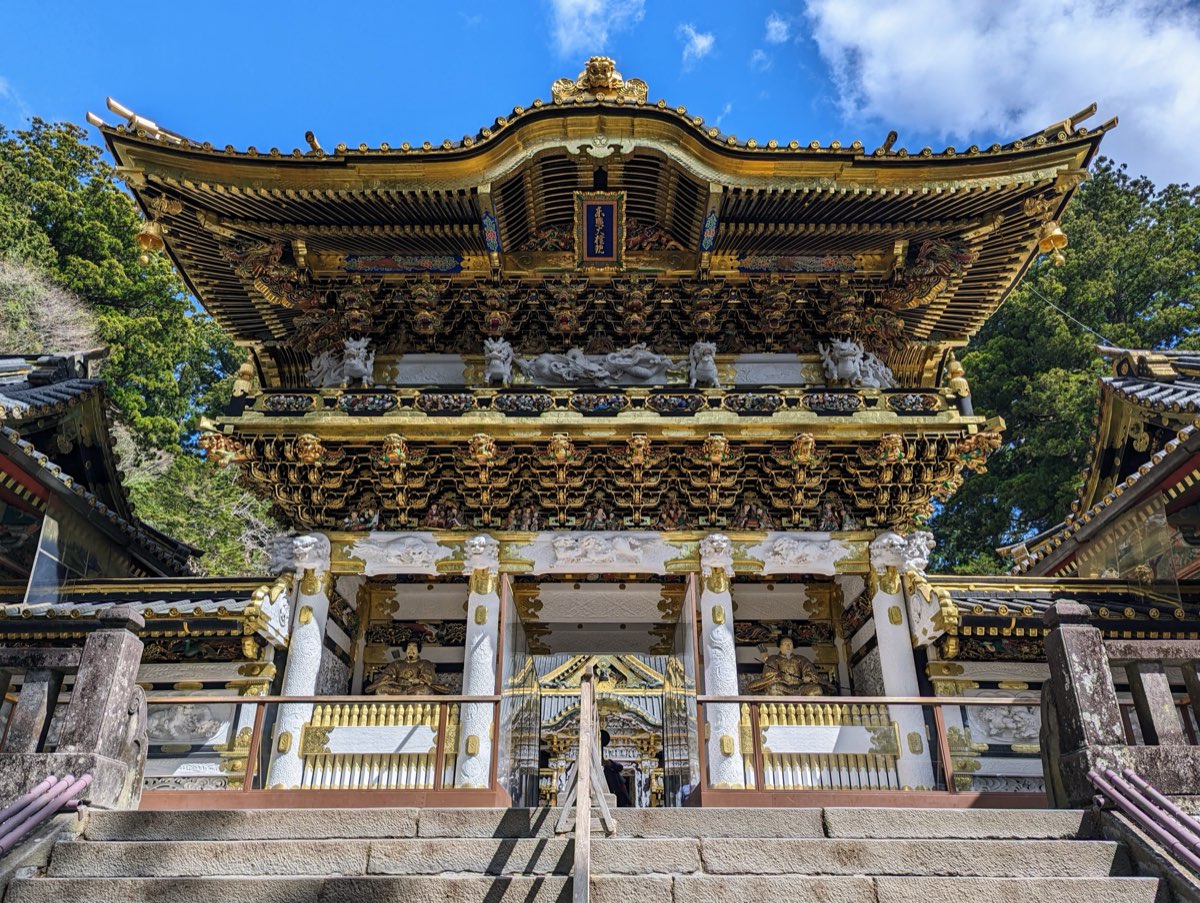
In 1645 Tōshōsha received the title "gū" and was renamed Tōshōgū. Nikko City states that with Toshogu, the shrine style called gongen-zukuri, in which the main hall is joined to the worship hall by a connecting room called the ishi-no-ma, can be said to have reached its completed form. It adds that the highest techniques of the time were used for carving and color.
The city calls the Yōmeimon gate, built in 1636, the most famous building in Nikko. Its roof has been re-covered and its paint renewed, but according to the city its carvings and main decorative parts are original. At Toshogu, eight buildings are National Treasures and 34 are Important Cultural Properties.
Iemitsu died in 1651 and, also by his own wish, was buried in Nikko. His mausoleum, the Taiyūin, was completed in 1653 and now belongs to Rinnōji. The temple notes that 22 National Treasures and Important Cultural Properties stand within it, along with 315 lanterns.
Nikko was more than a family tomb. The city's pamphlet notes that the shogunate granted Toshogu lands, successive shoguns made formal visits, the imperial court sent envoys with offerings, and envoys from Korea also visited. In the city's words, Nikko can be called a place that played an important role in supporting the political order of the Edo period.
Separation and repair after 1868
The Meiji government pursued a policy of separating Shinto from Buddhism. Nikko City writes that this policy was put into effect at Nikko in 1871, but that strong appeals from people connected with the shrines and temple kept its effects to a minimum. Among the changes was the moving of Rinnōji's main hall, the Sanbutsudō, from beside Futarasan Shrine to its present site, completed in 1881.
Rinnōji explains that from the Meiji era Nikko's places of worship were counted as three: Rinnōji, Toshogu, and Futarasan Shrine. Nikko City refers to them together as "two shrines and one temple" (nisha ichiji).
The fall of the shogunate also ended the regular repairs that had kept the buildings in condition, and according to the city they began to fall into disrepair. In 1879 local townspeople and people connected with the former shogunate founded a society, the Hōkōkai, and repairs resumed.
Later an office for repairing the shrines and temple was organized, the forerunner of today's Nikko Shaji Cultural Properties Preservation Society. According to the city, repairs now follow a plan, so that some building is always under repair.
A World Heritage site
In December 1999 the World Heritage Committee, meeting in Marrakesh, inscribed the "Shrines and Temples of Nikko" on the World Heritage List. The property covers 103 buildings of the two shrines and one temple, 9 National Treasures and 94 Important Cultural Properties, together with the surrounding site, recognized as a cultural landscape.
The inscribed area is 50.8 hectares, with a buffer zone of 373.2 hectares. Nikko City also notes that festivals handed down at the shrines and temple, such as the Yayoi Festival, the procession of a thousand samurai, and the Gōhan-shiki ritual, were valued as closely connected to the site.
The Japan Tourism Agency summarizes what the committee valued: the combination of architecture and art integrated into a natural setting, the influence of Nikko on later Japanese architecture, and the way the site expresses Shinto ideas in harmony with nature.
Visiting today
Toshogu publishes visiting hours, fees, and an audio guide in several languages, including English, on its official website as of 2026. Rinnōji likewise publishes visiting information for the Sanbutsudō, the Taiyūin, and its treasure house. Futarasan Shrine's main shrine stands in the same area, the Nikko Sannai.
Rituals and events are held at Toshogu and Rinnōji, and some areas may be closed while they take place. Please check each official website for hours and closures before you go.
Sources
- 日光市の概要Nikko City
- 旧日光市歴史年表(古代~鎌倉)Nikko City
- 日光東照宮Nikko City
- 未来へ届けたい日光(改訂版)Nikko City (日光市)
- 日光の社寺(文化遺産オンライン 世界遺産)Agency for Cultural Affairs (文化庁, 文化遺産オンライン)
- Nikko Futarasan Shrine (Japan Tourism Agency multilingual commentary database)Japan Tourism Agency (観光庁, 地域観光資源の多言語解説文データベース)
- 世界遺産:日光の社寺(観光庁 地域観光資源の多言語解説文データベース)Japan Tourism Agency (観光庁)
- 輪王寺について(日光山輪王寺 オフィシャルサイト)Nikkozan Rinnoji Temple (日光山輪王寺)
- 拝観のご案内(日光山輪王寺 オフィシャルサイト)Nikkozan Rinnoji Temple (日光山輪王寺)
- 拝観時間・料金(日光東照宮ホームページ)Nikko Toshogu (日光東照宮)