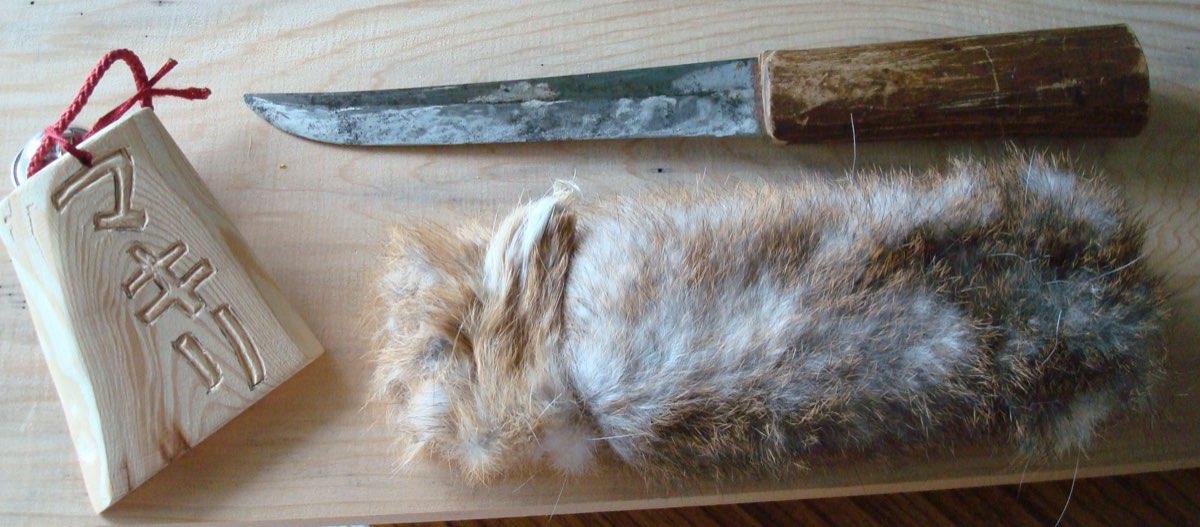
In the mountains of northern Japan, the word matagi has long named a particular kind of hunter. Akita Prefecture defines Matagi as people with traditional hunting skills who hunt in the mountain areas of the Tohoku region, or the hunting they do. What set them apart, the prefecture says, was that they carried scrolls handed down through generations and hunted according to old rules of conduct.
This article follows the Matagi of the Ani district in Kitaakita City, where a prefectural survey and the national designation recorded tools in the settlements of Neko, Utto, and Hitachinai. Their story is not one of an unchanging way of life. It is the story of mountain villages that combined hunting with farming, medicine trading, and later tourism, while writers, researchers, and filmmakers recorded and portrayed them.
Who the Matagi are
Kitaakita City quotes the researcher Taguchi Hiromi: in Fukushima, Niigata, and Nagano, mountain hunters were generally called yamabito, and "Matagi" meant the hunters of Akita. According to the city, Akita Matagi hunted large animals such as bears in groups and followed disciplined rules based on their own rituals and beliefs.
Matagi settlements were not limited to Ani. The city lists areas around the Shirakami Mountains, the Senboku region, and Mount Chokai, and says they were also scattered around Mount Taiheizan. Ani, however, has long been seen as the place with many full-time hunters, who also traveled to hunt elsewhere and carried medicines made from their game to sell in distant places.
The Agency for Cultural Affairs describes Ani Matagi as known for group hunting. They lived by hunting large animals such as bears and Japanese serows, and small ones such as hares and flying squirrels. Some hunted near their homes; others, called tabi-matagi or traveling Matagi, went as far as Fukushima and Niigata and sold medicines such as bear gall along the way.
Interpretations differ
Where the word "matagi" comes from is not settled. Akita Prefecture's 2008 survey report lists several theories, including derivations from the word yamadachi, the kanji spelling 又鬼 ("again demon"), the legendary hunter Banji Banzaburo, and even Sanskrit. The Edo-period writer Sugae Masumi suggested it came from mada-hagi, stripping the bark of the linden tree, but the report notes it is unclear whether that was his own idea or a story already told locally. The report's lead researcher found little support for it among the Matagi tools.
Records from the Edo period
The prefecture's report begins its review of written records with the Edo period. Sugae Masumi, who traveled the Tohoku region for nearly 50 years, wrote in 1785 that "matagi" meant hunters, and later showed strong interest in the special words they used in the mountains. He visited Utto and Hitachinai and wrote about the Matagi of Neko.
Another writer, Suzuki Bokushi of Echigo, met a hunter from a mountain village three ri from the castle town of Akita during a journey to the Akiyama area in 1828. Bokushi called him simply a "hunter," not a Matagi. The report concludes that the word "matagi" was a local term, used only in particular regions.
Documents kept in Neko show the Matagi's ties to the Akita domain. According to the report, one Matagi group there delivered bears to the domain, and documents record that guns were granted in return for bear gall and entrusted to the hunters only from October to April. Akita Prefecture also notes a late Edo-period document showing that bear gall was delivered to the domain's medicine office.
Rules of the hunt and the mountain god
In Ani, the report says, Matagi were regarded as companions of strong body and spirit who crossed high peaks and deep valleys to hunt. They worshipped the mountain god, honored Banji Banzaburo as their founder, and valued rules.
Groups were led by a shikari. In Neko, relatives or friends formed a group, and the shikari was the person with the most ability; a son could follow his father, but leadership was not necessarily hereditary.
Before setting out, Matagi prepared themselves through ritual. People in Neko recalled that hunters prayed through the night to the mountain god for a week before going out, then tested their guns at a target in the rice fields. The 12th day of the 12th month was the mountain god's day, when people working in the mountains were not supposed to enter them.
Leaves of morobi, a fir brought back from Mount Moriyoshi, were smoked so that hunters could purify themselves. There were also rules about birth: after a child was born in the household, hunters avoided going into the mountains for a time. One researcher, after hearing such stories, wrote of the constant tension of work in which death was always close.
The Matagi also had rules for sharing. Under the custom remembered as "Matagi kanjo" (Matagi accounting), the catch was divided equally among everyone who took part. When a bear was taken, its gall bladder, hide, and other parts were auctioned among the group, and the money and meat were shared equally.
Farming, medicine, and a changing village
Hunting was only one part of Matagi life. A 1932 description of Neko, cited in the prefecture's report, says farming was the main occupation, with hunting and medicine peddling as side work. Interviews about life around 1955 show a year that resembled any mountain farming village, with rice planting, harvesting, and shared village work.
Hunting followed the seasons and the market. People in Neko said hunters seldom went out from summer into autumn, because a bear's gall bladder held little bile then and fetched a poor price.
Bear hunting began again in late October. Women had a great deal of work while men were away hunting or peddling; the 1932 description says they gathered and sold wild plants in summer and chestnuts, mushrooms, and fruit in autumn.
Medicine became an important source of income. According to the report, Neko was the only Ani settlement that made medicine, and peddling across the country is thought to have begun in the Meiji period.
In 1932 there were 76 peddlers in Neko. The report's author suggests that what Neko learned of the wider world through hunting trips and peddling helped it absorb outside culture readily.
Concern that Matagi customs would soon vanish was heard from about the Showa 10s (1935–1944). In 1943 a researcher wrote that, as game declined sharply, it had become hard to live mainly by hunting, and many turned to farming or forestry.
The prefecture's report says that the Matagi as a livelihood has continued to decline, while tourism has brought new attention to Matagi settlements. Depopulation is a problem there too.
Around 2008, the report noted, experienced hunters in their seventies and men in their fifties and sixties still took part in group hunts, but there were only four or five young successors in each of the three settlements.
The Matagi also reached a wider public. According to the report, the films "Matagi" (1982) and "Itazu" (1987) were made about the Ani Matagi, and the Akita-born cartoonist Yaguchi Takao published a manga titled "Matagi." The report admits that such works were partly dramatized, but says they drew people's interest.
Protecting the tools
In 1958 a member of Akita's cultural properties council surveyed Matagi tools in the Ani area. Kitaakita City quotes his concern that unless the customs were recorded and the tools preserved, they would leave no trace.
In 1959 the prefecture designated 126 items as a Prefectural Tangible Folk Cultural Property. After a new survey of Neko, Utto, and Hitachinai in fiscal 2005–2007, more items were added, including tools for making and selling medicine and objects connected with faith in the mountain god.
In 2013 the national government designated 293 items as an Important Tangible Folk Cultural Property, "Hunting Tools of the Ani Matagi." According to Kitaakita City, they include 119 items for hunting large animals such as bears, 97 for small and medium animals, 33 for birds, 20 for life in mountain huts, and 24 for peddling. About 190 of the items are owned by individuals in the community.
Kitaakita City also notes newer ways of looking at the Matagi. Earlier attention focused on distinctive hunting methods and mountain words, but research now looks at the whole environment that shaped Matagi life. The city adds that learning from Matagi hunting methods and ways of living to coexist with nature is being encouraged.
Visiting Ani today
In 2013, Kitaakita City said that some of the tools recommended for national designation were displayed at the Matagi Museum in Utto and at the Neko children's hall. An Akita Prefecture reference sheet on the additional designation listed the Matagi Museum within the Kitaakita City Furusato Center in Ani Utto, which opened in 1982 with a Matagi museum. Exhibits and opening days may change, so check the latest official information from Kitaakita City before visiting.
Sources
- 参考資料 阿仁マタギ用具(追加指定)Akita Prefecture
- 阿仁マタギ用具 調査報告書(資料索引)Akita Prefecture
- 第2章 阿仁マタギ習俗の概要(秋田県指定有形民俗文化財 阿仁マタギ用具 文化財収録作成調査報告書)Akita Prefectural Board of Education (秋田県教育委員会)
- 第3章 「もの」から見た阿仁マタギ Ⅰ序・Ⅱ生活基盤(秋田県指定有形民俗文化財 阿仁マタギ用具 文化財収録作成調査報告書)Akita Prefectural Board of Education (秋田県教育委員会)
- 阿仁マタギの狩猟用具(文化遺産オンライン)Agency for Cultural Affairs (文化庁, 文化遺産オンライン / 国指定文化財等データベース)
- 阿仁マタギの狩猟用具(市で初となる国の重要有形民俗文化財に)Kitaakita City (北秋田市)
- 重要有形民俗文化財 阿仁マタギの狩猟用具 国指定までの経緯Kitaakita City (北秋田市)