In the summer of 1853 four American warships appeared off Uraga. Six years later, Yokohama, then a small fishing village with almost no harbour facilities, opened as a port for foreign trade.
This article follows the steps between those two moments: Commodore Perry's two visits, the treaty signed on the shore at Yokohama, and the opening of the port itself. Dates are given in the Japanese lunisolar calendar, with the Western dates the sources give.
Four warships off Uraga
According to a history textbook for junior high school students published by the Yokohama City Board of Education, four warships led by Perry, commander of the US East India Squadron, appeared off Uraga on 8 July 1853 (the 3rd day of the 6th month of Kaei 6). Foreign ships had come before, but never a squadron in formation with gun ports open, ready to fight.
The same textbook explains why the United States had come. As American industry grew, it sought markets in Asia and planned a direct route across the Pacific.
Ships of the time needed coal and water along the way, and Japan was the best place for a stop. According to Yokohama City Central Library, Perry was also sent to negotiate shelter and supplies for whaling ships and help for shipwrecked sailors.
Yokohama City's history of the port says that Perry strongly demanded that Japan change its policy of sakoku, the "closed country," and open its ports. Until then, the city explains, Japan had for a long time had little exchange with foreign countries apart from a very few, such as the Netherlands.
Pressure in Edo Bay
The shogunate had been warned by the head of the Dutch trading post in Nagasaki that Perry was coming, but it did not change its policy. It asked him to sail to Nagasaki, its place for negotiations. According to the textbook, Perry took a firm stance: while talks went on, his ships surveyed Edo Bay and advanced as far as Koshiba off Kanazawa, showing that the squadron could head straight for Edo if the talks stalled.
The shogunate ordered daimyo to guard the coast around Edo Bay. The Kumamoto domain took Honmoku, the Hirado domain Kanagawa, and the Kokura and Matsushiro domains Yokohama village. The textbook notes that daimyo had never before been mobilised for such a large-scale defence.
Pressed by Perry's firm stance, the shogunate agreed to receive the President's letter at Kurihama. On 14 July 1853 (the 9th day of the 6th month of Kaei 6), in a hastily built reception hall, a letter from President Fillmore was handed to the Uraga magistrate. It asked for friendship, trade, supplies of coal and food, and protection for castaways.
The shogunate replied that Nagasaki was the proper place for negotiations and that it could not give an answer. Perry, judging that he had achieved his first aim, said he would return the next year for the answer and left Japan. The squadron had stayed only eight days.
According to the textbook, the visit sent ripples across the country. The daimyo split between those who favoured opening the country and those who favoured expelling foreigners.
Rumours of war led to hoarding and a rise in the price of rice. Villages along the Kanazawa road, which linked Uraga with the Tōkaidō highway, were called on to carry official goods and the baggage of the guarding daimyo, and their burden rose to more than twice its usual level.
The treaty on the shore at Yokohama
Perry returned on the 16th day of the 1st month of Kaei 7 (13 February 1854, according to Yokohama City Central Library), this time with seven ships, and anchored off Koshiba. Talks on where to meet began the next day. The shogunate proposed Uraga, Kamakura and other places, but the Americans demanded a site close to Edo.
The textbook describes how Perry moved the squadron farther in, as far as off Kanagawa and Haneda, so close that the ships could be seen from near Edo. Alarmed, the shogunate proposed Yokohama village, across the water from the post town of Kanagawa. According to the library, the choice of Yokohama was made on the 28th day of the 1st month (25 February), with the shogunate pushed by the Americans' hard-line stance.
Interpretations differ
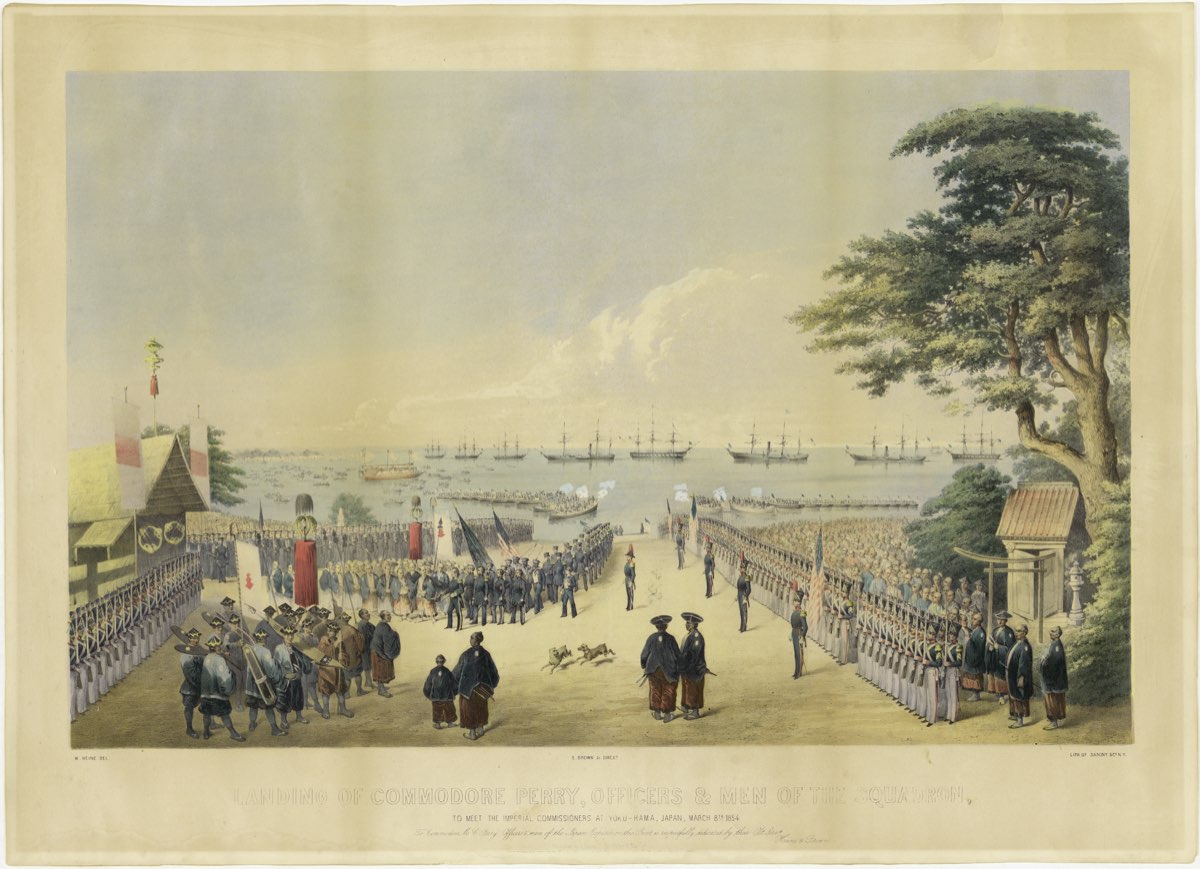
A reception hall was built with materials taken from the hall at Uraga. According to the library, the first meeting was held on the 10th day of the 2nd month (8 March), and on that day Perry landed at Yokohama village for the first time to begin negotiations with the shogunate's chief envoy, Hayashi Daigaku-no-kami (Fukusai). The city's junior high school textbook gives a different date for the first meeting: 4 March 1854 (the 6th day of the 2nd month).
Between sessions both sides held friendly events. The Americans presented gifts including a telegraph and a model steam train that, according to the textbook, could carry a child of about six. The Japanese side showed off sumo wrestlers and gave silk, ceramics and lacquerware.
The Treaty of Peace and Amity between Japan and the United States, also called the Treaty of Kanagawa, was signed on the 3rd day of the 3rd month of Kaei 7 (31 March 1854). Its 12 articles opened Shimoda and Hakodate. According to the textbook, the shogunate accepted supplies of coal, firewood, water and food, ports of refuge, and the rescue and humane treatment of castaways, but not trade; it also agreed that the United States could station a consul general.
Yokohama City Central Library describes the result this way: the policy of seclusion that the shogunate had kept for so long finally broke down, and Japan's path toward opening was decided. According to Yokohama City, the treaty was concluded in what is now the courtyard of the Yokohama Archives of History.
Kanagawa or Yokohama?
The Treaty of Amity and Commerce between Japan and the United States followed in 1858 (the 6th month of Ansei 5); Yokohama City states that it was signed aboard the Powhatan off Kanagawa. The shogunate then concluded treaties with the Netherlands, Russia, Britain and France.
According to Yokohama City, the American consul general Harris did not originally include Kanagawa or Yokohama among the ports he wanted. The shogunate proposed Kanagawa, which was linked to the 1854 treaty and was the port closest to Edo, and Harris is thought to have accepted it.
But the two sides meant different places. Harris had in mind the post town of Kanagawa, on the busy Tōkaidō highway.
The shogunate, wanting to keep foreigners and Japanese apart, strongly favoured Yokohama and went ahead and built the new port there unilaterally. The library adds that the treaty names Kanagawa, but Yokohama was treated as part of it.
A port is born
On the 2nd day of the 6th month of Ansei 6 (1 July 1859), Kanagawa, Nagasaki and Hakodate opened to free trade with foreign countries. Yokohama had almost no port facilities, so two landing piers were built near the base of today's Ōsanbashi Pier. Ships could not come alongside them; they anchored offshore, and small boats carried cargo and people to land.
The city lists raw silk and tea as the main exports of the time, and cotton textiles as the main import. A customs house was set up near the site of today's Port Opening Memorial Hall, and the town of Yokohama grew up around it. According to the library, Perry had died the year before the port opened, aged 63.
The port kept growing. Yokohama City's timeline records the opening of the East Pier in 1864, the first railway between Shinbashi and Yokohama in 1872, the founding of the city government in 1889, and the completion of the first section of the port's construction works in 1896. Kanagawa Prefecture writes that Yokohama became a window linking Japan and other countries, a place where Western civilisation flowed in early.
The prefecture also writes that the shogunate, which had kept its sakoku system, gave in to the American squadron pressing for opening with military pressure behind it, and concluded the treaty.
Visiting today
In Kurihama, Yokosuka, Perry Park was created to commemorate Perry's landing. Its monument was erected in 1901 by the Beiyū Kyōkai, with an inscription by Itō Hirobumi. As of 2026, the Perry Memorial Hall in the park displays historical materials and models; picture scrolls and broadsheets of the time show how surprised and shaken people were.
In Yokohama, the Port Opening Memorial Hall was built in 1917 (Taishō 6), mainly with citizens' donations, to commemorate the 50th anniversary of the port opening. According to Yokohama City (2024), visitors can see its corridors, stairways, stained glass and a small exhibit corner on the second floor. Check the official websites of Yokosuka City and Yokohama City for opening days and times before you visit.
Sources
- 横浜港の開港City of Yokohama
- History of the Port of YokohamaCity of Yokohama
- 神奈川県の歴史Kanagawa Prefecture
- 鎖国から開国への日々Yokohama City Central Library
- 『横浜の歴史』(平成15年度版・中学生用)「開国」関連部分(横浜市中央図書館「横浜の歴史」ページに掲載)Yokohama City Board of Education (published via Yokohama City Central Library)
- よくある質問 歴史・文化について(横浜市開港記念会館)Naka Ward, City of Yokohama
- ペリー公園/ペリー記念館Yokosuka City