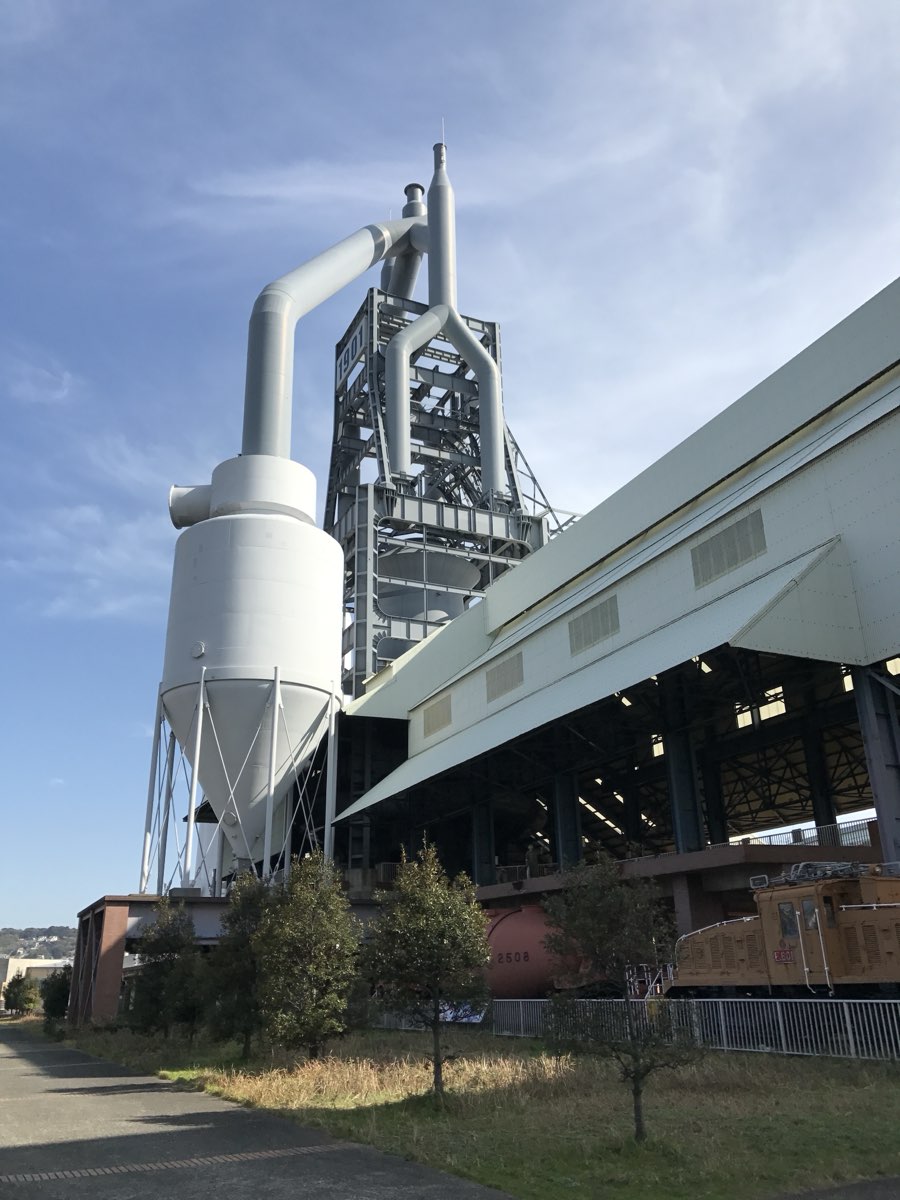
On February 5, 1901, a fire was lit in the Higashida No. 1 Blast Furnace of a new government-run steelworks in Yawata, a village on the northern coast of Kyushu in what is now Kitakyushu City. The works had been built with German designs and equipment, and its first years were difficult.
Japanese engineers solved the problems, and within about ten years the Imperial Steel Works at Yawata had become a commercial success. Today four of its buildings are components of the World Heritage site "Sites of Japan's Meiji Industrial Revolution: Iron and Steel, Shipbuilding and Coal Mining." This article follows the works from its planning to the buildings that survive.
Why Japan needed its own steel
According to Kitakyushu City, after the Meiji Restoration the government hoped to establish a steel industry quickly, under the slogans "rich country, strong army" and "increase production, promote industry." Fukuoka Prefecture explains that by the middle of the Meiji era, as industries such as textiles developed, demand rose for iron, the material for ships and railways, but most of it was imported.
An earlier attempt had not succeeded. In the early Meiji era the government built its first state ironworks with Western-style blast furnaces at Kamaishi in Iwate Prefecture, but according to Fukuoka Prefecture it did not produce satisfactory results and stopped operating after three years.
The metallurgist Noro Kageyoshi, whom Fukuoka Prefecture calls the father of Japanese metallurgy, is quoted as saying that "iron is the mother of industry and the foundation of national defense." The World Heritage council notes that iron and steel were essential for both military and domestic use.
A national project in a coastal village
Kitakyushu City states that the First Sino-Japanese War of 1894-1895 raised momentum for founding a modern Western-style steelworks. According to the World Heritage council, a proposal to establish a steelworks was approved by a majority under Prime Minister Itō Hirobumi, at a time when demand for steel was expanding.
The site chosen was Yawata village, close to the Chikuhō coalfield and facing Dōkai Bay. Fukuoka Prefecture names two reasons for the choice: the village lay next to the Chikuhō coalfield, which had the largest coal output in Japan, and local people campaigned enthusiastically to attract the works.
In June 1897 the government steelworks office opened in Yawata village. The design and construction of the works were ordered from the German company Gutehoffnungshütte, known as GHH. Engineers were brought in from Germany and from the Tanaka ironworks at Kamaishi.
The head office was completed in 1899, two years before the works began operating and ahead of the production facilities. It is a two-story red brick building with a central dome and a symmetrical plan, combining Japanese and Western styles under a Japanese tile roof. Inside were the offices of the director-general, the chief engineer and the foreign adviser engineers.
Fire in the furnace, and early troubles
On February 5, 1901, the Higashida No. 1 Blast Furnace was fired up, and a ceremony to mark the start of work was held on November 18 the same year.
The works did not run smoothly at first. According to the World Heritage council, a series of problems forced the blast furnace to stop, but Noro Kageyoshi and other Japanese engineers overcame these setbacks and stabilized operation.
Fukuoka Prefecture explains that the furnace was altered to suit conditions in Japan and the methods of operation were improved. The council's English page states that Japanese engineers modified the design and that successful operation followed in 1904.
Success within ten years
Fukuoka Prefecture states that the Imperial Steel Works became a commercial success within ten years of starting operation, and that three later expansion plans increased its steel output. According to the prefecture's magazine, ten years after its founding it was producing more than 90 percent of the steel made in Japan.
The World Heritage council describes Yawata as the first full-scale integrated iron and steel works to succeed in Asia, and says it laid a foundation for the Japanese economy.
The buildings that support the works tell the story of technology transfer. The repair shop, built in 1900 to the design of GHH and with its steel, was used to repair machinery and to make and process parts.
The council calls it the oldest existing steel-framed building in Japan. It was extended three times as steel output grew, and it is still in use, with its original overhead crane still used for maintenance.
According to the council, the steel in the first section of the repair shop is stamped with the mark of GHH, while the later extensions use steel stamped "Yawata," made by the works itself. The council sees this as evidence of the rapid transfer of technology from Germany to Japan.
The former forge shop, also built in 1900 with GHH designs and steel, made forged items needed to build the works, such as large spanners and hammers. It was doubled in size in 1909, moved to its present site in 1917 and used as a product testing station. It now serves as an archive.
The expansion also needed water. To make up for the shortage of industrial water caused by the first expansion, the Onga River pumping station was built about 10 kilometers from the river mouth, in today's Nakama City.
Fukuoka Prefecture dates its construction to 1909, and the Cabinet Secretariat states that it began operating in 1910. Its power changed from steam to electricity, and it still operates.
World Heritage
In July 2015 the UNESCO World Heritage Committee decided to inscribe the Sites of Japan's Meiji Industrial Revolution, made up of 23 component parts in eight prefectures and eleven cities. According to the Cabinet Secretariat, the sites testify to the successful transfer of industrialization from the West to a non-Western nation, over the half century from the 1850s to 1910.
The Yawata components are the Imperial Steel Works, represented by the first head office, the repair shop and the former forge shop in Kitakyushu, and the Onga River pumping station in Nakama. They are counted among the important bases of heavy industry of the late Meiji era, up to 1910.
At the inscription, Japan told the Committee it would take measures allowing an understanding that "there were a large number of Koreans and others who were brought against their will and forced to work under harsh conditions in the 1940s at some of the sites," and that it had implemented a requisition policy during World War II. The statement covers the property as a whole, which has 23 component parts in eight prefectures, and does not name the sites it means.
The Ministry of Foreign Affairs notes that the statement does not acknowledge illegal "forced labour." A 2022 government report says requisitioned workers from the Korean Peninsula "were only present at some sites."
Places to visit
The four component buildings stand inside the premises of the Nippon Steel Kyushu Works and are not open to the public, partly because they are still in use. A viewing space from which the first head office can be seen from outside opened on April 17, 2015. Fukuoka Prefecture says it has explanation panels and old photographs, and that volunteer guides are on hand.
The Higashida No. 1 Blast Furnace Site in Yawatahigashi Ward is designated a historic site by Kitakyushu City. The furnace standing there today is not the original of 1901 but its tenth rebuild, which according to the city was Japan's first high-pressure blast furnace and operated from August 1962 to January 1972. It is not itself a World Heritage component.
When checked in October 2026, Kitakyushu City's page stated that the square around the furnace was closed for the time being because part of the facility is unsafe, so check the official websites of Kitakyushu City for the current situation and opening hours before visiting.
Sources
- 【市指定】東田第一高炉跡Kitakyushu City
- 官営八幡製鐵所Japan's Meiji Industrial Revolution World Heritage Council
- The Imperial Steel Works, Japan|YAWATA|STORY & SITES|Sites of Japan's Meiji Industrial RevolutionWorld Heritage Council for the Sites of Japan's Meiji Industrial Revolution
- 八幡|ストーリー&サイト|明治日本の産業革命遺産World Heritage Council for the Sites of Japan's Meiji Industrial Revolution
- 遠賀川水源地ポンプ室|八幡|ストーリー&サイト|明治日本の産業革命遺産World Heritage Council for the Sites of Japan's Meiji Industrial Revolution
- 世界遺産「明治日本の産業革命遺産 製鉄・製鋼、造船、石炭産業」とはFukuoka Prefecture
- 【小特集】官営八幡製鐵所(せいてつしょ)120年|グラフふくおか 2021 WINTERFukuoka Prefecture (Public Relations Division 県民情報広報課, グラフふくおか)
- 「明治日本の産業革命遺産 製鉄・製鋼、造船、石炭産業」の概要Cabinet Secretariat (Office for World Heritage of Industrial Heritage)
- 官営八幡製鐵所 旧本事務所眺望スペースFukuoka Prefecture Tourism Association (クロスロードふくおか)
- 「明治日本の産業革命遺産 製鉄・製鋼,造船,石炭産業」のユネスコ世界遺産一覧表への記載決定(第39回世界遺産委員会における7月5日日本代表団発言について)Ministry of Foreign Affairs of Japan
- State of Conservation Report: Sites of Japan's Meiji Industrial Revolution: Iron and Steel, Shipbuilding, and Coal Mining (Japan) (ID: 1484)Cabinet Secretariat, Government of Japan
- OUV:世界遺産としての価値(明治日本の産業革命遺産 製鉄・製鋼、造船、石炭産業)World Heritage Council for the Sites of Japan's Meiji Industrial Revolution