Every winter in the mountain districts of Takachiho, in northern Miyazaki Prefecture, a village house is turned into a sacred space and local men dance thirty-three kagura through the night. The Takachiho night kagura (yokagura) was designated a national Important Intangible Folk Cultural Property on May 22, 1978.
Takachiho is also a name that appears in the myths of the Kojiki and Nihon shoki. This article looks at both: stories written down in the eighth century, presented here as myth, and a ritual still performed today.
Myths written down in the eighth century
According to the National Diet Library's Japan Search, the Kojiki is said to be the oldest surviving history book in Japan. It was written down by Ō no Yasumaro from older accounts that Hieda no Are had learned to recite, and was presented to the throne in 712. The Nihon shoki, in thirty volumes with one volume of genealogies, was presented in 720 and completed by Prince Toneri and others.
Miyazaki Prefecture explains that the first volume of the Kojiki has three settings: Takamagahara, the plain of heaven; Izumo; and Hyūga, the old name for the Miyazaki area. The "Hyūga myths" tell of three generations of gods, Ninigi, Hoori and Ugayafukiaezu, who in the story are the ancestors of Jinmu, counted as the first emperor.
In the myth, Ninigi, the grandson of the sun goddess Amaterasu, descends from heaven to "the peak of Kushifuru at Takachiho in Hyūga in Tsukushi." The Hyūga myths end as Jinmu sets out by boat to seek a land to rule in Yamato.
Japan Search describes the two works together as valuable sources that convey both myth and history. The Hyūga stories belong to the myths, and this article treats them as stories, kept apart from what can be dated.
Where is the Takachiho of the myth?
In Takachiho town, Kushifuru Shrine is linked with the Kojiki passage. According to the town, the shrine once worshipped the Kushifuru peak itself as its sacred object, and a shrine building was put up in 1694.
Takachiho town is not the only place linked with the story. The Ministry of the Environment describes a 1,574-meter peak in the Kirishima mountains, also named Takachiho, as a mountain where the myth of the descent from heaven is handed down.
Takachiho town is also linked with another myth, that of the heavenly rock cave. Amanoiwato Shrine enshrines the cave where, in the story, Amaterasu shut herself away, and its sacred object can be viewed from the western hall by application. About ten minutes' walk away is Ama-no-Yasukawara, a large cave where the gods are said to have gathered to decide what to do.
Takachiho Shrine: tradition and record
Interpretations differ
Here tradition and record need to be kept apart. Takachiho Town's page says the shrine was founded about 1,900 years ago, in the reign of Suinin, counted as the eleventh emperor. The Agency for Cultural Affairs states that its founding is not certain.
The shrine has long been revered as the head shrine of the eighty-eight shrines of Takachiho-gō.
What can be dated is the main hall. According to the Agency, it was completed in 1778, with the lord of the Nobeoka domain as its chief patron, and carpenters from Tsurusaki in Ōita took part in building it.
Its carvings show subjects connected with local legends and festivals, and the Agency calls it a large main hall representative of southern Kyushu. It became an Important Cultural Property in 2004.
A night of thirty-three dances
The Agency for Cultural Affairs describes the night kagura as it is held in each district of Takachiho in winter. A private house is chosen by rotation as the kagura lodge. Its main room becomes the sacred dancing ground, decorated with a temporary seat for the gods, and thirty-three dances are performed through the night.
The dances are of two kinds: dances without masks, in which the dancers hold sacred objects, and masked dance-dramas. Late at night, young men sing kagura seri songs.
The kagura first prays for the gods to come down and purifies the land, then honors the gods of fire, water, mountains, grain and the sea. Dances of thanks to the gods follow, including the opening of the rock cave. At the end, in the dance called Kumo-oroshi, the inner sacred rope is taken down and everything is finished.
No special status is needed to dance; ordinary men of each district pass the kagura on. The Agency notes that kagura made up of these two kinds of dance exists in many parts of Japan, but values Takachiho's as well ordered, handed down as one with local folk life, and showing regional character.
According to Takachiho Town, the village festivals are held as autumn harvest thanksgivings, winter festivals of the sun's revival and the calming of spirits, and spring prayers for the harvest. Inviting the local guardian deity to the kagura lodge and offering thirty-three dances through the night is the old custom.
In recent years some communities cannot hold the night kagura because of the circumstances of the dancers and of the villagers who take on festival duties. Instead they hold a daytime kagura of a few dances, centered on the three dances called the shiki-sanban.
On the festival day an outer sacred area called the yama is set up in the garden, and an inner one, the kōniwa, in the main room. According to the town, the cut-paper decorations show the influence of Shinto-Buddhist blending and of yin-yang and five-element thought.
The dancers are called hoshadon. The number thirty-three is said to come from the idea that the bodhisattva Kannon saves people in thirty-three forms. The masks are called omote-sama and are regarded as the gods themselves.
In the town's list of the thirty-three, three early dances are counted the most important and are always performed at festivals. In the dance called Goshintai, the dancers come in among the spectators.
The Iwato dances act out the rock-cave story: Tajikarao searches for the cave, Uzume dances before it in what the town calls the beginning of kagura, and in Totori the rock door is opened. In the final dance, paper snow falls to mark the completion of all thirty-three.
Kagura in a living landscape
Other kagura in Miyazaki are also designated. Mera kagura, in which thirty-three dances are offered at the festival of Shiromi Shrine, was designated in 1977. Shiiba kagura, still performed at about twenty-six places, followed in 1991; the Agency notes that it strongly keeps a blend of Shinto and Buddhist elements.
On December 15, 2015, the "Takachihogō-Shiibayama mountainous agriculture and forestry system" was recognized by the UN Food and Agriculture Organization as a Globally Important Agricultural Heritage System. According to the Ministry of Agriculture, Forestry and Fisheries, people here have long combined conifer timber, shiitake grown on broadleaf wood, wagyu cattle, tea, rice on terraced fields and slash-and-burn farming.
The area covers five towns and villages: Takachiho, Hinokage, Gokase, Morotsuka and Shiiba. Irrigation channels cut along the mountainsides total 500 kilometers, and the regional council counts more than 1,800 hectares of terraced fields.
The Ministry links the kagura to this way of life: kagura, a sacred dance praying for good harvests, is still offered in almost every community.
Places to visit
Takachiho Shrine shows four dances from the night kagura in its kagura hall every evening of the year, an hour from 8 p.m. The four are Tajikarao, Uzume, Totori and Goshintai.
The night kagura itself runs from November to February in local houses and community centers. Takachiho Town publishes the dates only for communities that have agreed to have them made public to tourists. No booking is needed, and it is good manners to bring an offering of shochu or money.
The town tells visitors that they too become parishioners for one night, and asks them to respect village customs. Some lodges have no parking, so check the town's latest schedule before going.
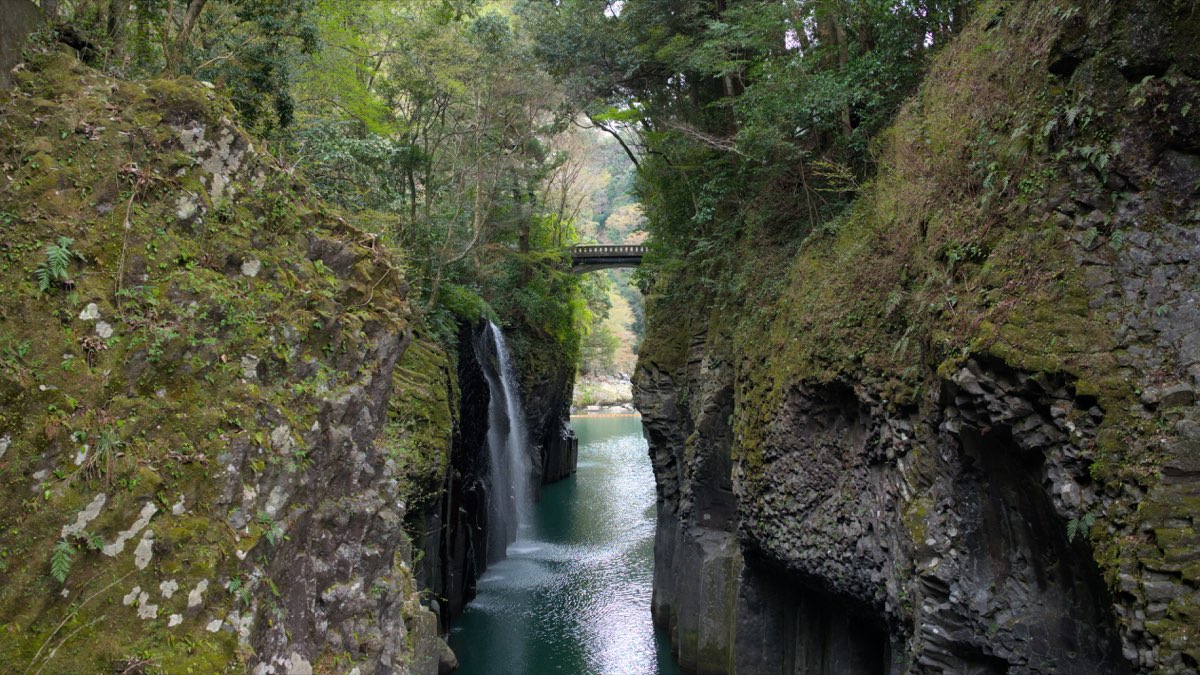
Amanoiwato Shrine, Ama-no-Yasukawara and Kushifuru Shrine are places linked with the myths. Takachiho Gorge, a national Place of Scenic Beauty and Natural Monument since 1934, has cliffs formed from pyroclastic flows of a great eruption of Aso; its Manai Falls is said to carry the water of a sacred spring brought there at the time of the descent.
Check the official websites for current times before visiting.
Sources
- 高千穂の夜神楽Agency for Cultural Affairs (National Cultural Heritage Database)
- 米良の神楽Agency for Cultural Affairs (National Cultural Heritage Database)
- 椎葉神楽Agency for Cultural Affairs (National Cultural Heritage Database)
- 記紀編さん1300年記念事業(記紀と日向神話)Miyazaki Prefecture
- 古事記・日本書紀(ギャラリー)Japan Search (National Diet Library)
- 宮崎県 高千穂郷・椎葉山地域Ministry of Agriculture, Forestry and Fisheries
- 宮崎県の世界農業遺産と日本農業遺産Miyazaki Prefecture (Hinata MAFiN)
- 世界農業遺産 高千穂郷・椎葉山地域とはTakachihogo-Shiibayama GIAHS Regional Revitalization Council (five towns and villages and Miyazaki Prefecture)
- 高千穂神社本殿Agency for Cultural Affairs (Cultural Heritage Online)
- 高千穂峰登山コース(霧島錦江湾国立公園)Ministry of the Environment
- 高千穂の夜神楽ミニ解説Takachiho Town (Planning and Tourism Section)
- 夜神楽三十三番Takachiho Town (Planning and Tourism Section)
- 高千穂神楽Takachiho Town (Planning and Tourism Section)
- Yokagura dance (in English)Takachiho Town (Planning and Tourism Section)
- 令和7年度 高千穂の夜神楽日程表について(令和7年12月12日現在)Takachiho Town (Planning and Tourism Section)
- 槵觸(くしふる)神社Takachiho Town (Planning and Tourism Section)
- 天岩戸神社Takachiho Town (Planning and Tourism Section)
- 天安河原Takachiho Town (Planning and Tourism Section)
- 天岩戸神社 天安河原(あまのやすがわら)All Takachiho Tourism Area Development Council (text in the Japan Tourism Agency multilingual explanation database)
- 高千穂神社Takachiho Town (Planning and Tourism Section)
- 高千穂峡Takachiho Town (Planning and Tourism Section)