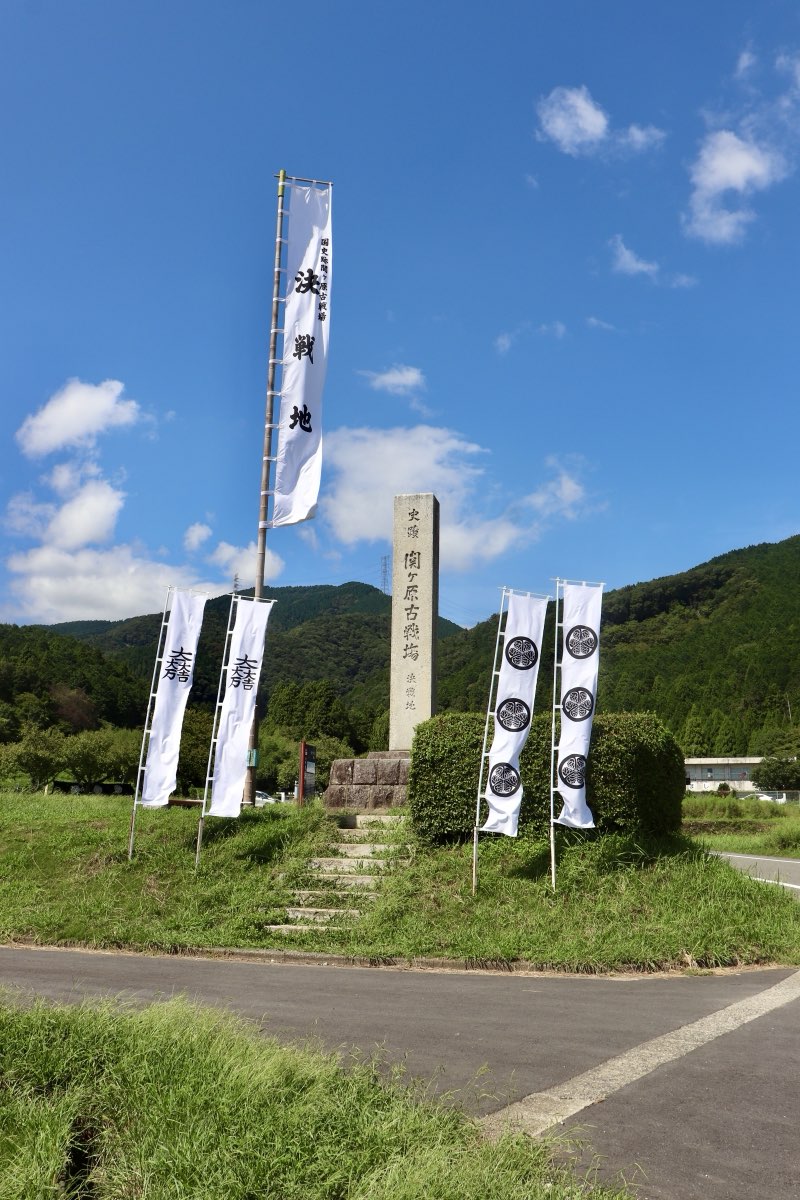
On the 15th day of the ninth month of Keichō 5 (1600, lunisolar calendar), two great armies met at Sekigahara in Mino Province, in today's Gifu Prefecture. One side was led by Tokugawa Ieyasu, the other by Ishida Mitsunari. The battle is known as the one that "divided the realm."
According to the director of the Gifu Sekigahara Battlefield Memorial Museum, power passed after the battle from the Toyotomi to the Tokugawa. This article follows the road to the battle, the course of the day as official and museum sources describe it, and how the site is preserved and presented today.
The road to Sekigahara
According to a Mie Prefecture archaeological center lecture, Toyotomi Hideyoshi died on the 18th day of the eighth month of Keichō 3 (1598). Maeda Toshiie, one of the five senior lords, died the following year.
In the sixth month of Keichō 5 (1600), Ieyasu set out to campaign against Uesugi Kagekatsu of Aizu. In the seventh month, Mōri Terumoto, Ukita Hideie, Natsuka Masaie, Mashita Nagamori, Maeda Gen'i and others issued a statement condemning Ieyasu and gathered troops. This became the western side.
Ieyasu left Edo on the 21st day of the seventh month. The western side attacked Fushimi Castle, which fell on the first day of the eighth month. The same lecture shows that fighting also spread to Ise, where castles such as Tsu were besieged before the main battle.
The museum director, while using the names "Eastern Army" and "Western Army" for the two sides, notes that they were not used at the time.
Gifu Prefecture's description of the national historic site gives about 85,000 for the western army under Ishida Mitsunari and about 75,000 for the eastern army under Tokugawa Ieyasu. The museum director writes of more than 150,000 men on the two sides combined.
The day of the battle
According to the museum, Ieyasu reached Okayama, in present-day Ōgaki City, on the 14th day of the ninth month. Around 6 a.m. on the 15th he took up position on Momokubariyama, at the eastern end of today's Sekigahara town.
The museum describes the western army spread in a "crane's wings" formation, with Mitsunari on Sasaoyama and Kobayakawa Hideaki on Matsuoyama. The eastern army formed a "fish scale" formation in the middle of the basin, with Fukushima Masanori in the vanguard.
Mitsunari's position on Sasaoyama overlooked the whole field and controlled the Hokkoku road. On a hill called Okayama, Kuroda Nagamasa and Takenaka Shigekado camped with about 5,000 men and raised a signal fire when the fighting began.
According to the museum, Ii Naomasa thought it important that the Tokugawa house strike first. With Matsudaira Tadayoshi he went ahead of Fukushima's vanguard and opened fire on the Ukita unit. Gifu Prefecture's page says the battle is said to have begun around 8 a.m., when Ii charged the Shimazu unit.
The museum speaks of the western army's unexpectedly strong fight. Ieyasu later moved his headquarters forward to Jinbano, close to the front.
On Matsuoyama, at an elevation of 293 meters, Kobayakawa Hideaki overlooked the main battlefield. According to the museum, he decided to go over to the eastern army, with which he had long been in secret contact, and the western army quickly collapsed.
Wakisaka Yasuharu and three other commanders camped at the foot of Matsuoyama also changed sides. The unit of Ōtani Yoshitsugu, who had camped facing Matsuoyama because he was wary of Kobayakawa, was attacked from three sides and destroyed. According to the museum, Ōtani, who was ill and commanded from a palanquin, took his own life.
According to Gifu Prefecture, tradition holds that the Ishida unit broke near the site now marked as the decisive battle site around 2 p.m., and that the fighting ended there. The museum says the outcome was decided in only about half a day.
Mitsunari fled toward Mount Ibuki. Tanaka Yoshimasa was later ordered to search for him and captured him in a cave in the Ibuki mountains.
Shimazu Yoshihiro, who had camped with about 1,500 men, stayed on the defensive in the morning and refused Mitsunari's request for reinforcements. When the western army collapsed, he broke through the center of the eastern army and returned to Satsuma.
After the battle
The day after the battle, according to the museum, Ieyasu ordered Takenaka Shigekado, the local lord, to repair shrines destroyed in the fighting and to deal with the dead left on the field. Shigekado buried the bodies and built two mounds, one in the east and one in the west.
Gifu Prefecture describes these Eastern and Western Head Mounds as places where the heads of those killed were buried. Both are part of the national historic site. The museum adds that a head inspection was held at Ieyasu's last camp after the battle.
According to Shizuoka City, Ieyasu, having won at Sekigahara, was appointed shōgun in Keichō 8 (1603) and opened the Edo shogunate. He handed the title to his son Hidetada in 1605.
Accounts that differ
Interpretations differ
Some details of the day differ between the museum's pages and Gifu Prefecture's page. The prefecture says Ieyasu commanded from his first camp until about 10 a.m. and then moved forward because he judged the eastern army to be at a slight disadvantage. The museum gives about 11 a.m. and says he moved because he could not grasp the situation.
Interpretations differ
The two also describe the first shots differently, as an attack on the Ukita unit or a charge on the Shimazu unit.
Interpretations differ
Kobayakawa's choice is presented in more than one way. The museum describes him as having long been in secret contact with the eastern side, yet also as a young commander torn between Mitsunari and Ieyasu until the end. The story that Ieyasu had guns fired toward Matsuoyama to threaten him is given by the museum only as "one account."
Research continues. In 2026 the museum's research group published a collection that includes a paper on how the "standard account" of the headquarters camp sites was formed.
Visiting today
The battlefield was designated a national historic site on 30 March 1931 (Shōwa 6). According to Gifu Prefecture, the designated area covers nine places, including the first and last camps of Ieyasu, Mitsunari's camp, the Okayama signal-fire site, Ōtani's grave, the opening and decisive battle sites, and the two head mounds.
The Gifu Sekigahara Battlefield Memorial Museum stands on the site of Ieyasu's last camp. It was registered as a museum under the Museum Act on 11 June 2025. On the first floor, a floor screen and a theater present the course of the battle.
The second-floor exhibition traces the battle from its origins to its end with original materials, and also shows how the battle has been told since the Edo period and how the sites have been preserved. A fifth-floor observation room looks out over Sekigahara.
Rental bicycles, the Sekigahara historic site guide service, and walking courses to the camp sites are offered through the museum. The climb to Kobayakawa's camp on Matsuoyama involves an elevation gain of about 190 meters and is the most demanding course.
Gifu Prefecture and Sekigahara Town promote themselves together with the battlefields of Waterloo and Gettysburg as the "world's three great battlefields." According to the museum, a summit held on 19 March 2016 reaffirmed their aim of conveying the historical significance of battlefields and the value of peace.
Check opening hours and current information on the museum's official website before visiting.
Sources
- 関ケ原の戦いGifu Sekigahara Battlefield Memorial Museum
- 関ヶ原古戦場 附徳川家康最初陣地ほかGifu Prefecture
- 徳川家康コース|古戦場・史跡巡りGifu Sekigahara Battlefield Memorial Museum (Gifu Prefecture)
- 石田三成コース|古戦場・史跡巡りGifu Sekigahara Battlefield Memorial Museum (Gifu Prefecture)
- 小早川秀秋コース|古戦場・史跡巡りGifu Sekigahara Battlefield Memorial Museum (Gifu Prefecture)
- 関ケ原古戦場・史跡巡りGifu Sekigahara Battlefield Memorial Museum (Gifu Prefecture)
- フロアマップGifu Sekigahara Battlefield Memorial Museum (Gifu Prefecture)
- 「関ケ原研究会寄稿集2026」を発行します。Gifu Sekigahara Battlefield Memorial Museum (Gifu Prefecture)
- 関ヶ原の戦と三重の城郭Mie Prefectural Center for Archaeological Properties (三重県埋蔵文化財センター)
- 徳川家康と駿府(駿府城公園公式サイト)Shizuoka City (Sunpu Castle Park official website)