In the Edo period, the province of Sanuki, today's Kagawa Prefecture, became known for three white products: salt, cotton and sugar. The Kagawa Prefectural Archives describes these "three whites of Sanuki" as the leading special products of early modern Sanuki. They grew under policies that encouraged each domain to produce the goods it needed within its own territory, and both the Takamatsu and Marugame domains worked to produce various goods locally and sold them outside their lands as special products.
This article follows two of the three whites. One is the great salt fields built at Sakaide in the 1820s by the scholar and engineer Kume Michikata. The other is wasanbon, a fine white sugar that the Takamatsu domain succeeded in making in 1808.
Kume Michikata, surveyor and scientist
Kume Michikata (1780–1841), also known as Kume Eizaemon, was born in Umayado village in eastern Sanuki, now part of Higashikagawa City. Sakaide City describes him as the son of a craftsman who made boat rudders.
According to the Agency for Cultural Affairs, he went to Osaka in 1798 and studied astronomy, calendar science and surveying under Hazama Shigetomi. After returning to Sanuki in 1802, he left a record in four fields: surveying and map-making for the domain, astronomical observation, the design and supervision of civil engineering works, and the improvement and manufacture of guns and other weapons.
Sakaide City states that he became a surveyor for the Takamatsu domain at the age of 27. In 1806, by order of the domain, he carried out a survey of its lands with instruments he had designed himself, and drew maps of very high accuracy.
Building the Sakaide salt fields
According to Sakaide City, by 1824 the finances of the Takamatsu domain were in decline and many people were living in poverty. Kume proposed to the lord, Matsudaira Yorihiro, that salt fields be built on the shallow coast off Sakaide, both to restore the domain's finances and to help the people. In 1826 he was made the commissioner in charge of the works.
The Agency for Cultural Affairs notes that he designed and supervised the reclamation himself and saw the project through. The domain's budget of about 20,000 ryō was not enough, so Kume added his own money. A total of about 1.94 million workdays were mobilized.
In 1829 about 132 hectares of salt fields were completed, including the East and West Ōhama fields. Another Sakaide City page describes the work as taking three and a half years.
The fields were of the irihama type. Sakaide City says that they were technically so advanced that they became known as "Kume-style salt fields" and served as a model for later salt-field development.
In praise of his work, Lord Yorihiro set up a stone monument in the grounds of Sugawara Shrine, at the center of the new land. The text was written by a Takamatsu domain writer known for his prose, the calligraphy was by Ichikawa Beian, and the stone was carved in Edo. It was brought to Sakaide by sea in the twelfth month of Bunsei 12 (1829) and was designated a cultural property of Sakaide City in 1957.
In 1828 a shrine was founded to pray for the safety and prosperity of the salt fields, with its deity invited from Shiogama Shrine in today's Miyagi Prefecture. Since 1964 it has stood on the slope of Mount Shōtsūji, looking out over the area of the Sakaide salt fields. Within its grounds, Sakaide Shrine honors Kume and Lord Yorihiro.
Working the salt fields
Salt-making was hard physical work. The city's Salt Industry Museum explains that the day in the salt fields began at around four in the morning and, with breaks, continued until dusk. It seems to have been very heavy labor, summed up in the saying hamado no isshō-meshi, "a salt worker's one shō of rice."
The day was a cycle of tasks, including raking the sand, sprinkling seawater, working the sand with hoes, collecting the concentrated brine and drawing it up. The museum adds that despite the harsh labor, in good years the fields were lively, and laughter and songs are said to have been heard from them.
According to the museum, after Kume's salt fields Kagawa came to produce one third of Japan's salt. Sakaide City's chronology of the salt industry records that in 1921 tenant disputes broke out frequently in salt fields in many places. In 1937 there were disputes in Sakaide, Utazu, Hayashida and elsewhere over the introduction of joint machine salt-making.
In the Shōwa 30s (1955–1964), the museum says, the flow-down (ryūka) method was introduced, which needed a tenth of the labor and doubled the output. It lasted only fifteen years before a new method using ion-exchange membranes took over. In 1972 the last salt fields in Japan disappeared, and the wide salt fields gradually became industrial and residential land.
From sugarcane to wasanbon
According to the Agency for Cultural Affairs, growing sugarcane and making sugar began in Sanuki in the early Edo period. The Takamatsu domain learned sugar-making techniques from Satsuma, and in 1808 it succeeded in making wasanbon, a high-quality white sugar.
Sugar-making began in the squeezing hut. Three stone rollers stood in the middle, and an ox pulled a wooden arm to turn them while the cane was fed between them. According to Shikoku Mura, which preserves such huts, this is why the buildings are round.
The juice was then boiled down in three kettles in a boiling house to make shirashita, the stage before white sugar. Shikoku Mura explains that this was refined further into white sugar, and that Sanuki's wasanbon came out of this process. There were no thermometers or sugar meters, so the quality depended on the craftsmen's skill.
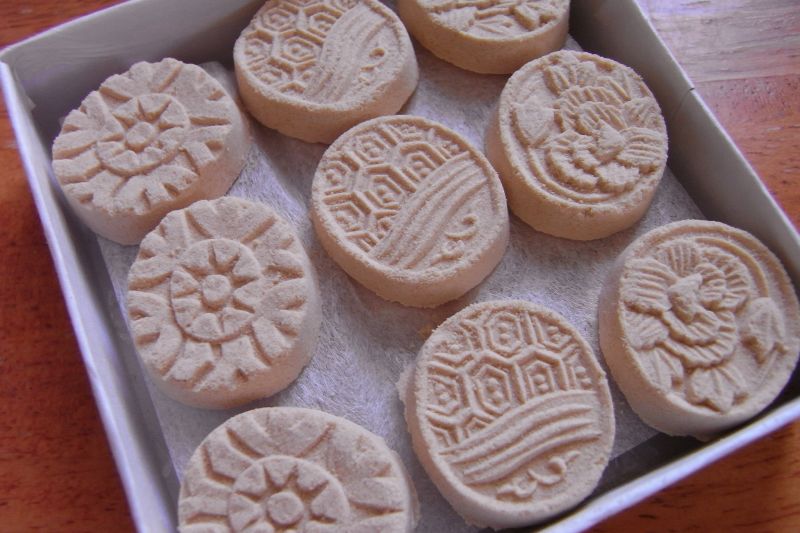
In a Japan Tourism Agency description, the refined crystals are kneaded with the right amount of water and polished several times into very fine grains. The name is explained by the sugar being polished three times on a tray (bon). Wasanbon was expensive, and its refining method was once kept secret.
The same description says that wasanbon is made mainly in eastern Shikoku, such as Kagawa and Tokushima, and has more than 200 years of history. Pressed into wooden molds, it becomes small dry sweets called higashi.
In 1983 a collection of 937 tools from Sanuki and nearby areas was designated an Important Tangible Folk Cultural Property, together with two squeezing huts and a boiling house. The tools cover each stage, from growing cane and making shirashita to making wasanbon.
Places to visit
Shikoku Mura, an open-air museum at the foot of Yashima in Takamatsu, preserves two round sugar-squeezing huts and a boiling house. The huts came from Sakaide, and the museum says they are the only surviving conical huts of this kind in Japan. Its storehouse of 937 sugar-making tools is normally closed, but reservation-only tours are held.
Kume Michikata's house was also moved to Shikoku Mura from Umayado. When it was taken down for the move, prototypes of cannon molds were found in the roof space.
In Sakaide, the city's Salt Industry Museum shows salt-making from ancient pottery to irihama fields, with tools and detailed models of each method. The Kamada Kyosaikai Local Museum holds Kume's papers and instruments, designated an Important Cultural Property in 2014, and the Sugawara Shrine monument and the shrine on Mount Shōtsūji can also be visited.
In Higashikagawa, Sanshū Izutsu Yashiki, a former merchant house, holds workshops that include making sweets with the wasanbon traditionally produced in the area. Check each official website for opening days and reservations before visiting.
Sources
- 近世讃岐の国産奨励 企画展示 讃岐三白と藍・和紙・蠟Kagawa Prefectural Archives
- 久米通賢関係資料Agency for Cultural Affairs (Cultural Heritage Online)
- 坂出塩田の父「久米通賢」Sakaide City
- 塩業のあゆみSakaide City
- 讃岐及び周辺地域の砂糖製造用具と砂糖しめ小屋・釜屋Agency for Cultural Affairs (Cultural Heritage Online)
- 坂出市塩業資料館Sakaide City (Cultural Promotion Division)
- 宮崎家砂糖しめ小屋Shikoku Mura Museum (Shikoku Minka Museum Foundation)
- 冨木田家砂糖しめ小屋Shikoku Mura Museum (Shikoku Minka Museum Foundation)
- 六車家釡屋Shikoku Mura Museum (Shikoku Minka Museum Foundation)
- 砂糖製造用具収蔵庫/醤油製造用具収蔵庫Shikoku Mura Museum (Shikoku Minka Museum Foundation)
- 久米通賢旧宅Shikoku Mura Museum (Shikoku Minka Museum Foundation)
- 四国村とはShikoku Mura Museum (Shikoku Minka Museum Foundation)
- 和三盆型抜き体験(観光庁 多言語解説文データベース)Japan Tourism Agency
- 讃州井筒屋敷(観光庁 多言語解説文データベース)Japan Tourism Agency