Sado Island, off the coast of Niigata, was rich in minerals. According to Niigata Prefecture, mining there became full-scale in the Edo period, from the 17th to the mid-19th century, and Sado became widely known as an island of gold.
The gold and silver mined there under the direct rule of the Tokugawa shogunate were turned into coins and supported the shogunate's finances. On 27 July 2024 the "Sado Island Gold Mines" were inscribed on UNESCO's World Heritage List.
This article follows how gold was found and worked on Sado, how ore became coins, and what can be seen on the island today.
Two kinds of gold
The World Heritage property is made up of two mining areas. Niigata Prefecture describes them as places of "visible gold" and "invisible gold."
The Nishimikawa Placer Gold Mine, in the southwest of the island, is thought to be the oldest on Sado. The Konjaku Monogatarishū, a Heian-period collection of tales, includes a story of gold-dust collecting that is presumed to refer to this area.
In 1589, Uesugi Kagekatsu of Echigo, who then ruled Sado, redeveloped the mine. From about 1593 its gold was delivered to Toyotomi Hideyoshi, and in the same year Ōyamazumi Shrine was built to pray for the mine's prosperity and safety.
The Aikawa-Tsurushi Gold and Silver Mine, by contrast, was dug for "invisible gold": gold held in veins inside hard bedrock. Getting it out required crushing the ore finely and treating it chemically.
Silver at Tsurushi, gold at Aikawa
The Tsurushi Silver Mine is said to have been discovered in 1542 and was the largest silver mine on Sado. Mining there continued until 1946.
At first miners dug ore where veins came to the surface, then followed the veins into the ground. Later, prospectors (yamashi) from the Iwami Silver Mine brought tunnel mining, which allowed several veins to be worked at once and greatly increased output.
Techniques such as cupellation, which uses lead to extract silver from ore, also came from Iwami. Niigata Prefecture says this laid the technical foundation for the gold production that later began at Aikawa.
The development of Tsurushi led to the discovery of large gold and silver veins in the mountains of Aikawa, about 1.2 kilometers to the north. According to Niigata Prefecture, Aikawa produced about 40 tonnes of gold and 1,800 tonnes of silver during the Edo period and was Japan's largest gold and silver mine.
The shogunate's mine
In 1603 Tokugawa Ieyasu appointed Ōkubo Nagayasu as daikan (intendant) of Sado, and the base for managing the mines moved from Tsurushi to Aikawa. Ōkubo brought in the technology and management methods of the Iwami Silver Mine.
He also built an administrative office in Aikawa (later the Sado Magistrate's Office), laid out a planned town, and improved the roads to the mines and the port of Ogi. Gold and silver output rose higher than ever before.
Aikawa had been a small seaside village. As people arrived from outside the island, its population is said to have reached 50,000 at its peak.
Around the magistrate's office, districts were laid out by trade, such as Kyōmachi, Komeyamachi (rice sellers) and Misoyamachi (miso sellers). Rice, timber, clothing and other necessities were shipped in from all over Japan.
Niigata Prefecture emphasizes the wider setting. While mining was being mechanized in other parts of the world, Japan's so-called seclusion policy limited the flow of technology from abroad.
Under these conditions, Sado kept up advanced mining and smelting by hand for more than 250 years. The prefecture says a management and labor system set up by the Tokugawa shogunate made it possible to produce large amounts of high-quality gold, making Sado one of the world's leading gold mines in the 17th century.
From ore to koban
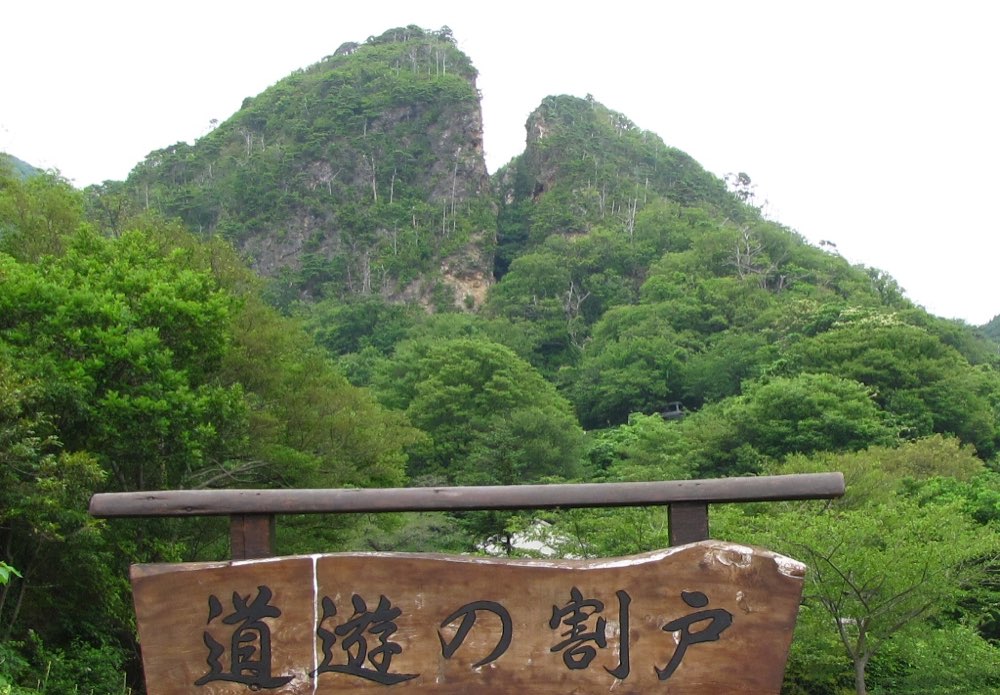
Early mining at Aikawa took ore from veins exposed at the surface. The best-known trace is Dōyū no Warito, a mountain split in two.
Its upper open cut was dug by human strength in the Edo period and measures 74 meters deep, 30 meters wide and 120 meters long. The large hole at its base dates from mining with dynamite after the Meiji period.
As the veins went deeper, miners dug tunnels. They cut the ore with chisels and hammers, and the rock is said to have been so hard that a miner advanced only about 10 centimeters a day.
Water seeping into the tunnels was a constant problem. In 1653 a pump called the suishōrin, a screw inside a tube known in the West as the Archimedes screw, was introduced after reaching Japan by way of China.
The ore was broken with hammers and ground with stone mills, and the gold and silver were washed out with water. In smelting, cupellation produced an alloy of gold and silver, which was then separated using sulfur and salt.
The gold was refined to the purity of koban coins, 66 to 87 percent gold. Niigata Prefecture says remains of the salt method survive almost nowhere else in the world, and in Japan only on Sado.
In 1759 the magistrate Ishigaya Kiyomasa gathered the workshops that had been scattered around the town into the magistrate's office. From then on, gold was produced under the office's direct management.
The coins themselves were made at a mint next to the office. According to Niigata Prefecture, Sado was the only mine in Japan where everything from mining to minting was done in one place, and more than 100 picture scrolls showing the process survive.
Every year the koban were carried under guard from Aikawa to Ogi, shipped across to Izumozaki, and taken overland by the Hokkoku Kaidō and Nakasendō roads to Edo. The prefecture says the shogunate used Sado's gold and silver to fund government and foreign trade.
Decline, and a long afterlife
From the late 17th century the good veins began to run out, and deeper tunnels flooded. Magistrate Ogiwara Shigehide had the Minamizawa drainage tunnel dug from 1691.
Cut by hand with chisels and hammers over five years, about one kilometer long, it was dug from six points at once and met with almost no error. Production rose again, and the tunnel still carries water into the Sea of Japan today.
A 2014 Sado City survey report says that from the 1770s, mushukunin (people without a fixed address) increasing in Edo were sent to Aikawa as drainage workers, to restore order in Edo and ease a mine labor shortage. They drew water with buckets in day-and-night shifts on alternate days.
After the 18th century began, however, no new veins were found, and the mines slowly declined. At Nishimikawa, output dwindled until the mine closed in 1872; the families who had worked it turned to farming and forestry and stayed on the land.
Mining at Aikawa continued into the modern era. Sado City reports that by the time mining was suspended in 1989, the island had produced at least 78 tonnes of gold and 2,330 tonnes of silver on record.
When the mines were inscribed in July 2024, the Japanese government told the World Heritage Committee that it had already installed new exhibits relating to all the workers at the site's interpretation facility "to explain the severe conditions of their work and remember their hardship," and that it would continue its efforts "sincerely remembering all the workers at the Sado Island Gold Mines, especially those from the Korean Peninsula."
According to the statement, the exhibits explain that during the war "Open Recruitment," then "Official Placement" and, from September 1944, "Requisition" were carried out on the Korean Peninsula. They also include data indicating that a higher percentage of workers from the Korean Peninsula did dangerous tasks inside the mine shafts, such as rock drilling.
The mines also left a mark on island culture. Niigata Prefecture says that noh spread on Sado after Ōkubo Nagayasu arrived with noh performers, and more than 30 noh stages remain.
At the festival of the Ōyamazumi Shrine where the god of the mine is enshrined, a ritual performance called yawaragi uses mining tools as costume and instruments. It is said to carry the miners' wishes that the hard ore and the heart of the mountain god would both soften.
Visiting today
As of July 2026, in Aikawa, the Historic Site of the Sado Magistrate's Office, restored in 2000 to its appearance in the Ansei era (mid-1850s), receives visitors, as do the Aikawa Local Museum and the guidance facility Kirarium Sado.
The Nishimikawa area, around today's Sasagawa settlement, is a place where people still live and has no facilities for tourists. Niigata Prefecture asks visitors to come on a guided tour.
At Tsurushi, the ground is rough and there are dangerous spots. As of 2026 the prefecture recommends guided tours and says tours are being prepared.
At every site, do not enter closed areas or take anything away. Check Niigata Prefecture's and Sado City's official websites for current opening days and tours before you go.
Sources
- 佐渡島の金山とは新潟県(観光文化スポーツ部 文化課 世界遺産室)
- 相川金銀山新潟県(観光文化スポーツ部 文化課 世界遺産室)
- 西三川砂金山新潟県(観光文化スポーツ部 文化課 世界遺産室)
- 鶴子銀山新潟県(観光文化スポーツ部 文化課 世界遺産室)
- 鉱石から小判ができるまで新潟県(観光文化スポーツ部 文化課 世界遺産室)
- 伝統的手工業による鉱山技術新潟県(観光文化スポーツ部 文化課 世界遺産室)
- 鉱山由来の文化と暮らし新潟県(観光文化スポーツ部 文化課 世界遺産室)
- 現地見学をご検討中のみなさまへのお願い新潟県(観光文化スポーツ部 文化課 世界遺産室)
- 「佐渡島の金山」世界文化遺産登録2周年記念 3施設の無料開館(佐渡市よりお知らせ)佐渡市(新潟県の世界遺産ページに掲載)
- 佐渡金銀山を世界遺産に佐渡市
- 佐渡金銀山 相川金銀山跡分布調査報告書(佐渡金銀山遺跡調査報告書第18集)Sado City (佐渡市世界遺産推進課)
- ユネスコ第46回世界遺産委員会における「佐渡島の金山」の審議に際する 日本政府代表ステートメントMinistry of Foreign Affairs of Japan
- Statement by the Japanese Delegation on the occasion of the deliberation of "Sado Island Gold Mines" at the 46th Session of the World Heritage Committee of UNESCOMinistry of Foreign Affairs of Japan