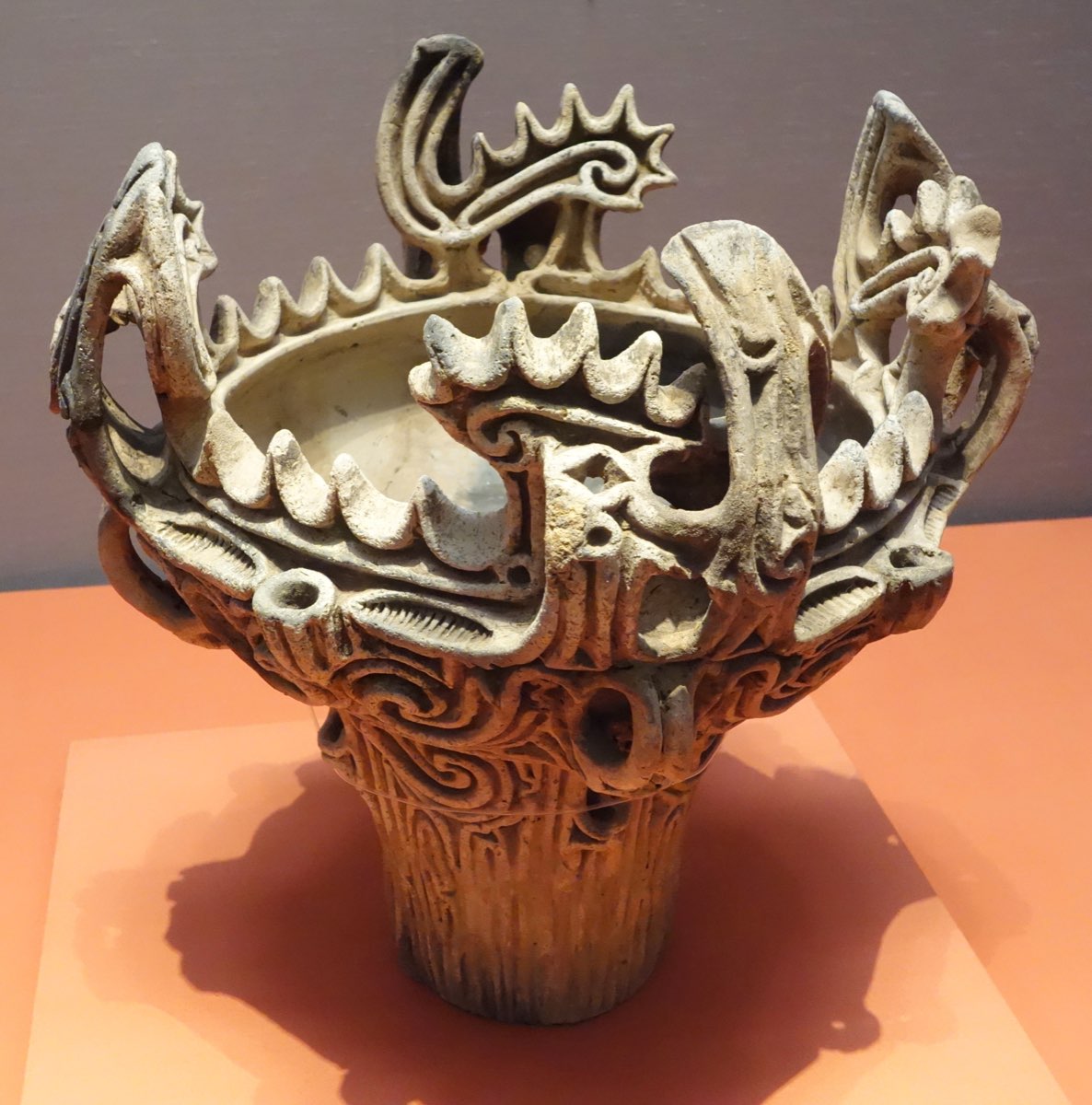
About 5,000 years ago, in the Middle Jōmon period, people living along the Shinano River in what is now Niigata Prefecture made clay vessels with tall, sweeping projections around the rim. Tokamachi City explains that the name "flame-style pottery" (kaen-gata doki) comes from these projections, which look like flames blazing upward.
Today one group of these vessels is a National Treasure, and the pottery is at the center of a Japan Heritage story shared by several towns along the river. This article looks at how the style was named, what makes its form distinctive, what researchers say about how the pots were used, and how they are valued now.
One pot found in 1936
The story of the name begins with a single vessel. According to the Japan Tourism Agency's multilingual text for the Umataka Jōmon Museum in Nagaoka, the first example of this regional pottery was discovered at the Umataka site in 1936.
The archaeologist Nakamura Kōzaburō later classified it as "Flame, A-type, no. 1," and it became a point of reference for other flame pots in Niigata and elsewhere in Japan. The Shinano River Flame Highway Council, a group of local governments, explains that "kaen doki" (flame pot) is a nickname for that one pot. Similar vessels are called "kaen-gata doki" (flame-style pottery) to tell them apart.
The Umataka site lies on the left bank of the Shinano River. Together with the neighboring Sanjūinaba site, it was designated a National Historic Site in 1979. The Umataka remains date from the Middle Jōmon period, between about 5,500 and 4,500 years ago.
Reading the form
What sets flame-style pottery apart is its rim. The museum text describes four large projections with serrated edges; the council calls them cockscomb-shaped handles and sawtooth projections.
A closely related style, the crown type, has projections that the English text compares to mountain peaks; the Japanese text calls them strip-shaped. Both styles are generally deep bowls, but the Umataka site also yielded a rare shallow bowl of the flame type.
Tokamachi City Museum explains that "flame-style" and "crown-style" are names for styles peculiar to the Shinano River basin. Almost all known examples of both are deep bowls, meaning vessels that are taller than they are wide.
The National Center for the Promotion of Cultural Properties describes a flame-like bowl in the Tokyo National Museum. Its decoration covers almost the entire surface, and its handles also resemble a rooster's comb.
The style also changed over time. According to the Umataka museum text, three or possibly four stages can be seen at sites in Nagaoka. Early pots are stubby, with no clear waist and little detail around the rim.
Later examples from the Umataka and Iwanohara sites have a narrower waist and a rim that flares broadly outward. The text adds that the pottery flourished for a short time after it first appeared, around 5,000 years ago.
Where the pots are found
The Umataka museum text counts 150 sites in Niigata Prefecture that have yielded flame pottery. Most are concentrated along the middle and upper Shinano River, in Nagaoka, Tokamachi and Tsunan. Others lie along other rivers, as far as the Sea of Japan coast and the area around Sado Island.
Excavations in the western part of the prefecture have found relatively few. The Japan Heritage story states that flame-style pottery is found almost only within Niigata Prefecture and that its heartland is the Shinano River basin.
The same story says that more than 400 Middle Jōmon sites have been found in the basin. By that account, the size and density of villages there were among the highest in Japan.
The vessels also point to contact with other regions. Tokamachi City Museum notes that some of the 57 deep bowls from the Sasayama site show shapes or patterns influenced by the Tohoku, Hokuriku, central highland and Kanto regions. The museum calls them valuable for understanding how flame-style pottery arose and how the people of Sasayama interacted with other areas.
Cooking pot or vessel of ideas?
Interpretations differ
How were these elaborate pots used? The sources registered for this article do not give a single answer.
Interpretations differ
The National Center for the Promotion of Cultural Properties notes that the heavy decoration led some to suggest a ceremonial use. It adds that marks suggesting boiling or burning have led scholars to believe the bowl it describes was used to cook nuts, berries or meat.
Interpretations differ
The Umataka museum text also reports blackening by fire on flame-type and crown-type pots, which supports the view that they were used for cooking. Its Japanese version adds that because such pots make up only about one tenth of everyday pottery, they are thought to have been used in festivals and other rituals.
Interpretations differ
The same text points out that flame-type pots are found in the same conditions as plain pottery, and that they were rarely placed or buried in a special location.
Interpretations differ
The Japan Heritage story takes a different view. It argues that the large projections would get in the way of putting food in and taking it out, so the pots were not made for practical use but to express ideas from the Jōmon worldview. Yet the same story also mentions scorch marks thought to come from cooking salmon.
How the pottery is valued today
The best-known group comes from the Sasayama site in Tokamachi. Seven excavations between 1980 and 1985, carried out before sports facilities were built, uncovered a Middle Jōmon village there.
On 7 June 1999, finds from the site were designated a National Treasure. Tokamachi City says this was the first National Treasure in Niigata Prefecture and the first ever for Jōmon pottery.
The designation covers 57 deep bowls, including 14 flame-style and 3 crown-style vessels, with 871 further items attached: pottery and clay objects, stone tools and lumps of red pigment, 928 items in all.
According to Tokamachi City Museum, the flame-style vessel listed as No. 1 has been called the finest of all Jōmon pottery because of its proportions and how completely it survives. The museum adds that it was shown abroad, at the Arthur M. Sackler Gallery in Washington, D.C. in 1992, at the Maison de la culture du Japon in Paris in 1998 and at the British Museum in 2001.
Tokamachi City's English site says the pottery has been highly evaluated internationally as the origin of Japanese art. In Nagaoka, the finds from the Umataka site, 300 items including the original "kaen doki," are designated an Important Cultural Property.
The artist Okamoto Tarō is said to have exclaimed "Nanda, kore wa!" ("What on earth is this?") on seeing flame-style pottery.
The same words begin the title of a Japan Heritage story about flame-style pottery and snow-country culture. The Agency for Cultural Affairs certified it in 2016 on a proposal from Niigata, Sanjō, Nagaoka, Tokamachi and Tsunan, and Uonuma joined in 2017.
The story calls Jōmon culture a source of Japanese culture and, in that sense, places flame-style pottery alongside ukiyo-e and kabuki as Japanese culture itself. It also notes that many flame-pottery monuments now stand in towns along the Shinano River.
Visiting today
The Umataka Jōmon Museum in Nagaoka stands on the National Historic Site of Umataka-Sanjūinaba. It exhibits the original "kaen doki" and other finds from the Umataka site, along with displays on Jōmon village life.
Tokamachi City Museum displays the National Treasure flame-style pottery from the Sasayama site. Tokamachi City asks visitors to check exhibition dates before going.
Several other museums along the river, listed by the Shinano River Flame Highway Council, also show flame-style pottery. Opening days and hours change, so please check each museum's official website before you visit.
Sources
- 【国宝】新潟県笹山遺跡出土深鉢形土器(火焔型土器)Tokamachi City
- Tokamachi City OverviewTokamachi City
- 新潟県笹山遺跡出土深鉢形土器十日町市博物館
- Umataka Jomon Museum Captions(馬高縄文館 展示解説)Japan Tourism Agency (観光庁 地域観光資源の多言語解説文データベース)
- 「なんだ、コレは!」 信濃川流域の火焔型土器と雪国の文化(STORY #026)文化庁 日本遺産ポータルサイト
- Deep Bowl with Flame-like Ornamentation (cultural property reproduction record)National Center for the Promotion of Cultural Properties
- 日本遺産 火焔型土器 –「なんだ、コレは!」信濃川流域の火焔型土器と雪国の文化(トップページ・火焔型土器とは?)Shinano River Flame Highway Council
- 馬高縄文館(火焔型土器のある博物館)Shinano River Flame Highway Council