For about two centuries in the medieval period, the Ōuchi family ruled a wide area of western Japan from Yamaguchi. Drawing on trade with Korea and Ming China and on the culture of Kyoto, they built a city that, according to Yamaguchi's tourism federation, came to be called the "Kyoto of the West."
In 1550 and 1551 the Jesuit missionary Francis Xavier came to this city, and the Ōuchi lord allowed him to preach. This article follows the Ōuchi's Yamaguchi, Xavier's stay there, the end of the Ōuchi, and how Yamaguchi remembers him today.
A new base in Yamaguchi
According to Yamaguchi City, Ōuchi Hiroyo, the twenty-fourth head of the family, moved his residence from Mibori to the center of Yamaguchi around 1360. The city credits him with laying the foundations for the later flowering of Ōuchi culture.
The Agency for Cultural Affairs describes Yamaguchi as a small basin with mountains on the east, north and west and an opening to the south, with the Fushino River running through it. It calls this a typical landscape for the base of a medieval powerful family.
Hiroyo is said to have laid out the town in imitation of Kyoto. In the tourism federation's account, the Ichinosaka River, which runs through the town, was treated as Yamaguchi's version of Kyoto's Kamo River.
The Ōuchi residence is said to have stood where Ryūfukuji Temple is today, although the Agency notes that firm proof is lacking. According to the tourism federation, it is said to have occupied a plot about 100 ken square (ken is a traditional unit of length), enclosed by a moat and earthworks.
The Yamaguchi City Board of Education describes the residence as the Ōuchi's political base for governing their provinces, and as a center of economy and culture. The site became a national Historic Site in 1959, and excavation has continued there since 1978.
Trade with Korea and Ming China
The Ōuchi grew rich through trade overseas. According to the tourism federation, they began dealings with the Korean kingdom at the end of the fourteenth century. From the mid-fifteenth century they also took part in sending ships to Ming China.
Among the cultural properties listed by Yamaguchi Prefecture is a set of seals and documents that the Ōuchi are said to have used in this trade, now an Important Cultural Property. Among them is a bronze seal reading "tsūshinfu." It was made in Korea in 1453 as an official seal for the trade, and it is noted as the only surviving example.
The prefecture lists what moved in each direction. Swords, sulfur, copper and fans went out from Japan, while Yongle coins, ceramics and books came in. Imported goods were prized in Japan as karamono, "Chinese things," and sold at high prices, which brought the Ōuchi large profits.
Culture in the "Kyoto of the West"
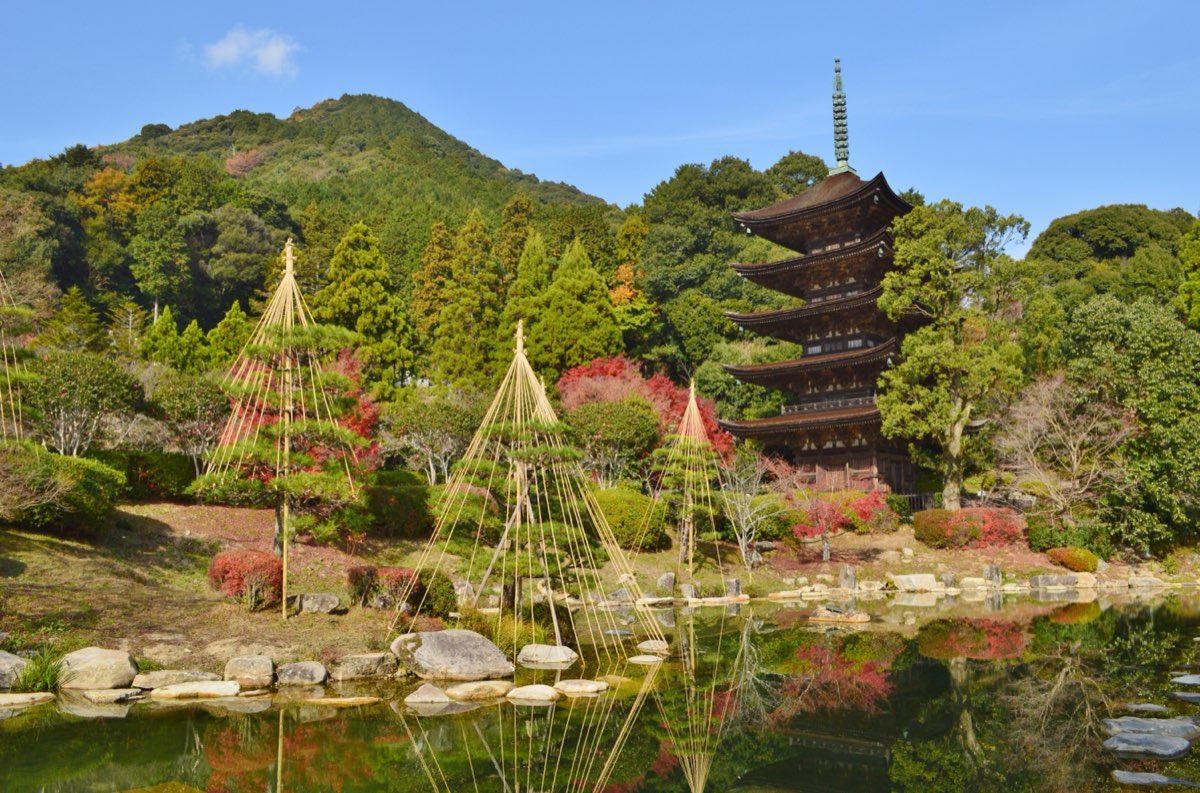
The best-known building of Ōuchi times is the five-storied pagoda of Rurikōji Temple. According to the Agency for Cultural Affairs, it is said to have been built by Ōuchi Morimi to pray for the soul of his elder brother Yoshihiro (1356–1399).
During repairs in the Taishō period, an ink inscription dated 1442 was found, which revealed when the pagoda was built. It stands 31.2 meters tall and was designated a National Treasure in 1952. The Agency notes that the round altar inside its first story has no other example among pagodas.
The painter-monk Sesshū also worked under Ōuchi protection. According to the tourism federation, in 1467 he sailed to Ming China on a ship run by the Ōuchi under Ōuchi Masahiro and returned in 1469. He then based himself in Yamaguchi.
In the same years, Masahiro received nobles and scholars who left Kyoto to avoid the Ōnin War, among them the linked-verse poet Sōgi. The garden of Jōeiji Temple is said to have been made by Sesshū.
Excavation at the residence site has found the remains of at least three gardens from the Muromachi period. The largest, a pond garden about 39 by 20 meters, was made around the end of the 1400s. A gold-leafed earthenware dish of the Kyoto type was found in a nearby stone well.
Xavier comes to Yamaguchi
Francis Xavier (1506–1552) was a Spanish missionary and one of the founders of the Jesuits. According to the Yamaguchi Prefectural Archives, he landed at Kagoshima in 1549 and, by way of Hirado, reached Yamaguchi the following year.
His first meeting with the lord, Ōuchi Yoshitaka, did not go well. Xavier went on to Kyoto early in 1551, but there he found he could not achieve his purpose. He decided to concentrate on Yamaguchi instead.
He returned the same year, this time with unusual gifts and letters of recommendation from the viceroy of India and the bishop of Goa. The Prefectural Library adds that he dressed suitably for the occasion. Yoshitaka formally received him, gave him permission to preach, and provided a disused temple as his base.
Yamaguchi Prefecture calls this the first church in Japan. Later in 1551, at the invitation of the Ōtomo family, Xavier left Yamaguchi for Bungo, in today's Ōita Prefecture.
His time in Yamaguchi totaled only a little over six months. Even so, the Archives say his work there is regarded as the true starting point of the Christian mission in Japan, against the background of the prosperity of the Ōuchi castle town.
Missionaries remained in Yamaguchi after Xavier left. According to the tourism federation, the church was then run by Father Torres, who had traveled with Xavier. In 1552, missionaries celebrated Christmas in Yamaguchi with Japanese believers. Yamaguchi Prefecture says this is considered the first Christmas celebrated in Japan, while the Yamaguchi Prefectural Archives describe the idea that Christmas in Japan began in Yamaguchi as a theory that has drawn attention in recent years.
Interpretations differ
Much about the church known as Daidōji remains unclear. The Archives say it is not known whether Daidōji was a church called by that name, a church built on the site of a temple called Daidōji, or the same disused temple that Yoshitaka gave. Its location is usually placed around today's Xavier Memorial Park, but another view places it near Honkokuji Temple.
The end of the Ōuchi
Ōuchi rule did not last much longer. In 1551, after a coup by the senior retainer Sue Takafusa and others, Yoshitaka took his own life. His successor, Ōuchi Yoshinaga, built Kōnomine Castle on a hill west of the town in 1556 to prepare for an attack by the Mōri family.
When the Mōri attacked in 1557, Yoshinaga first held the castle, then judged it hard to defend and fled to Nagato Province. With the fall of the Ōuchi, Yamaguchi passed into Mōri hands. The pond garden at the residence site went out of use in the mid-1500s, when the Ōuchi fell.
Remembering Xavier
Interest in Xavier's Yamaguchi revived centuries later. According to the Prefectural Archives, Father Villion, who came to the Yamaguchi church in 1889, is said to have identified the site of Daidōji from an old map of Yamaguchi, with help from the local historian Kondō Kiyoishi.
A preservation society was formed in 1921, and in 1926 a Gothic-style monument 5 meters tall was unveiled at the site, now Xavier Memorial Park. The Archives note that the exact site is thought to lie within the neighboring grounds of a former army garrison.
For the four hundredth anniversary of Xavier's arrival in Japan, a memorial church was built on Kameyama hill in Yamaguchi and completed in 1952. It was lost to fire in 1991 and rebuilt in 1998.
Places to visit
The site of the Ōuchi residence is now the grounds of Ryūfukuji Temple. The pond garden and a dry landscape garden found by excavation have been restored.
The five-storied pagoda of Rurikōji stands in Kōzan Park, which also has statues of Ōuchi Hiroyo and Sesshū. The garden of Jōeiji Temple, known as Sesshū's garden, is also in Yamaguchi City.
Xavier Memorial Park, with its 1926 monument, is in the Kanakoso district of Yamaguchi City. It is a different place from the Yamaguchi Xavier Memorial Church on Kameyama. Check the official websites for opening hours and admission before visiting.
Sources
- 大内弘世墓(山口市の歴史文化資源)Yamaguchi City
- 大内氏遺跡 附 凌雲寺跡Agency for Cultural Affairs (Cultural Heritage Online)
- 瑠璃光寺五重塔Agency for Cultural Affairs (Cultural Heritage Online)
- 関連文化財群(3)今に息づく大内氏の歴史文化Yamaguchi City
- 大内氏勘合貿易印等関係資料Yamaguchi Prefecture (Cultural Properties)
- 山口まめ知識Yamaguchi Prefecture (Public Relations Division)
- 資料展示「フランシスコ・サビエルの肖像」Yamaguchi Prefectural Library
- 3-1-3 ヨーロッパ人との出会い キリスト教の伝来(フランシスコ・サビエル肖像 解説)Yamaguchi Prefectural Archives (山口県文書館)
- 記念碑でかたりつぐ(第20回中国四国地区アーカイブズウィーク 展示パネル16)Yamaguchi Prefectural Archives (山口県文書館)
- 史跡 大内氏館跡 池泉庭園(パンフレット)Yamaguchi City Board of Education (山口市教育委員会 文化財保護課)
- 室町時代に「西の京」山口で華ひらいた「大内文化」とはYamaguchi Prefectural Tourism Federation (山口県観光連盟, おいでませ山口へ)
- 大内氏館跡(大内氏遺跡)Yamaguchi Prefectural Tourism Federation (山口県観光連盟, おいでませ山口へ)
- サビエル公園Yamaguchi Prefectural Tourism Federation (山口県観光連盟, おいでませ山口へ)