Ōmi was the old name of the province around Lake Biwa, today's Shiga Prefecture. In the Edo period, merchants from several towns there kept their family homes in Ōmi while they traded in distant parts of Japan. They are known together as Ōmi merchants (Ōmi shōnin).
Shiga University describes them as representative merchants of early modern Japan. They started out as peddlers, opened branch shops across the country as their markets grew, and ran their businesses rationally, as their joint enterprises and account books show. This article looks at where they came from, how they traded, and where their houses can still be seen.
Peddlers with shoulder poles
The popular image of an Ōmi merchant, as a 2018 study by Koda Hirofumi of Toyo University puts it, is of a peddler carrying goods on a shoulder pole (tenbinbō) around markets across Japan from the early Edo period. The same study stresses that the merchants of each home town differed in where they traded, what they sold and how they sold it.
According to Shiga University, their trade eventually reached the whole country, but in the early days it centered on northern Kantō, Tōhoku, Hokuriku and the San'in region, areas that were then economically less developed. Because they moved in during hard times, they had to sell cheaply.
To make up for thin profits, they had to turn over their goods faster and trade in larger amounts. Shiga University explains that this led them to practices seen as forerunners of modern business, such as market research and joint investment to spread commercial risk.
Why Ōmi?
Interpretations differ
Why so many traveling merchants came from Ōmi is a question with no single answer. The Toyo University study lists theories put forward by many researchers. Some trace the merchants to people in hardship, such as immigrants, warriors, townspeople or farmers, who turned to trade. Others point to the early growth of markets and trade privileges in Ōmi, and to the free-market policies (rakuichi rakuza) of the late sixteenth century.
Interpretations differ
The study also describes Ōmi as a fertile granary and a hub of land and water routes, where farmers had time for side work making mosquito nets, tatami covers, hemp cloth, lacquered bowls and medicine. But it notes that the opposite view also exists: that Ōmi was a poor land whose people had to find a living in trade.
Four groups of merchants
The study counts four main groups, named after their home areas. The Takashima merchants, from the western shore of Lake Biwa, appeared at the end of the Warring States period. After trading in nearby Kyoto, they were the first Ōmi merchants to go to Tōhoku, where they helped build the town of Morioka.
The Hachiman merchants of today's Ōmihachiman followed in the early Edo period. Based at home, they opened large shops in Edo, Kyoto and Osaka and spread branch shops from there.
The Hino merchants worked instead in the smaller towns of northern Kantō and Tōhoku. The Kotō, or Gokashō, merchants of today's Higashiōmi came last, and the study notes that they succeeded as wholesalers in the great cities after the Meiji Restoration of 1868.
Hachiman: a town built for trade
Ōmihachiman began as a castle town. Ōmihachiman City explains that Toyotomi Hidetsugu, a nephew of Toyotomi Hideyoshi, built Hachimanyama Castle in 1585 and dug the Hachiman Moat around the hill, linking it to Lake Biwa. The moat is said to have served both for transport on the lake and for defense.
The townspeople's quarter was laid out in a straight grid. According to the city, this Kyoto-style planning and the free-market rules of a town code issued in 1586 drove the later growth of the Hachiman merchants. They kept their head shops in Hachiman and opened branches where they peddled.
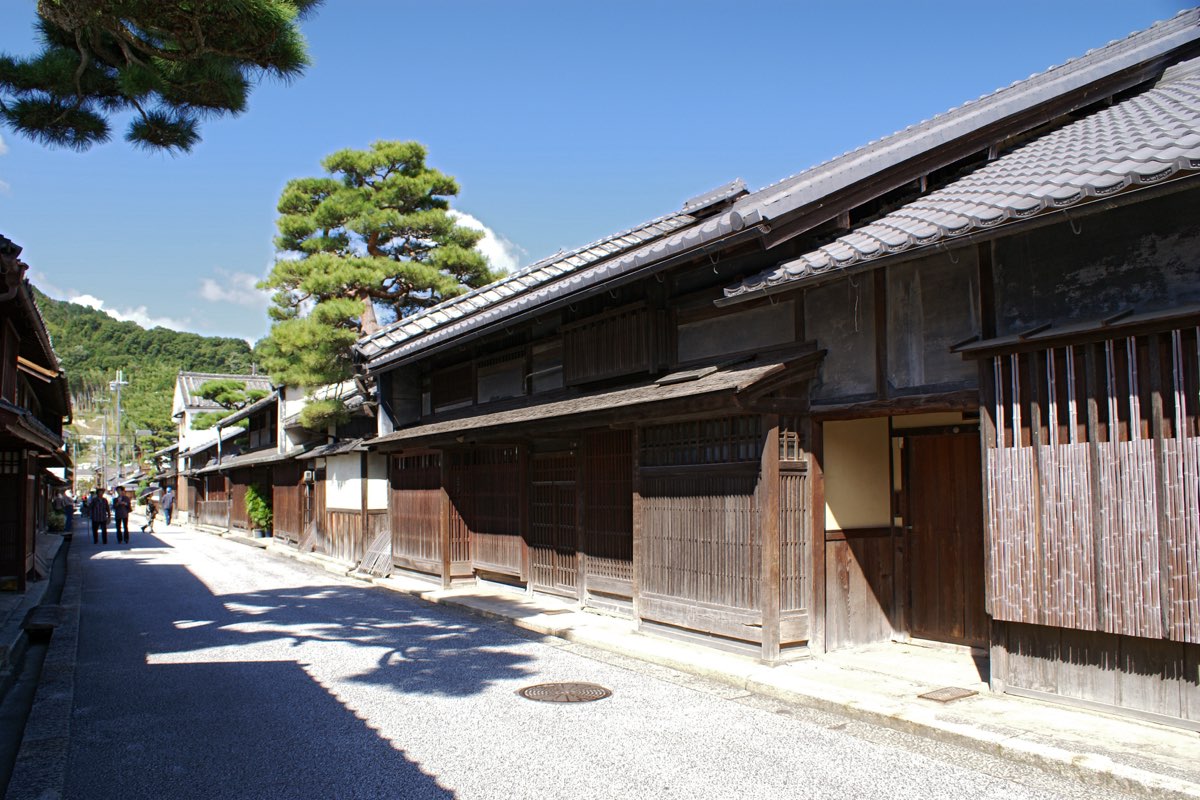
The Agency for Cultural Affairs adds that Hachiman later grew into a country town at the heart of Ōmi merchant trade, and that fine townhouses of Hachiman merchants active throughout the Edo period survive along its old grid of streets.
One such family were the Nishikawa. The Agency records that they are said to have lived in the town since Hidetsugu founded it, and that they dealt widely in tatami covers, mosquito nets and other goods. According to the local tourism association, the first Nishikawa Riemon (1590–1646) opened a shop called Daimonjiya in Edo and another called Omiya in Osaka.
Hino: bowls, medicine and a merchants' union
Hino, inland from the southeastern shore of Lake Biwa, was the castle town of the Gamō family for about four hundred years, according to the Toyo University study. Markets were held there from medieval times, and a free market was approved in 1582. When the town was built in 1533, woodworkers and lacquerers were gathered there, which led to the lacquered bowls known as Hino-wan.
The study explains that Hino merchants first peddled bowls, lacquerware, pipes, medicine and tea in the northeast, relying on the new domains of their former lord Gamō Ujisato. In the Genroku era (1688–1704) they began setting up branch shops in the places where they traded. Hino bowls were their main product until sales declined in the eighteenth century.
Medicine took their place. In 1701 Shōno Genzō of Hino created a compound medicine, and as its reputation grew, Hino medicine gradually replaced the bowls and was sold through the merchants' existing network.
In 1680 the Hino merchants formed an association called the Dai-tōban nakama, with more than 800 members. It divided the merchants into six groups that took turns running its affairs each year. An agreement of 1690 shows two main purposes: helping members collect unpaid debts in other provinces, and arranging designated inns along the roads.
How the business worked
The study describes several practices shared by Ōmi merchants. One was the "saw trade" (nokogiri akinai). Merchants carried goods made in Ōmi, such as mosquito nets, tatami covers, hemp cloth, Hino bowls and medicine, to the places where they peddled.
With the money they bought local raw materials, such as ramie fiber, safflower and raw silk, and brought them home to make new goods. The name comes from a saw that cuts both when pushed and when pulled.
Another was a network of shops. A family kept its main house in Ōmi, set up a base shop in another province, then opened branch shops and many smaller sub-branches.
The study describes the "thousand-ryō shop" of Hino, opening a new shop each time a thousand ryō had been saved, as distinctive of Hino merchants. Several merchants also put up capital together and ran businesses jointly, a form known as noriai akinai.
Today the Ōmi merchants are often linked with the motto sanpō yoshi, "good for the seller, good for the buyer, good for society." Shiga University points out that this phrase does not appear in the merchants' own house rules or shop regulations. It is a recent coinage that sums up their diligent, honest and steady attitude and their practice of doing good quietly.
Places to visit
In Ōmihachiman, the merchant townscape along Shinmachi Street, Nagahara-machi Street and the Hachiman Moat was selected as a national Important Preservation District for Groups of Traditional Buildings in 1991. The city notes townhouses and storehouses from the Edo to the Meiji periods.
On Shinmachi Street, the Former Nishikawa Residence was designated an Important Cultural Property in 1983. The Agency calls it an important surviving example of an Ōmi merchant's main house, plain throughout. According to the tourism association, it was built in 1706, restored between 1985 and 1988, and is now open as a museum.
In Higashiōmi, the Gokashō Kondō district was selected as an Important Preservation District for Groups of Traditional Buildings in 1998. According to Higashiōmi City, this is the home area of the Gokashō merchants, active from around the middle of the Edo period.
It describes merchants' main houses on large plots, with plain main buildings and white-walled storehouses, and exhibitions are held in the merchant houses there through the year. The Tonomura House in the district is an Important Cultural Property.
In Hino, the house of the Yamanaka family has become the Ōmi Hino Merchants' Museum. Its main building, a registered cultural property, shows features of an early Shōwa residence. Check each official website for opening hours before visiting.
Sources
- 近江商人とはShiga University Faculty of Economics
- 重要伝統的建造物群保存地区についてOmihachiman City
- 近江日野商人の独自性と売薬行商の展開Toyo University Research Center for Creation of Management Capability (東洋大学経営力創成研究センター), 『経営力創成研究』第14号
- 近江八幡市八幡(商家町 滋賀)Agency for Cultural Affairs (Cultural Heritage Online, 国指定文化財等データベース)
- 旧西川家住宅(滋賀県近江八幡市新町) 土蔵Agency for Cultural Affairs (Cultural Heritage Online, 国指定文化財等データベース)
- 旧西川利右衛門家住宅 (Former Nishikawa Riemon House)Omihachiman Tourism and Products Association (近江八幡観光物産協会; text in the Japan Tourism Agency multilingual commentary database)
- 東近江市五個荘金堂(滋賀県) 保存地区の概要Higashiomi City (東近江市; district sheet published on the Agency for Cultural Affairs site)
- 外村家住宅 前蔵Agency for Cultural Affairs (Cultural Heritage Online, 国指定文化財等データベース)
- 近江日野商人館(旧山中兵右衛門家住宅)主屋Agency for Cultural Affairs (Cultural Heritage Online, 国指定文化財等データベース)