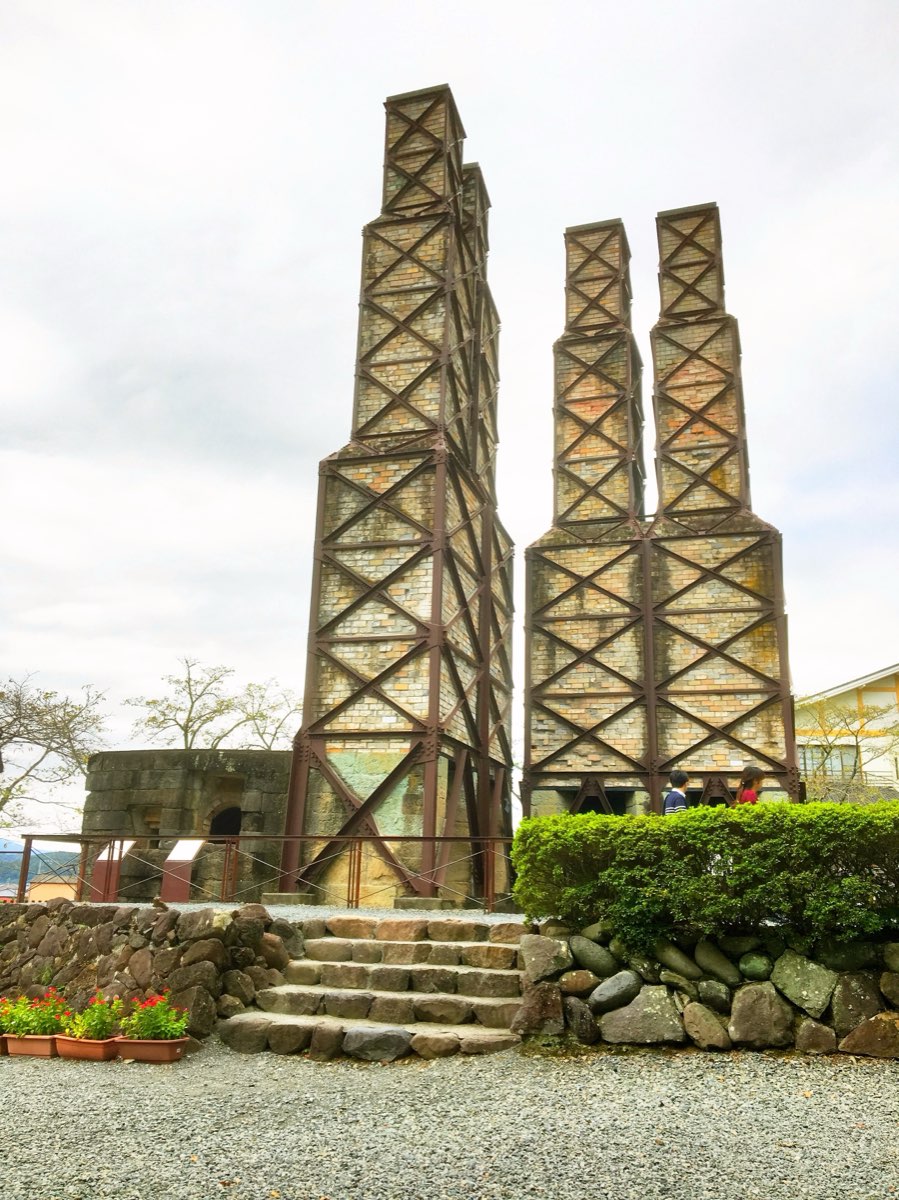
In Izunokuni, a city in the north of the Izu Peninsula in Shizuoka Prefecture, stand the tall brick chimneys of the Nirayama Reverberatory Furnaces. A reverberatory furnace is a furnace for melting metal to cast cannon and other objects.
The project was begun by Egawa Hidetatsu, a shogunate intendant in the last years of the Edo period, and completed in 1857 by his son Hidetoshi. According to Izunokuni City and Shizuoka Prefecture, it is the only reverberatory furnace in Japan that actually operated and still survives.
The intendant of Nirayama
Egawa Hidetatsu, also known by his pen name Tan'an, was born in 1801 (Kyōwa 1) into the Egawa family, who held the post of Nirayama intendant (daikan) for the shogunate by inheritance. He trained under his father from 1824, and in 1835 (Tenpō 6) he became the thirty-sixth head of the family and intendant.
The Nirayama intendant governed lands held directly by the shogunate in the provinces of Izu, Suruga, Sagami, Kai, and Musashi. Izunokuni City's pamphlet notes that in his time foreign ships were arriving one after another, asking for supplies and trade.
In governing, according to the pamphlet, Hidetatsu set an example of frugality and asked the same of his staff. He toured villages to relieve the poor, sent officials to investigate local conditions and sometimes went himself, and set up long-term, low-interest loans for struggling villages.
As a result, the pamphlet says, the people of his lands came to call him "Yonaoshi Egawa Daimyōjin," a title praising him as a deity who would set the world right. A 2026 edition of the city's pamphlet notes that local people still affectionately call him "Tannan-san."
Coastal defense and Western learning
Hidetatsu also took a deep interest in coastal defense. To plan the defense of Edo Bay, he first sought accurate information about foreign countries through scholars of Dutch learning, becoming friends with Hatazaki Kanae, Watanabe Kazan, and Takano Chōei.
The pamphlet suggests that, as he learned more about the West, his conviction that coastal defense was essential probably grew stronger. He proposed to the shogunate a series of policies: Western gunnery, the production of iron cannon, gun batteries built with Western methods of fortification, the creation of a navy, and peasant soldiers with Western training.
The city counts many of his achievements as projects for coastal defense, from spreading Western gunnery and building the Shinagawa batteries to introducing bread. To cast iron cannon, a reverberatory furnace was needed.
How a reverberatory furnace works
According to Izunokuni City, reverberatory furnaces were developed in Europe in the seventeenth and eighteenth centuries. A furnace has a body with a domed inner ceiling and a tall brick chimney.
Fuel such as coal is burned, and the ceiling reflects, or "reverberates," the heat and flames onto the pig iron, concentrating them to reach the well over 1,000 degrees Celsius needed to melt it. This reflecting mechanism gave the furnace its name.
From Shimoda to Nirayama
The shogunate did not decide to build a furnace until Commodore Perry's squadron arrived in 1853 (Kaei 6). The city's pamphlet notes that Hidetatsu had been studying reverberatory furnaces before then, so when the order came he could quickly gather materials and craftsmen.
Izunokuni City says that Hidetatsu, now responsible in practice for the coastal defense of Edo Bay, was ordered to build the furnace alongside the gun batteries in Edo Bay. Building it relying only on descriptions in Dutch books, the city adds, was a very difficult task.
The site first chosen was Hongō village near the port of Shimoda, where foundation work began in the twelfth month of 1853. At the end of the third month of 1854 (Ansei 1), sailors from Perry's squadron, then in Shimoda, entered the construction site.
The site was therefore moved to Naka village, close to the intendant's office at Nirayama. Bricks and stone prepared for Shimoda were carried there and reused, and firebricks able to withstand the high heat were made at Nashimoto village (now the town of Kawazu).
The design followed a Dutch book by Huguenin on casting methods at a royal iron cannon foundry. It consisted of two "twin" units, each with two melting furnaces, set at right angles, so that four furnaces could run at once to cast large guns.
Completion with help from Saga
Work at Nirayama did not go smoothly. Hidetatsu died in the first month of 1855 (Ansei 2), before the furnaces were finished.
His son and successor Hidetoshi asked for help from the Saga domain, which was actively adopting Dutch learning and had built reverberatory furnaces of its own. Engineers and craftsmen from Saga, including Sugitani Yōsuke and Tashiro Magosaburō, arrived in the second month of 1857 (Ansei 4).
In the eleventh month of 1857, three and a half years after construction began, the Nirayama Reverberatory Furnaces were completed. The furnace body has an outer layer of tuff from Izu and an inner lining of firebrick, the chimneys are brick, and the whole stands about 15.7 meters high.
A cannon works
The furnaces were not a single building but part of a cannon factory. Izunokuni City describes a system of workshops beside a river: pig iron from Iwami and Nanbu was melted with coal from Chikugo and Jōban and charcoal from Amagi, and poured into molds.
The cast barrels were then bored out by a water wheel turned by the river, finished in a separate workshop, and test-fired near the furnaces. Excavations at the site have found molds for cannonballs.
According to Izunokuni City, by 1864 (Genji 1) Nirayama had cast Western-style guns including iron 18-pounder cannon and bronze field guns.
According to the World Heritage council for the Meiji industrial sites, it was one of eleven metal-melting furnaces built in Japan in the 1850s from Dutch technical books to cast iron cannon for coastal defense, and it is confirmed to have actually operated. Shizuoka Prefecture notes that of the furnaces built in this period, only those at Hagi and Nirayama keep their original form.
Preserving the furnaces
The furnaces passed to the Army Ministry in 1873 (Meiji 6) and were designated a national Historic Site in 1922 (Taishō 11). The city says they have been preserved for more than 150 years since operations ended, through repeated repairs with the understanding and help of local people.
Iron bands were added to the chimneys in 1908, and steel trusses were fitted outside the chimneys in 1957 and replaced in a major reinforcement from 1985 to 1989.
In 2015 the furnaces were inscribed on the World Heritage List as part of "Sites of Japan's Meiji Industrial Revolution: Iron and Steel, Shipbuilding and Coal Mining," a property of 23 components in eight areas. The World Heritage area at Nirayama covers the furnaces, the sites of the related buildings, and a section of the river.
Visiting today
Visitors begin at the Nirayama Reverberatory Furnace Guidance Center, which opened in 2016 and explains the furnaces' background, operation, and conservation through films and exhibits. Izunokuni City says a visit takes about 45 minutes to an hour, and site guides are available; the city recommends booking one in advance.
The Egawa family residence, home of the hereditary intendants and an Important Cultural Property, is about five minutes away by car, and a joint ticket for both sites is sold. Please check the official websites for opening times and admission before visiting.
Sources
- 韮山反射炉とはIzunokuni City
- 韮山反射炉Shizuoka Prefecture
- 韮山反射炉解説パンフレット(P2・P11:海防政策の革新/反射炉築造への道/江川家住宅)伊豆の国市教育部歴史文化課 (Izunokuni City Education Department, History and Culture Division)
- 韮山反射炉解説パンフレット(P3・P10:韮山反射炉を造った男 江川英龍)伊豆の国市教育部歴史文化課 (Izunokuni City Education Department, History and Culture Division)
- 韮山反射炉解説パンフレット(P4・P9:築造に至る歴史的背景/なぜ「反射炉」と呼ばれるのか)伊豆の国市教育部歴史文化課 (Izunokuni City Education Department, History and Culture Division)
- 韮山反射炉解説パンフレット(P5・P8:築造の経過/韮山反射炉の歴史/ガイダンスセンター)伊豆の国市教育部歴史文化課 (Izunokuni City Education Department, History and Culture Division)
- 韮山反射炉解説パンフレット(P6・P7:大砲製造工場としての産業システム/韮山反射炉の変遷)伊豆の国市教育部歴史文化課 (Izunokuni City Education Department, History and Culture Division)
- 韮山反射炉見学Izunokuni City
- 韮山反射炉(ストーリー&サイト)World Heritage Council for the Sites of Japan's Meiji Industrial Revolution