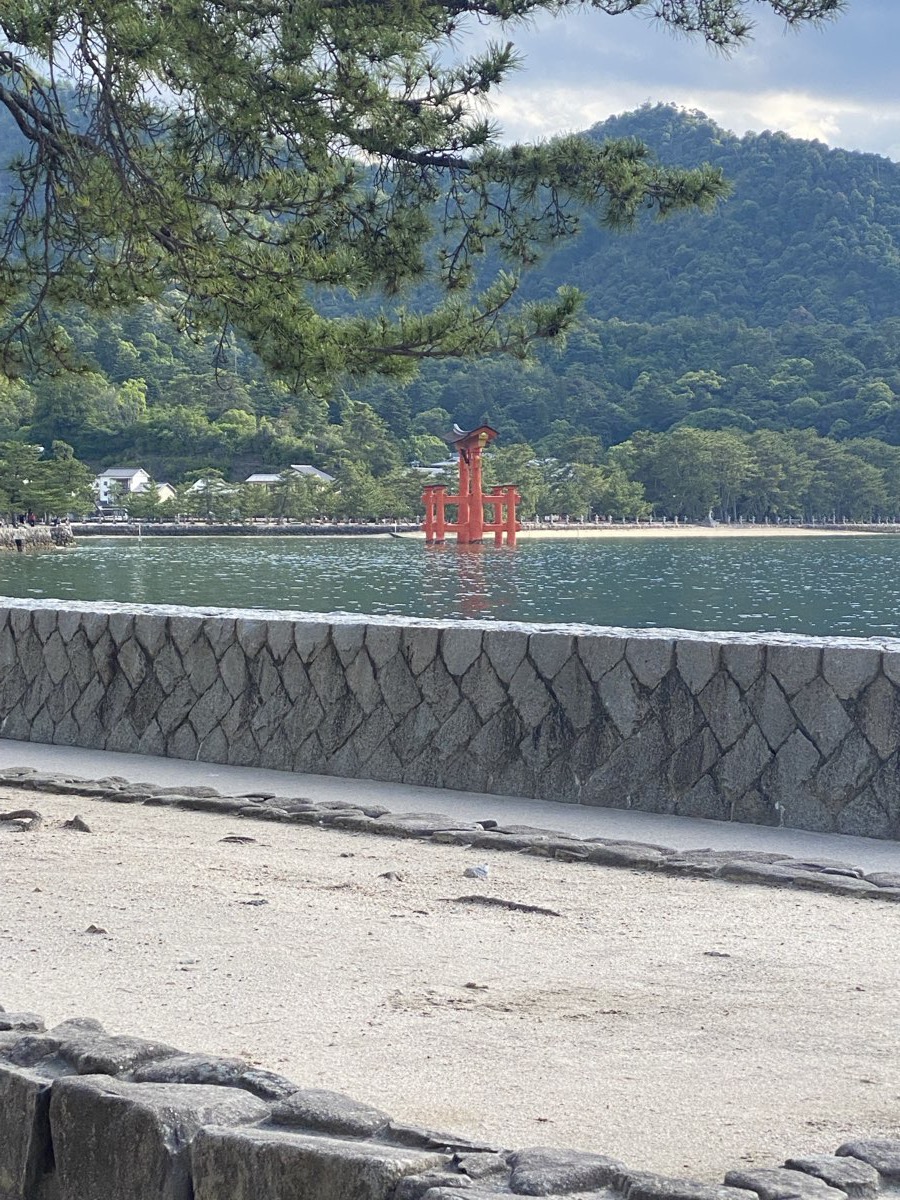
On the island of Itsukushima, better known as Miyajima, in the Seto Inland Sea, a shrine stands in an inlet of the sea with the island's forested mountains behind it. The Agency for Cultural Affairs calls it a shrine rare even in Japan, with rows of wooden buildings standing in the sea itself.
This article looks at the beliefs that drew a shrine to this island, the rebuilding associated with Taira no Kiyomori in the twelfth century, how the halls have been kept standing on the water since, and why the shrine was inscribed on the World Heritage List in 1996.
A sacred island
Itsukushima is an island of about 30 square kilometers. According to the Agency for Cultural Affairs, its highest peak, Mount Misen, about 530 meters above sea level, has long been an object of worship, and the whole island was regarded as sacred.
The Agency thinks that this is why a shrine was built here. Hiroshima Prefecture notes that the name Itsukushima is said to come from the idea of an island where gods are worshipped.
The shrine enshrines three goddesses: Ichikishimahime, Tagorihime and Tagitsuhime. According to the shrine, they have long been revered as deities who protect the imperial house and the nation and guard those who travel by sea.
How old is the shrine?
The shrine's own account gives a founding legend. Saeki no Kuramoto, who governed the island, received a divine message.
Led by a sacred crow, he sailed around the island with the deities and built a shrine at the present site, where the tide flows in and out. The shrine says that, according to tradition, this was in 593, the year Empress Suiko came to the throne.
Interpretations differ
Official heritage records are more cautious. The Agency for Cultural Affairs' database of designated cultural properties states that the founding of the shrine is not clear. The Agency's explanation of the World Heritage property says the shrine was probably founded in the sixth century. The date of 593 is therefore a tradition, and the exact date of the founding cannot be confirmed.
Taira no Kiyomori and the halls on the sea
The layout of the halls goes back to the twelfth century. According to the shrine, Taira no Kiyomori, who became governor of Aki Province, deeply revered the shrine, and in 1168 he rebuilt its halls in a style drawn from shinden-zukuri, the architecture of aristocratic residences of the time. The Agency's database says the halls are said to have been built at the end of the Heian period with Kiyomori's support, and that the present scale of the shrine seems to have been set then.
As Kiyomori rose at court, visitors came not only from the Taira family. The shrine records that the cloistered emperor Go-Shirakawa visited in 1174 and the retired emperor Takakura twice in 1180, and that many members of the imperial family and nobles brought the culture of the capital with them.
The design is complex. The main shrine and the smaller Marōdo shrine each have a main hall followed in a line by an offering hall, a worship hall and a purification hall.
In front of the main shrine lie a wide flat stage over the water and a raised stage. Long corridors, 107 bays in total, wind across the water to link the two shrines.
Fire, rebuilding and a preserved style
Kiyomori's halls did not survive unchanged. The Agency's database records that the shrine burned in 1207 and again in 1223, and that almost all the halls were rebuilt in 1241.
The present buildings are thought to date mostly from that rebuilding, with some older parts. The main hall of the main shrine had a major repair in 1571, and the present corridors were rebuilt between the late Muromachi and Momoyama periods.
Even so, the Agency explains that because the rebuilding was carried out precisely, the buildings keep the style of shrine architecture from the late twelfth to early thirteenth centuries. In its words, the present halls date from the thirteenth century but accurately reflect the twelfth-century style of the shrine built by Kiyomori.
Later rulers kept up their support. According to the shrine, reverence for it continued when the age of the Taira gave way to that of the Minamoto, and it was revered by the Ashikaga shoguns Takauji and Yoshimitsu and, in the Warring States period, by the Ōuchi and Mōri families. The Agency notes that, although the wooden buildings stand in a harsh environment on the sea, the patronage of successive regimes has allowed them to pass on an old style.
Buildings were added around the halls as well. The shrine's five-storey pagoda, a little over 29 meters tall, was built in 1407, and its two-storey Tahōtō pagoda was built in 1523 by a Zen monk.
Today, six buildings are National Treasures, including the main shrine, the Marōdo shrine and the east and west corridors. Eleven buildings and three other structures are Important Cultural Properties, among them the Noh stage, the arched bridge, the two pagodas and the great torii gate that stands in the sea.
Sea, mountain and World Heritage
For centuries the scenery has been part of the shrine's fame. The Agency explains that from around the seventeenth century the island's green forests meeting the shore were praised as one of the "Three Views of Japan", and the shrine notes that the other two are Matsushima and Amanohashidate.
In December 1996 Itsukushima Shrine was inscribed on the World Heritage List. In the same month the Atomic Bomb Dome in Hiroshima City was also inscribed. The property covers 431.2 hectares of the island, including the shrine buildings and the forest centered on Mount Misen.
The Agency's explanation of its value stresses the whole scene: the halls at the center, the sea in front and the mountain behind. This view has been regarded as a standard of Japanese ideas of beauty. The Agency also says the halls show the general tradition of Japanese shrines of worshipping natural features such as mountains, and calls them material evidence of Kiyomori's achievement.
Keeping wooden halls standing on the sea takes constant care. According to the Agency, the shrine, which owns the buildings, employs a qualified engineer for the repair of cultural property buildings, who carries out daily maintenance and plans repairs after damage from typhoons.
When new material is needed, the same kind of material is added using the same techniques after careful study. The shrine itself explains that the corridor floors are laid with gaps between the boards as a measure against high tides.
Places to visit
Itsukushima Shrine is open every day, with opening hours that change through the year; check the shrine's official website before visiting. The route through the halls runs from the entrance along the east corridor, past the Marōdo shrine and the main shrine, and out along the west corridor past the Noh stage. Because of the gaps between the corridor boards, the shrine asks visitors to take care with footwear such as high heels.
The great torii gate stands in the sea. According to the shrine, repair work on the torii, which began in June 2019, was completed in December 2022. Other repair work on the halls may be in progress; the shrine's website lists current work.
The shrine's treasure hall, completed in 1934 opposite the exit of the corridors, displays part of the shrine's treasures. The shrine says it was the first building in Japan made of concrete coated with lacquer so that it would look like a wooden building in harmony with the halls.
The island of Itsukushima itself is a national Special Historic Site and Special Place of Scenic Beauty. According to Hiroshima Prefecture, the primeval forest on the northern slope of Mount Misen, long protected as the shrine's sacred forest, is a national Natural Monument.
Sources
- 御由緒Itsukushima Shrine (official site)
- 厳島神社(世界遺産)Agency for Cultural Affairs (Cultural Heritage Online)
- 厳島神社 詳細解説(PDF)Agency for Cultural Affairs (Cultural Heritage Online)
- 厳島神社 本社祓殿(国指定文化財等データベース)Agency for Cultural Affairs (Cultural Heritage Online)
- 広島県の国指定文化財一覧(PDF)Hiroshima Prefecture
- 原爆ドームはいつ世界遺産に認定されたんですか。Hiroshima City
- 文化財・建造物Itsukushima Shrine (official site, 嚴島神社)
- 拝観施設及び料金Itsukushima Shrine (official site, 嚴島神社)
- 参拝順路Itsukushima Shrine (official site, 嚴島神社)
- 工事状況及び計画Itsukushima Shrine (official site, 嚴島神社)