At 8:15 in the morning on 6 August 1945, an atomic bomb was dropped on Hiroshima. Hiroshima City describes it as the first use of an atomic bomb in human history. Three days later, on 9 August, a second atomic bomb was dropped on Nagasaki.
This article follows that morning, the damage as the city and its museum record it, Hiroshima's rebuilding as a "Peace Memorial City", and how survivors' experiences are now passed on.
A city at war and the morning of 6 August
According to the learning handbook of the Hiroshima Peace Memorial Museum, published by the city, Hiroshima grew from the Meiji era as a "military city", a base for sending troops overseas in the wars with Qing China and Russia.
The handbook explains that in the United States a committee of military officers and scientists studied possible target cities, and that on 2 August 1945 Hiroshima was placed first in order of priority.
The city's account of the morning begins with clear summer weather. A warning sounded at 7:09, but only a single American aircraft passed high overhead, and the warning was lifted at 7:31. People were returning home from shelters, eating a late breakfast or setting off for work.
The bomb exploded 43 seconds after it was released, about 600 meters above the ground. The point directly below, the hypocenter, was Shima Hospital, of which only the round windows and pillars around the entrance remained.
According to the city, the center of the fireball exceeded one million degrees Celsius, and the ground around the hypocenter reached 3,000 to 4,000 degrees. Heat rays and radiation spread in all directions, and the expanding air became a blast of enormous pressure. The three acted together to cause the damage.
Lives lost and a city destroyed
About 350,000 people are thought to have been in Hiroshima that morning. They included residents and soldiers, and people who had come in from nearby towns to commute or because they had been mobilized for building demolition work.
The victims were not only Japanese. Hiroshima City lists Japanese Americans born in the United States, German priests, students from Southeast Asia, people from Korea and Taiwan, then Japanese colonies, people from mainland China, and American prisoners of war.
Interpretations differ
The exact number of people killed by the bomb is still not known. Hiroshima City estimates that about 140,000 people had died by the end of December 1945, when the acute effects of radiation had more or less subsided. Hiroshima Prefecture likewise estimates that people equal to about 40 percent of the city's population had died by the end of 1945. These are estimates, not exact counts.
The city states that at 1.2 kilometers almost half of the people died that day, and that closer in, 80 to 100 percent are estimated to have died.
Almost all buildings within two kilometers were destroyed and burned. According to city statistics from 1946, of 76,327 buildings standing before the bombing, 51,787 were completely destroyed or burned. Hiroshima Prefecture gives about 92 percent of the city's buildings as collapsed or burned.
Radiation set this bomb apart from ordinary bombs. People within about one kilometer of the hypocenter received fatal doses of initial radiation, and many died within days.
Many who seemed uninjured fell ill and died months later. Some who entered the city afterward to search for family or to help the injured also fell ill or died.
Leukemia began to increase two to three years after the bombing and peaked at seven to eight years, and increases in cancer are thought to have begun about five to ten years after. The city notes that the long-term effects of radiation are still not fully understood and that research continues. It also stresses that the bomb took family members, relatives and friends from people and destroyed social life itself.
Rebuilding as a Peace Memorial City
The Nakajima district, between the Motoyasu and Honkawa rivers, had been one of Hiroshima's busiest areas since the Edo period. Close to the hypocenter, it was wiped out in an instant. In 1946 the city's reconstruction plan included a park there.
The city's account says reconstruction moved slowly, partly because of a lack of funds, until 1949. That May the national Diet passed the Hiroshima Peace Memorial City Construction Law, which under the Constitution needed the approval of local voters.
In a referendum on 7 July, 71,852 votes were cast in favor and 6,340 against. The law took effect on 6 August 1949, and the city calls it Japan's first special law.
In the same year a design competition for the Peace Memorial Park drew 145 entries. The design by a group of four led by Tange Kenzō, then an associate professor at the University of Tokyo, won first prize.
The Memorial Cenotaph for the A-bomb Victims, designed by Tange, was unveiled on 6 August 1952, with a register of the names of the dead placed inside. The museum's Main Building was completed on 6 August 1955 and opened that month. In 2006 it became the first postwar building in Japan designated an Important Cultural Property.
The Agency for Cultural Affairs explains that Tange set the park's axis on a line running from Peace Boulevard through the open ground floor of the museum and the arch of the Cenotaph to the Atomic Bomb Dome, linking sight with the act of mourning. The central area of the park became a national Place of Scenic Beauty in 2007.
The Atomic Bomb Dome
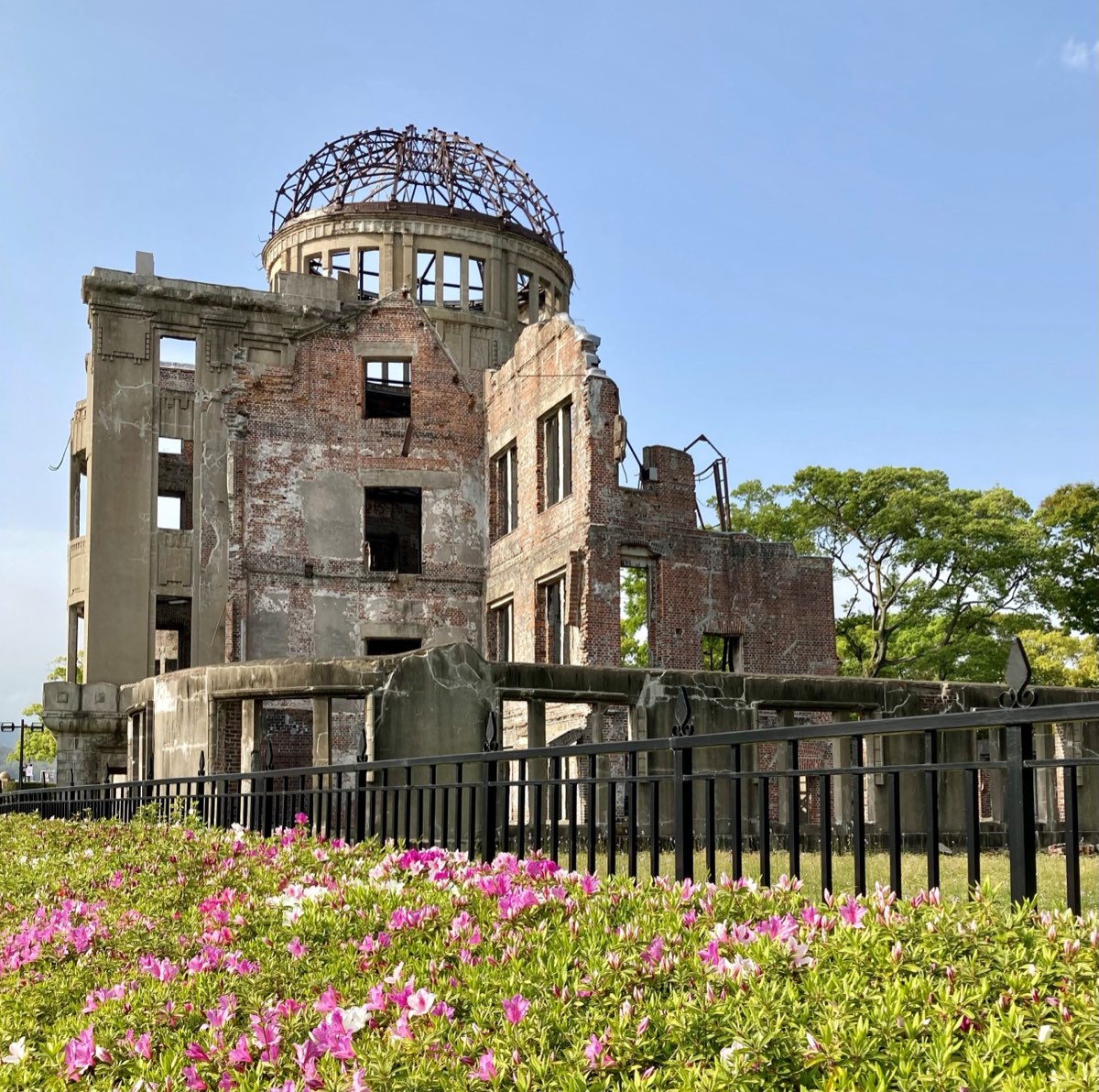
The building now called the Atomic Bomb Dome opened in 1915 as the Hiroshima Prefectural Commercial Exhibition Hall, designed by the Czech architect Jan Letzel. By 1945 it was called the Hiroshima Prefectural Industrial Promotion Hall, and its work had ended in March 1944.
The building stood about 160 meters northwest of the hypocenter. It was heavily damaged and burned out, and all of the roughly 30 staff inside died instantly.
Because the blast came from almost directly above, the central part of the dome is thought to have escaped collapse. The name "Atomic Bomb Dome" is said to have arisen naturally among the people of Hiroshima.
As cracks spread and pieces fell, the ruin was fenced off in 1962. In 1966 the city council resolved to preserve it, and the first preservation work in 1967 was paid for entirely by donations. Further works followed, most recently from 2020 to 2021.
The Dome was inscribed on the World Heritage List in December 1996. Hiroshima City describes it as a monument that conveys the devastation of the first nuclear weapon used in human history.
In the same month, Itsukushima Shrine, also in Hiroshima Prefecture, was inscribed as well. The Dome became a Special Historic Site in 2025.
Passing on the survivors' memories
As the hibakusha, the survivors of the bombing, grow older, fewer of them are able to speak about their experiences. In fiscal 2012 Hiroshima City began training "A-bomb legacy successors", who take on the experiences and wishes for peace of survivors and pass them on.
Training takes about two years. Trainees attend lectures on the reality of the bombing and on speaking, receive a survivor's experiences directly, write a script and practice giving the talk.
From fiscal 2022 the city also began training "family successors", who pass on the experiences of survivors in their own families. The first seven were appointed in April 2023. As of 1 April 2026, 264 successors and 48 family successors were active.
At the Peace Memorial Museum, successors give talks of about 45 minutes every day the museum is open, including a session in English; no reservation is needed and the talks are free. The Hiroshima National Peace Memorial Hall for the Atomic Bomb Victims sends survivors and successors free of charge to schools and local governments across Japan.
Places to visit
The Hiroshima Peace Memorial Museum stands in the Peace Memorial Park, and its Main Building reopened after renewal in April 2019. Check the museum's official website for opening hours and for the times of the successors' talks.
The Atomic Bomb Dome stands at the end of the park's axis. Entry inside has been prohibited since 1962, and it is seen from outside its fence.
The Hiroshima National Peace Memorial Hall for the Atomic Bomb Victims, also in Nakajima-chō, registers the names and photographs of those who died and collects survivors' memoirs. Check its official website before visiting.
Sources
- 原爆被害の概要Hiroshima City
- 死者数Hiroshima City
- 広島平和記念資料館 学習ハンドブック 原爆被害の実相Hiroshima City (Hiroshima Peace Memorial Museum)
- 広島の原爆と復興についてHiroshima Prefecture (Hiroshima for Global Peace)
- 広島平和記念資料館 学習ハンドブック なぜ原爆が投下されたか?Hiroshima City (Hiroshima Peace Memorial Museum learning handbook)
- 建物の被害Hiroshima City (広島市 市民局国際平和推進部 平和推進課)
- 放射線による被害Hiroshima City (広島市 市民局国際平和推進部 平和推進課)
- 後障害Hiroshima City (広島市 市民局国際平和推進部 平和推進課)
- Web展示会「平和記念公園ができるまで」Hiroshima City
- 平和記念公園Agency for Cultural Affairs (Cultural Heritage Online)
- Web展示会「復興の礎として 平和記念都市建設法と広島」全国初の住民投票と特別法制定Hiroshima City
- 広島の歴史Hiroshima City
- 施設概要Hiroshima Peace Memorial Museum (広島平和記念資料館)
- 原爆ドーム(世界遺産)Agency for Cultural Affairs (Cultural Heritage Online)
- 広島県の国指定文化財一覧(PDF)Hiroshima Prefecture
- 原爆ドームの保存工事について教えてほしい(FAQID-5593)Hiroshima City
- 原爆ドームはいつ世界遺産に認定されたんですか。Hiroshima City
- 厳島神社(世界遺産)Agency for Cultural Affairs (Cultural Heritage Online)
- 被爆体験伝承者養成事業Hiroshima City
- 「伝承者」の存在Hiroshima Prefecture (Hiroshima for Global Peace)
- 【毎日実施】被爆体験伝承講話/家族伝承講話 定時開催Hiroshima Peace Memorial Museum (広島平和記念資料館)
- 被爆体験伝承者などの派遣Hiroshima National Peace Memorial Hall for the Atomic Bomb Victims
- 国立広島原爆死没者追悼平和祈念館 トップページHiroshima National Peace Memorial Hall for the Atomic Bomb Victims (国立広島原爆死没者追悼平和祈念館)