Early in the morning of the 2nd day of the 6th month of Tenshō 10 (1582, lunar calendar), the troops of Akechi Mitsuhide attacked Honnō-ji, a temple in Kyoto where his lord Oda Nobunaga was staying. Nobunaga took his own life as the temple burned. The same day, his eldest son and heir, Nobutada, also died in Kyoto.
The date follows Japan's old lunisolar calendar. Japan only switched to the Gregorian calendar in 1873, so the 6th month of 1582 should not be read as June. This article sets out what the records show, what has been found in the ground, and why Mitsuhide's motive is still debated.
Nobunaga, Kyoto and the spring of 1582
Nobunaga came to Kyoto from Gifu in the 9th month of 1568, bringing with him Ashikaga Yoshiaki, who became the fifteenth Muromachi shogun. According to Kyoto City, Nobunaga built a castle for Yoshiaki in the city. When the two men later became enemies, the castle was pulled down and its materials were taken to Nobunaga's new castle at Azuchi.
By 1582 Nobunaga was, in the words of the Kyoto City Archaeological Museum, pressing on toward unifying the country. A chronology prepared by the museum shows him returning to Azuchi from a campaign in Kai Province on the 21st day of the 4th month.
On the 15th of the 5th month, Mitsuhide was ordered to entertain Tokugawa Ieyasu at Azuchi. Two days later Nobunaga decided to lead a campaign against the Mōri family in western Japan, and Mitsuhide went back to his castle at Sakamoto to prepare.
At the same time, a war in Shikoku was planned. On the 7th day of the 5th month, Nobunaga named his third son, Nobutaka, as commander of an expedition there. When the incident took place, Nobutaka was in Ōsaka with that army.
Mitsuhide moved to Kameyama Castle, in today's Kameoka, on the 26th. Nobunaga arrived in Kyoto on the 29th and lodged at Honnō-ji, where he held a tea gathering on the 1st day of the 6th month.
The night march and the attack
Late on the night of the 1st, Mitsuhide's army left Kameyama Castle. Kameoka City puts its strength at 13,000; one researcher gives a range of 13,000 to 20,000. The army crossed the Oinosaka pass toward Kyoto.
Tradition says that before dawn, at the Katsura River, Mitsuhide told his men that "the enemy is at Honnō-ji." Kameoka City presents this as something that "is said," not as a recorded fact.
Interpretations differ
A few days before, Mitsuhide had held a linked-verse (renga) gathering at Mount Atago - on the 28th of the 5th month according to Kameoka City, on the 27th according to the Kyoto City Archaeological Museum. His opening verse has often been read as a hidden statement of his plan. Kameoka City notes, however, that another record of the gathering gives the verse with different wording. Kameoka City also suggests that the famous reading may have been created by later rulers who wanted to cast Mitsuhide as a villain.
On the 2nd, Mitsuhide's forces attacked Honnō-ji. Nobunaga died there.
They then attacked the Nijō new palace, a former residence of the Nijō noble family that Nobunaga had acquired and later presented to Crown Prince Sanehito. After the prince left, Nobutada and his guards fought there and died.
The temple and what lies beneath
The Honnō-ji of 1582 did not stand where the temple stands today. Kyoto City's historical marker record places its precinct between Rokkaku Street to the north, Takoyakushi to the south, Nishinotōin to the east and Aburanokōji to the west. The Kyoto City Archaeological Museum describes the precinct as about 120 metres square.
Excavations have given the written records a physical form. Archaeologists found a moat lined with a stone wall inside the precinct, and roof tiles bearing the character 能 (nō) from the temple's name. They also found tiles turned red by heat and burnt wall plaster from the late sixteenth century.
Excavators also found a levelling layer of the late sixteenth century, which the museum identifies as ground levelled after the incident. The museum stresses that much about the layout is still unknown, and that testing the accounts of the incident against the ground still has a long way to go.
After the attack
Documents kept in Kyoto show how people reacted to the sudden change of power. Temples and towns asked the armies for written prohibitions (kinsei); the texts were prepared in advance, and the name of the place that asked was added. According to the Kyoto Institute, Library and Archives, Mitsuhide issued such prohibitions to Ōyamazaki on the 3rd.
He issued them to Kamigamo and Kibune on the 7th and to Daitoku-ji on the 9th. Nobutaka in turn issued his own to Tō-ji and other temples; the one for Tō-ji forbade soldiers to commit violence, to camp in the grounds and to cut the crops in the fields.
Within a few days Mitsuhide had entered Nobunaga's castle at Azuchi. His hold did not last.
On the 13th of the 6th month, at Yamazaki on the border of Yamashiro and Settsu provinces, the side of Nobutaka, including the army of Hashiba (later Toyotomi) Hideyoshi, defeated Mitsuhide. Mitsuhide was killed that night at Ogurusu while fleeing.
Kyoto City's chronology states that Hideyoshi rose to prominence as a result. In the 6th month of the following year he moved into Ōsaka Castle.
Mitsuhide's senior retainer, Saitō Toshimitsu, was captured and paraded through Kyoto on the 17th. Courtiers wrote in their diaries that he had been a leading figure in the plot.
Why did Mitsuhide do it?
Interpretations differ
No one can say for certain why Mitsuhide turned on his lord. A study published by Kyoto Sangyo University notes that explanations have multiplied from the Edo period to today, including popular theories with no basis in reliable documents. A chart from a Fukuchiyama promotion council lists about fifty theories as arranged by one researcher. The Kyoto City Tourism Association, too, notes that much about Mitsuhide's origins and the end of his life is still unclear.
Interpretations differ
For a long time the most familiar answer was a personal grudge: Mitsuhide, it was said, could no longer bear Nobunaga's harsh treatment. The Kyoto Sangyo study explains that this view spread in the Edo period through war tales, and remained dominant into the Meiji period. The Fukuchiyama chart still describes it as the commonly held view, while pointing out that most of the stories of Nobunaga humiliating Mitsuhide come from writings of the Edo period, long after the event.
Interpretations differ
Other explanations include personal ambition, which Tokutomi Sohō put forward in the Taishō period. There are also theories that someone else stood behind Mitsuhide, such as the imperial court, the former shogun Yoshiaki, Hideyoshi, Ieyasu, Sakai merchants or the Jesuits. These appear in the chart as theories.
Interpretations differ
The Kyoto Sangyo study also discusses the so-called Shikoku theory. In this view, Nobunaga's changing policy toward Chōsokabe Motochika, the ruler of Tosa in Shikoku, left Mitsuhide, who had handled relations with Motochika, in a difficult position. Like the other theories, it remains an interpretation, not a settled fact.
Places to visit
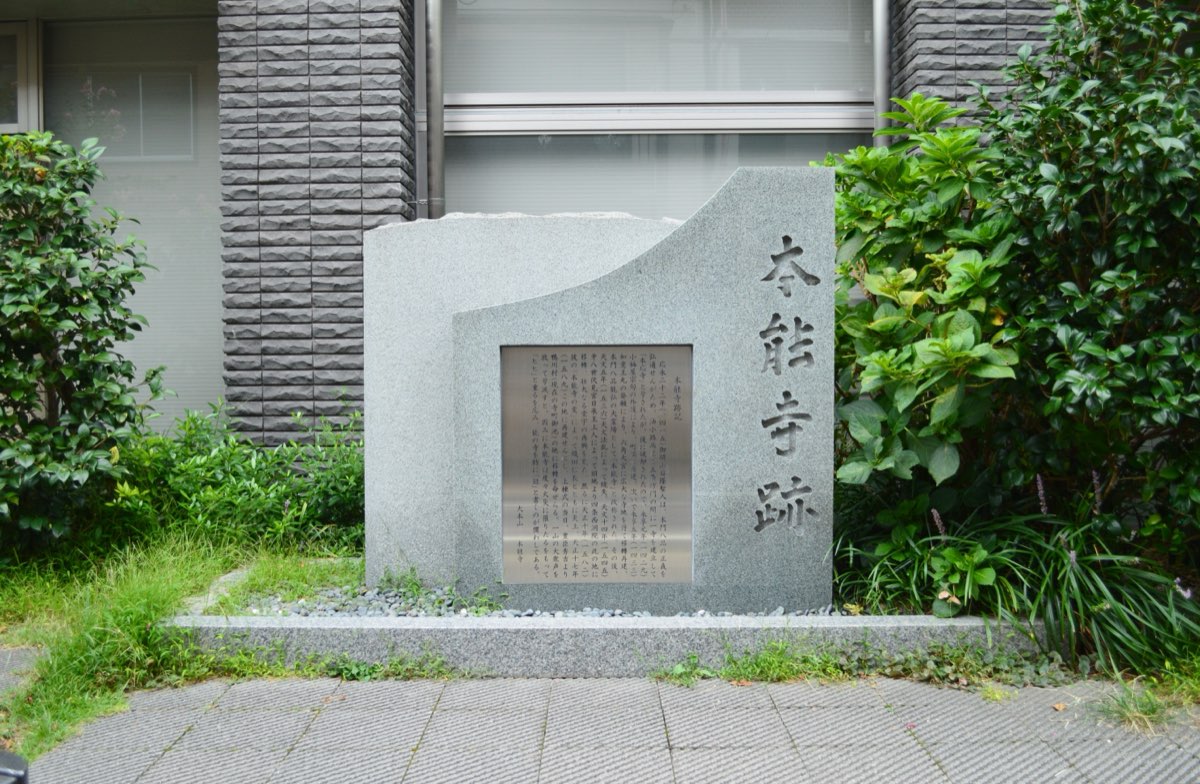
The site of the 1582 temple is marked by a stone at Aburanokōji-dōri Takoyakushi-sagaru, on the east side of the street in Nakagyō Ward. The stone was set up in 1994 by Honnō-ji. Its plaque tells the temple's own account of its many moves.
Today's Honnō-ji stands at Teramachi-dōri Oike-sagaru. It was moved there on Hideyoshi's orders, but sources give different years for the move: 1589 according to the Kyoto City Tourism Association, 1591 according to the Kyoto City Archaeological Museum, and 1592 according to the temple. The temple burned again in the Edo period, and its present main hall was rebuilt in 1928.
The temple keeps a memorial to Nobunaga that it says was built on the orders of his son Nobutaka. Its treasure hall, the Daihōden, shows tea utensils and letters that the temple says belonged to Nobunaga.
It also shows a bronze incense burner called the "Three-legged Frog," which, according to legend, cried out on the night before the attack. Check the temple's official website for opening hours and exhibition changes before you visit.
Sources
- 明智光秀と「本能寺の変」(第312回京都市考古資料館文化財講座・アスニー京都学講座 資料)Kyoto City Archaeological Museum / Kyoto City Archaeological Research Institute (京都市考古資料館・京都市埋蔵文化財研究所)
- 本能寺跡Kyoto City
- 京都の歴史年表―都市のすがたKyoto City
- 東寺の禁制Kyoto Institute, Library and Archives
- 旧二条城跡の発掘調査(京都市内の埋蔵文化財 発掘調査速報 No.002)Kyoto City (京都市 文化市民局 文化芸術都市推進室 文化財保護課)
- History2 歴史上最大の下克上「本能寺の変」とはKameoka City
- 本能寺の変の再検証―先行研究の成果と『石谷家文書』から判明した史実の結合Institute of Japanese Culture, Kyoto Sangyo University
- Calendar History 2 — The Japanese CalendarNational Diet Library
- 明智光秀は、なぜ本能寺で主君・織田信長を討ったのか?(本能寺の変の真相をめぐる諸説)福知山光秀プロジェクト推進協議会 (Fukuchiyama Mitsuhide Project Promotion Council; hosted on the Fukuchiyama City website)
- 明智光秀 京都・ゆかりの地をめぐる京都市観光協会 (Kyoto City Tourism Association)
- 本能寺について法華宗大本山 本能寺 (Honnōji Temple)
- 境内のご案内法華宗大本山 本能寺 (Honnōji Temple)