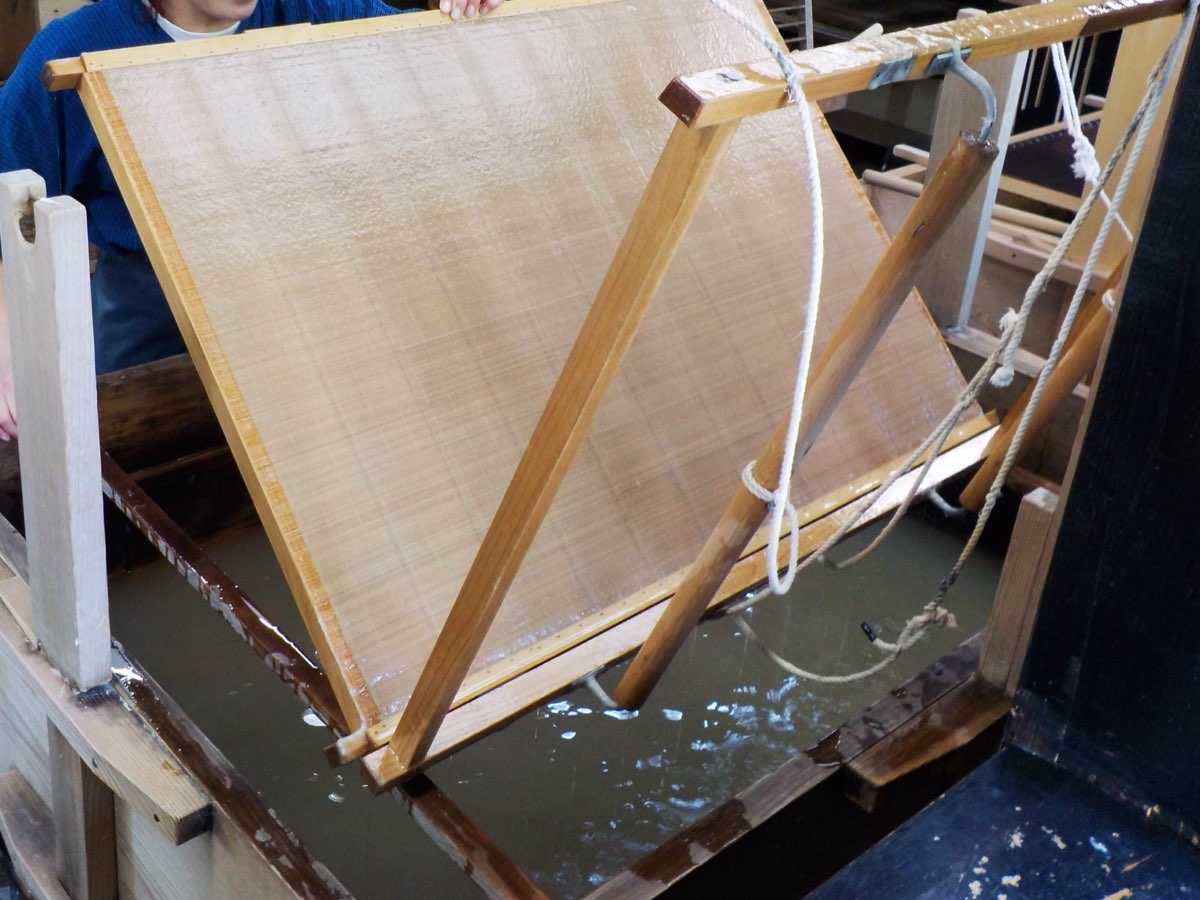
In the hills east of the Takefu basin, in today's Echizen City, Fukui Prefecture, five villages have made paper by hand for centuries. Together they are called Goka, "the five places": Oizu, Ōtaki, Iwamoto, Shinzaike and Sadatomo. According to the Fukui prefectural history, the Echizen paper made mainly in these villages has been highly valued from the late medieval period to the present.
This article follows Echizen paper from a local legend, through medieval documents and Edo-period paper money, to the techniques that are protected today.
A princess at the head of the river
Echizen City tells a legend about how papermaking began. About 1,500 years ago, it is said, a beautiful princess appeared upstream on the Okamoto River. She told the villagers that the land was blessed with clear water, so they should make their living by making paper, and she carefully taught them how.
When the villagers asked her name, she answered only that she lived upstream on the Okamoto River, and vanished. The people revered her as Kawakami Gozen, "the lady of the upper river," and built Okamoto Shrine to worship her. The city adds that they have passed on her teaching to this day.
This is a legend, not a dated historical record. The written evidence for paper in Echizen begins later and grows step by step.
Paper in ancient and medieval Echizen
Paper was part of the ancient state's tax system. According to the Fukui prefectural history, the Engishiki regulations required both Echizen and Wakasa to send paper as a tax, and to send kama, a fiber plant used for paper, as an annual tribute.
Echizen City notes that a tax account of Echizen Province kept in the Shōsōin is the oldest surviving paper made in Echizen. The city also suggests that demand for paper grew as temples were built across Japan and copied Buddhist sutras.
Papermakers appear in later records too. A document list from the late Heian period mentions paper workers attached to the provincial government, and in the early Kamakura period a papermaker lived on an estate in Wakasa.
The prefectural history identifies the first certain mention of Echizen paper in an old document as an account from 1460. Under it, villagers of Kōno-ura who visited the provincial shrine at Fuchū for the New Year received "Ōtaki paper" from its chief priest every other year.
That paper had been specially finished for writing. The prefectural history takes this to show that the production of high-grade paper centered on Ōtaki was already established by then.
Soon afterward, in the Bunmei era (1469–1487), nobles and monks in Kyoto and Nara began to take notice of Echizen as a source of the finest papers made from gampi, a shrub of the daphne family, such as torinoko, usuyō and uchigumori.
The prefectural history thinks that this rise rested on the stable rule of the Asakura family in Echizen and on the improving skills of the papermakers. A high-grade paper made from kōzo (paper mulberry), later famous as Echizen hōsho, appears as "hōsho paper" in a diary entry from the first month of 1573, and the history concludes that early modern papermaking techniques were established by about that time.
Hōsho and the Mitamura family
Hōsho was originally the name of a type of document issued by a retainer on his lord's behalf, and it also came to mean the official paper used for such documents. According to the Agency for Cultural Affairs, many domains made hōsho in the Edo period, but Echizen hōsho was rated the best in Japan.
In the late sixteenth century, a man called Ōtaki Kamon of Ōtaki Shrine was treated as the head of the papermakers and ordered to supply hōsho. The prefectural history names him as the founder of the Mitamura family's paper business.
In 1601 Yūki Hideyasu confirmed the Mitamura family's position as hōsho makers. From then on, the family was at the center of papermaking in Goka. According to the Agency for Cultural Affairs, from the beginning of the early modern period the Mitamura monopolized the rights and status involved in making and selling the paper.
Echizen City sums up this period by saying that Echizen developed as a producer of top-quality papers such as Echizen hōsho under the protection of the shogunate and the local lords.
Paper for money
Echizen paper was also used for money. According to the Fukui Prefectural Archives, the Fukui domain, facing financial difficulty, issued its own paper notes in the eighth month of 1661. The archives call this an early example of domain notes used to support domain finances.
The notes were later stopped, then issued again from 1730 until the end of the Edo period. The paper for them was made at Goka, under strict control, much like modern banknote paper.
Interpretations differ
An exhibition panel at the Fukui Prefectural Archives describes a dispute between the papermakers and the domain, recorded in the documents of the Katō Kawachi family.
Interpretations differ
When the price of hōsho fell sharply in the political and economic turmoil at the end of the Edo period, the Goka papermakers asked to suspend work. Domain officials, including Mitsuoka Hachirō, later known as Yuri Kimimasa, took offense at a mention of foreign ships in the petition.
Interpretations differ
They confiscated the papermakers' right to work and their tools (screens and frames), and ordered 500 households in Goka to be shut in and confined. Work was allowed again only in exchange for harsh penalties, such as jailing those involved, and the jailing and confinement were lifted after three people a day from the villages had gone to Fukui for about two months to apologize.
Interpretations differ
The archives date this incident to 1863, based on a record of domain officials' careers. A history of Imadate Town places it in 1864.
In 1868, five years later by the archives' dating, the new Meiji government issued Dajōkan notes on a proposal by the same Mitsuoka. Goka paper was designated for them, and with large orders Goka prospered.
A craft protected today
According to the Agency for Cultural Affairs, the traditional pure-kōzo Echizen hōsho, called kizuki hōsho, became rare after the Meiji era. Its advanced techniques were nevertheless passed on, answering new demand such as attempts to revive ukiyo-e woodblock printing.
The Agency lists the features of the technique: hand beating of the fibers, careful preparation of the raw material in a process called kamidashi, the traditional addition of white clay, slow forming of the sheets, and drying on boards. According to the Agency, the paper's main use today is for printmaking, and also for calligraphy and painting, for wiping Japanese swords, and for letter rolls.
In 2000 the technique of making Echizen hōsho was designated an Important Intangible Cultural Property. Echizen City adds that Echizen paper won strong support from many artists, beginning with Yokoyama Taikan.
Echizen torinoko-gami, a gampi paper, followed in 2017. According to the Agency, torinoko writing paper was already made in Echizen in the Muromachi period. Large maniai paper, over three shaku wide, was made from the eighteenth century, and paper for fusuma sliding doors flourished from the Meiji era.
According to the Kagakushū of 1444, the name torinoko comes from a color like that of an eggshell. The makers use the white inner bark of gampi with neri, a mucilage from the root of tororoaoi or the bark of noriutsugi, form the sheets on a bamboo screen, and dry them on boards such as ginkgo.
On 11 December 2025, UNESCO's intergovernmental committee decided to inscribe an extended "Washi, craftsmanship of traditional Japanese hand-made paper" on the Representative List of the Intangible Cultural Heritage of Humanity, and, according to the Agency, Echizen torinoko-gami was added as a new element. In the Agency's provisional translation of the decision, the committee called Echizen torinoko-gami a good example of the interdependence of safeguarding and sustainable development, noting that hand-made washi is made without over-harvesting plants. It also noted the role of women, who make up most of the newly added community.
On its website, last updated in 2023, Echizen City describes Echizen as the number one washi-producing area in Japan in quality, variety and quantity.
Visiting Goka
As of 2026, Echizen City lists three facilities in the papermaking area. The Paper and Culture Museum introduces the history of Echizen washi, the Udatsu Paper and Craft Museum lets visitors watch papermakers at work, and at the Papyrus House visitors can try making paper themselves. Check the official websites for opening hours before visiting.
Sources
- 越前和紙の歴史Fukui Prefectural Archives
- 越前和紙Echizen City
- 越前奉書Agency for Cultural Affairs (Cultural Heritage Online)
- 越前鳥の子紙Agency for Cultural Affairs (Cultural Heritage Online)
- 「和紙:日本の手漉和紙技術」「山・鉾・屋台行事」「伝統建築工匠の技:木造建造物を受け継ぐための伝統技術」の拡張提案に係るユネスコ無形文化遺産代表一覧表登録Agency for Cultural Affairs
- 三田村氏庭園Agency for Cultural Affairs (Cultural Heritage Online)
- 福井の藩札(学校向けアーカイブズガイド)Fukui Prefectural Archives
- 三岡八郎(由利公正)と今立五箇の「浅からぬ縁」Fukui Prefectural Archives