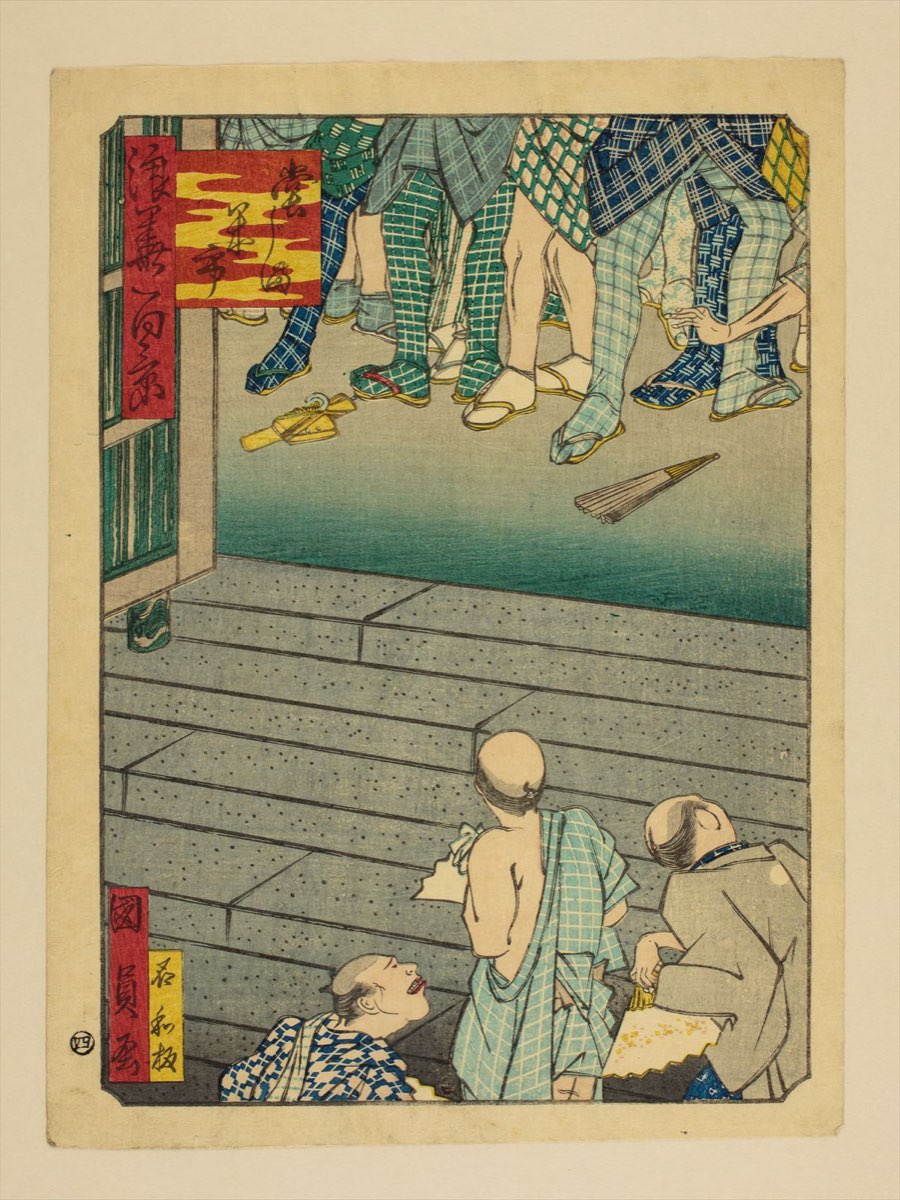
In Edo-period Japan, rice was not only food. Domain lords collected it as tax, and much of it was shipped to Osaka and other large cities to be sold. At Dōjima, on the north bank of the Dōjima River, merchants bought and sold paper claims to that rice, and the price they set there became the standard for rice markets across the country.
Osaka City describes the Dōjima Rice Market as the origin of exchanges in Japan and as widely known for being a forerunner of organized futures exchanges in the world. This article follows how the market came about, how its trading worked, why researchers are careful with the word "futures," and what can be seen at the site today.
Osaka, the hub of a nationwide market
The National Diet Library explains why Osaka grew into a commercial center. It was a castle town ruled directly by the shogunate, and it had excellent water transport: the Seto Inland Sea in front, and the Yodo and Yamato rivers behind, linking it to Kyoto and Yamato.
From around the Kanbun era (1661–1673), the western sea route brought ships from the Sea of Japan coast, via Shimonoseki, into the Inland Sea and on to Osaka. Together with shipping between Osaka and Edo, this put the city at the hub of a nationwide market. The library names three great markets of early modern Osaka: the Dōjima rice market, the Tenma vegetable market and the Zakoba fish market.
Rice was at the center of this system. According to the library, domain lords sold the rice they did not consume and bought goods with the money, which helped markets and the money economy to grow. The markets where lords sold their rice were concentrated in Osaka, and Osaka's rice price became the standard for the whole country.
Warehouse estates and rice certificates
To sell their rice, many domains set up warehouse estates, called kurayashiki, on and around Nakanoshima in Osaka. The Osaka Museum of History says that they sold tax rice and regional products there and that, around 1840, there were more than 120 of them.
The museum describes these estates as supporting domain finances and as a driving force in Osaka's growth, including the birth of the Dōjima rice market. Excavations have shown that they took many forms. Some, such as those of the Saga, Hiroshima and Takamatsu domains, had boat docks, storehouses and residences; that of the Akita Yashima domain had no dock and was filled with storehouses.
The sale worked through paper certificates. According to the Japan Exchange Group, domains sold the tax rice in their warehouses to rice brokers by bidding. Each successful bidder received rice certificates (kome kitte), each one a promise to hand over 10 koku of rice.
These certificates did not always stand for rice already in the warehouse. Some covered rice that had not yet arrived, or rice from future harvests. The certificates themselves came to be actively bought and sold.
From a street market to an officially recognized market
The trading began elsewhere. Osaka City explains that in the early Edo period, rice brought from many regions was traded on the street at Kitahama, along the Tosabori River. Because the wealthy merchant Yodoya was at its center, it was also known as "Yodoya's rice market."
Around Genroku 10 (1697), the market moved to Dōjima. Osaka City gives two reasons: the street trading obstructed traffic, and the move helped to promote Dōjima Shinchi, a newly developed district. The National Diet Library notes that this district was laid out after Kawamura Zuiken's work on the Dōjima River.
Trading in certificates was not always allowed. The National Diet Library says the shogunate had banned it. Then, in the first year of Kyōhō (1716), when the price of rice fell, it permitted certificate trading as a measure to raise prices.
In Kyōhō 15 (1730), the shogunate officially recognized two kinds of trading at Dōjima. Shōmai trading was the buying and selling of rice certificates.
Chōaimai trading was the buying and selling, on the books, of representative brands of rice. The Japan Exchange Group says the eighth shogun, Tokugawa Yoshimune, known as the "rice shogun," recognized the market to raise rice prices.
The economic historians Takatsuki Yasuo and Kamihigashi Takashi describe the steps in more detail. In 1730 the shogunate left trading at Dōjima free, and over the next two years it organized the Dōjima rice brokers into a licensed guild. With that, Dōjima became a formally recognized market.
How the trading worked
The Japan Exchange Group says the Dōjima market had a membership system and clearing functions that connect it to modern exchanges. In a 2012 speech, Bank of Japan Governor Shirakawa Masaaki said that rice trading at Dōjima in the early eighteenth century came with a system of margining and cash settlement.
Shirakawa added that the price of rice was set through day-to-day trading there. The trading houses around the market provided financial services to the warrior class, whose income came mainly from rice.
The trading did not happen in a grand hall. It took place on the street in front of the market office.
The Japan Exchange Group notes that water was scattered to drive away people who lingered after official trading ended. An Osaka map of 1806 marks the "rice market" on the north bank of the Dōjima River.
What happened at Dōjima did not stay in Osaka. Rice prices formed there were carried by couriers and by flag signals to Edo and to major regional cities, and became the standard for rice markets in each area.
According to the Japan Exchange Group's chronology, the market reached its peak in 1811. In that year, outstanding rice certificates in the market came to more than 3.56 million bales.
Was it a futures market?
Dōjima is often introduced as an early futures market, but researchers use the word with care. Takatsuki and Kamihigashi point out that people in the Edo period did not call their trading "futures." They called it chōaimai akinai or nobe baibai, and as far as the two authors know, the Japanese word for futures, sakimono, was not used in the Edo period.
The same authors note that chōaimai, in principle, did not involve trading rice itself, so it was not commodity futures trading. They see it as close to modern index futures. They also say that it is not wrong to call its mature form, from the mid-eighteenth century on, futures trading.
Interpretations differ
Why chōaimai was created is a matter of interpretation. Takatsuki and Kamihigashi conclude that it was devised as a means of speculation, and that some roles generally expected of futures were discovered "after the fact." They find little evidence that functions such as price discovery were expected when it was devised, in the late seventeenth to early eighteenth century, although people in the middle and later Edo period were aware of them.
Interpretations differ
Whether Dōjima was the world's first organized futures exchange is also open. Governor Shirakawa said Japan was "probably" home to the first. Takatsuki and Kamihigashi note that it is hard to establish strictly that it was first, and that writers differ on what counts as "organized." Osaka City and the Japan Exchange Group's Japanese page call it a forerunner.
After the Edo period
The market did not survive the end of the shogunate unchanged. In 1869 the new Meiji government banned trading at Dōjima, which the Japan Exchange Group says was seen as a cause of rising rice prices. In 1871 trading was revived as the Dōjima Kome Kaisho.
It was reorganized several times and became the Osaka Dōjima Rice Exchange. In 1939 it was abolished under the Rice Distribution Control Law. The Japan Exchange Group says that many of the trading rules and practices developed at Dōjima were passed on to the commodity, securities and financial futures exchanges of later times.
Places to visit
Osaka City includes the marker for the Dōjima Rice Market site on its historical walking routes. It stands at Dōjimahama 1-chōme 3, Kita-ku, at the northeast end of Nakanoshima Garden Bridge.
The Japan Exchange Group says there are two monuments at the site today. One is "A Grain of Light," designed by the architect Andō Tadao in 2018.
The other is "Children Delighted by Rice," a sculpture by Yokoe Yoshizumi from 1955. For directions and current information, please check the official websites of Osaka City and the Japan Exchange Group before you visit.
Sources
- 大阪の市場National Diet Library
- 発掘!大名たちの蔵屋敷-「天下の台所」に集う米・物・人- 開催告知Osaka City Museum Organization / Osaka Museum of History
- 18.堂島米市場(どうじまこめいちば)跡碑Osaka City
- 堂島米市場 — 世界における先物取引所の先駆けJapan Exchange Group
- Issues Facing the Futures Markets and the IndustryBank of Japan
- 投機かリスクヘッジか─堂島米市場再考─Osaka University of Economics Institute of Economic History / J-STAGE