Arita Town describes its porcelain as hard and durable, a translucent white ware painted with indigo and with bright colors such as red, yellow and gold. According to the Kyushu Ceramic Museum of Saga Prefecture, Japan's own porcelain was born in the Arita area at the start of the Edo period. It began by copying Chinese porcelain, using techniques brought from the Korean Peninsula, and developed as a production center with the help of good porcelain stone and the protection and control of the Saga domain.
By the mid-seventeenth century, Arita porcelain was being shipped to Europe. This article follows its story from the potters brought from the Korean Peninsula to the export trade, and then to the places in Arita where that history can still be seen.
Potters from the Korean Peninsula
A curator of the Kyushu Ceramic Museum explains that from around the Azuchi-Momoyama period, when the tea ceremony became fashionable, ceramics imported from China and the Korean Peninsula were popular in Japan.
At the end of the sixteenth century, during Toyotomi Hideyoshi's invasions of Korea, known in Japan as the Bunroku and Keichō campaigns, the lords of Hizen Province brought potters from the Korean Peninsula back to Japan. According to the curator, this raised interest across Hizen in making ceramics with overseas techniques. Arita Town likewise traces its history as a pottery town back to these invasions and to potters brought from the Korean Peninsula.
Hizen was already producing Karatsu ware a little before the invasions. Karatsu ware is stoneware, made from clay that is easy to find. Porcelain needs a different raw material, porcelain stone, and until then no place had been found where it could be mined in steady quantities.
Porcelain stone at Izumiyama
Interpretations differ
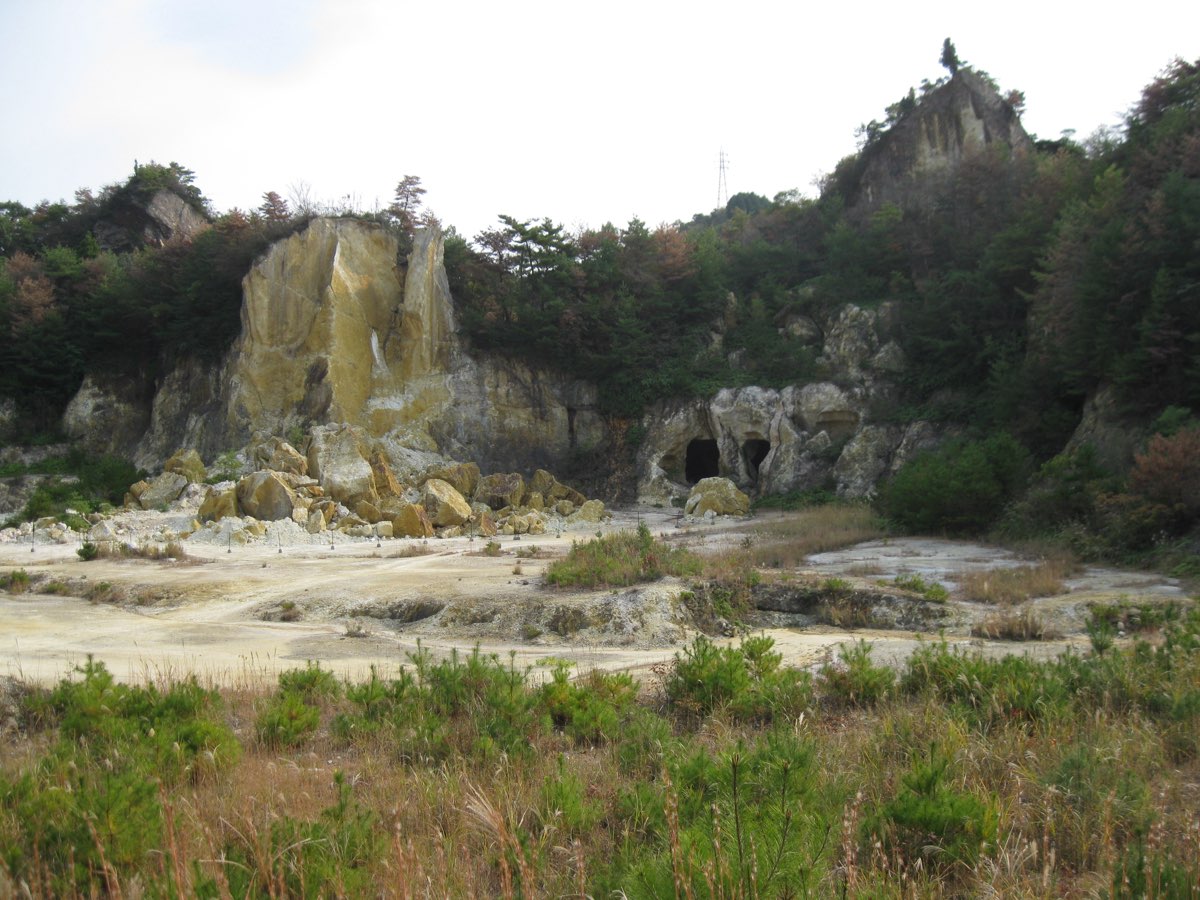
That changed at Izumiyama in Arita. The Agency for Cultural Affairs' Japan Heritage portal and Arita Town both relate that the quarry was found in the early seventeenth century by Ri Sanpei, a potter from Korea. He is also known by the Japanese name Kanagae Sanbē, and the Arita Tourism Association gives the Korean reading of his name as Yi Sam-pyeong. A text prepared for visitors in Arita presents the discovery as local tradition and records that he died in 1655.
Interpretations differ
The Arita Tourism Association adds that he and others first worked as potters in Taku and that they are said to have found the Izumiyama quarry in 1616. Both details are handed down as tradition.
What is clear is the result. According to the curator, the quarry made mass production of porcelain possible, and Arita grew into a great porcelain center under the leadership of the Saga domain. Arita Town states that porcelain was fired here for the first time in Japan, and that by the 1630s full-scale production was under way, under the strict control of the domain and with a division of labor close to the way Arita works today.
The visitor text in Arita says that the Nabeshima family, rulers of the Saga domain, guarded the quarry closely: checkpoints blocked the roads in and out of the Uchiyama area around Izumiyama, and no one could leave without the domain's permission.
Learning from China
The earliest Arita porcelain was fired in the same kilns as Karatsu stoneware. Dishes were stacked on top of one another, a method used at private kilns on the Korean Peninsula, which allowed many pieces to be fired at once but left marks where they had stuck together. The curator thinks it was simply a way to make ware cheaply.
Even this early ware was decorated in blue underglaze, known as sometsuke. The curator points out that on the Korean Peninsula, where the techniques came from, such decoration was made only for part of the court. In Japan it was used because the foreign goods the Japanese of the time longed for were colorful Chinese blue-and-white wares.
According to the Japan Heritage story, Arita soon became a center devoted to porcelain alone, under the leadership of the Saga domain.
The Kyushu Ceramic Museum describes a leap in technique a few decades after porcelain began. By bringing in Chinese methods and improving on them, Arita produced Japan's first porcelain with colored overglaze enamels, and its shaping and painting reached a quality close to Chinese porcelain.
The export age
In the mid-seventeenth century, the change of dynasty in China from the Ming to the Qing brought civil wars, and China's porcelain exports to the world fell sharply. Dutch merchants, for whom Chinese porcelain had been an important trade good, looked for a replacement. According to the museum, they chose Arita ware, which by then had come close to Chinese quality.
Some Hizen porcelain went by way of Nagasaki to Southeast Asia and Europe. The Japan Heritage story says that it charmed European royalty and nobles and had a great influence on porcelain making at Meissen and elsewhere. The curator adds that it was carried to Europe by the Dutch East India Company and became extremely popular as decoration for palaces.
The fall in Chinese imports also changed design at home. According to the curator, distinctly Japanese designs spread from the mid-seventeenth century. In the late seventeenth century, the museum says, Hizen porcelain reached two peaks, the Kakiemon style and the Nabeshima style.
Kakiemon-style ware, with its milky-white body known as nigoshide, was made at private kilns as luxury ware for European royalty and nobles and for Japanese daimyo families. Nabeshima-style ware was made at the Saga domain's own kiln as gifts for the shogun's family.
The porcelain was shipped from the port of Imari, about 10 kilometers from Arita, so it was also called Imari ware. Today, the curator explains, wares are usually named after the place where they are made. The museum states that the export age lasted about 100 years and brought great growth to Arita's porcelain industry.
When exports declined, the museum explains, the porcelain centers of Hizen turned to the home market, where townspeople's culture was flourishing. Just before Japan opened its ports at the end of the Edo period, Arita merchants again began exporting abroad.
The techniques that began in Arita also spread. The Japan Heritage story records how porcelain making developed after new stone was found at Mikawachi, Hasami, Imari and Ureshino. Each center used the same type of climbing kiln and tools but competed to develop its own character.
Places to visit
Izumiyama Porcelain Stone Quarry* (Arita). The quarry and five early kiln sites in Arita, Takeo and Ureshino were designated together as a national Historic Site in 1980 as the Hizen porcelain kiln sites. According to the visitor text, the quarry was worked until about 1995; most Arita ware today uses porcelain stone from Amakusa in Kumamoto Prefecture.
Tengudani Kiln Site* (Arita). Staff of Saga Prefecture's culture division describe it as a kiln from the first period when Arita turned mainly to porcelain, said to be linked with Kanagae Sanbē.
Excavation found at least four climbing kilns. The one visitors can see had 21 firing chambers and was 70 meters long, with a 21-meter difference in height, and they call it the largest climbing kiln of its time.
Arita Uchiyama district*. About 2 kilometers of streets centered on the main road were selected in 1991 as a national Important Preservation District for Groups of Traditional Buildings, the first in Saga Prefecture.
Kyushu Ceramic Museum* (Arita). The prefectural museum holds and displays about 30,000 ceramics from Hizen and across Kyushu, including Hizen porcelain that was once exported to Europe and has since returned.
The Arita pottery fair, held during the Golden Week holidays from April 29 to May 5, has a history of more than 100 years. Please check the official websites of the museum and Arita Town for opening hours and current information before visiting.
Sources
- 有田焼の歴史(常設展示)Kyushu Ceramic Museum (Saga Prefecture)
- 日本遺産巡り#37(肥前)Agency for Cultural Affairs (Japan Heritage portal)
- 肥前磁器窯跡(天狗谷・山辺田・原明・百間・不動山窯跡、泉山磁石場跡)Agency for Cultural Affairs (Cultural Heritage Online)
- 日本磁器のふるさと 肥前 〜百花繚乱のやきもの散歩〜(日本遺産ストーリー)Agency for Cultural Affairs (Japan Heritage portal)
- 佐賀県有田町が応援するふるさと名物 有田焼 ~400年の歴史を、未来へ繋ぐ~Arita Town, Saga Prefecture (佐賀県有田町; document published on the SME Agency's Mirasapo Plus site)
- 有田焼、四百年。(アリタノヒビキ)Arita Tourism Association (有田観光協会), feature written by Araoka Yayoi (荒岡弥生)
- 泉山磁石場(地域観光資源の多言語解説文データベース)Arita Inbound Multilingual Commentary Council (有田インバウンド多言語解説整備協議会; text in the Japan Tourism Agency multilingual commentary database)