Aichi Prefecture calls itself Japan's top manufacturing prefecture. According to the prefecture, citing a national survey, the value of goods shipped by its factories in 2024 was about 59.3 trillion yen, about 15.5 percent of Japan's total, and Aichi has ranked first for 48 years in a row. It says it is well known for transport machinery, typified by cars.
This article follows the thread from the cotton weavers of Mikawa and Chita, through the looms of Toyoda Sakichi, to the car factory that gave a city its name.
Cotton country
Cotton has a long history in Aichi. Aichi Prefecture notes that, according to the Ruijū kokushi and the Nihon kōki, in Enryaku 18 (799) a "Kunlun" man, said to have been from India, drifted ashore at Fukuchi village in Hazu district, now part of Nishio, with cotton seeds. This is said to be the arrival of cotton in Japan.
According to the prefecture, the first written mention of cotton made in Japan dates from Eishō 7 (1510), when a record kept at the Daijōin of Kōfukuji temple noted "Mikawa cotton" received as a tax payment. In the Edo period cotton growing and weaving flourished in the Mikawa region, and its cloth was shipped toward Edo. After Western techniques were adopted, Mikawa cotton and Mikawa stripes became known nationwide by those names in the Meiji period.
On the Chita Peninsula, cotton weaving began as a side job for farm families. The prefecture writes that records show plain white cotton was already being shipped to Edo in the Keichō era (around 1600). Later, bleaching techniques produced "Chita sarashi," which, shipped to Edo by sea, was prized there as the best-known and finest cotton cloth.
Toyoda Sakichi and the loom
According to the Japan Patent Office, Toyoda Sakichi was born in Keiō 3 (1867) in Tōtōmi Province, now Shizuoka Prefecture. Toyota's company history gives his birthplace as Yamaguchi village, now part of Kosai City.
The Patent Office writes that when Sakichi was 18, Japan issued its patent ordinance (Sembai tokkyo jōrei), and he resolved to make invention his life's work. In Meiji 23 (1890) he visited the third National Industrial Exhibition in Ueno, Tokyo, and seeing that most of the machines on show were foreign-made, he became still more eager to develop machines in Japan.
His first success was a wooden hand loom that, according to the Patent Office, greatly improved the productivity and the quality of cloth of the battan loom then in wide use. It earned him his first patent, No. 1195, in Meiji 24 (1891). Toyota's history records the date of the patent certificate as 14 May 1891.
Sakichi then turned to power. The Patent Office writes that in Meiji 27 (1894) he invented a yarn-reeling machine, and that, backed by its commercial success, he completed a wooden power loom three years later and patented it the following year. The Patent Office calls this the birth of Japan's first machine to weave by power.
According to Aichi Prefecture, in the Meiji period cloth production in Chita leapt after Toyoda Sakichi's invention of the power loom, and Chita's weaving developed into a key industry of the Japanese economy.
The automatic loom
Sakichi kept improving the loom. According to the Patent Office, in Meiji 36 (1903) he completed an automatic shuttle-changing device that refilled the weft thread automatically, the first invention of an automatic loom. In all, he received 84 patents and 35 utility model rights before his death in Shōwa 5 (1930).
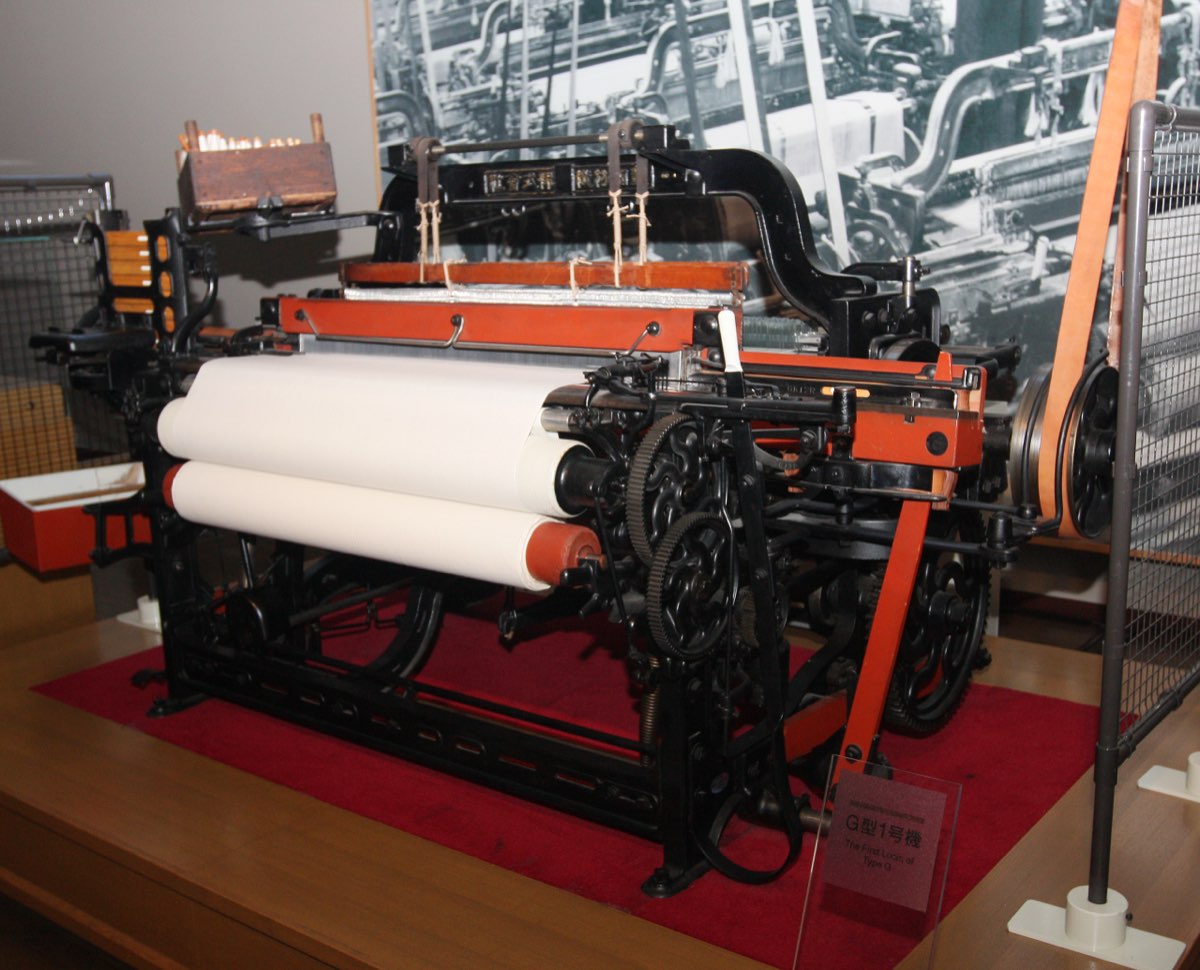
The Patent Office writes that in Taishō 13 (1924) Sakichi completed the non-stop shuttle-changing Toyoda automatic loom, Type G, which it calls a world-first invention. The loom could replenish the weft without slowing weaving at all.
Toyota's company history adds details from the company's side. The first Type G loom was completed in November 1925, and Toyoda Automatic Loom Works was established in Kariya on 18 November 1926 to manufacture automatic looms.
Interpretations differ
The sources tell the story of the Type G loom with different emphasis. The Patent Office presents it as Sakichi's invention. Toyota's company history describes Sakichi's son Kiichirō and his colleagues, under Sakichi's direction, developing the new loom, with new patents filed in Kiichirō's name, and calls the patents later sold abroad those of the shuttle-changing loom invented by Kiichirō.
According to the Patent Office, the rights were transferred to Platt of Britain, then the world's leading maker of textile machinery, for 1,000,000 yen at the value of the time. Toyota's history says the contract was signed in England on 21 December 1929 for 100,000 pounds in four instalments, finally settled in 1934 at 83,500 pounds.
From looms to cars
The Patent Office draws a direct line from the loom to the car. It writes that through this invention Japan's textile machinery and textile industries rose to world level, and that with these funds the development of Japan's car industry was started.
Toyota's history says that on his trip to sign the Platt contract, Kiichirō spent his time studying car factories, including Ford's, and machine tools, and became more convinced that Japan needed a car industry. On 1 September 1933 he set up a car manufacturing division within Toyoda Automatic Loom Works.
The car division needed a factory site. Toyota City explains that from the Meiji to the Taishō period the town of Koromo had prospered on silkworm raising and silk reeling, but in the Shōwa period demand for raw silk fell rapidly. Learning that the loom works in Kariya was looking for a site for its new car factory, the town's mayor (中村寿一) asked the town assembly for support and moved quickly to attract it.
Toyota Motor Co., Ltd. was established on 28 August 1937, according to the company's history. In 1938, the city says, the company's Koromo plant was completed on the hills of Ronchigahara, now Toyota-chō, and began producing trucks, buses and passenger cars. The city calls this the first step of "Toyota, the car town."
The company held the plant's completion ceremony on 3 November 1938 and made that day its founding anniversary. Koromo became a city in 1951. In January 1959, after a debate that the city says split it in two, Koromo changed its name to Toyota City, pledging to develop as an enterprise city.
Wool, and the industries today
Textiles continued too. In the Bishū district, according to the prefecture, linen, silk and cotton had long been woven, and from the Meiji period weavers took up wool as Japanese people adopted Western clothing. The prefecture describes Bishū today as Japan's largest wool-textile district and one of the world's leading ones.
Toyota City says that all 11 of Toyota Motor Corporation's production sites in Japan are in Aichi Prefecture, six of them in Toyota City and three in neighbouring Miyoshi, as of February 2026. The Koromo plant, now called the Honsha plant, is among them.
Visiting today
The Toyota Commemorative Museum of Industry and Technology in Nagoya is run by the Toyota Group. It preserves a Taishō-era factory where the Toyota Group began, and shows textile machinery and car technology with working machines and demonstrations. It opened to the public on 11 June 1994.
According to the museum, the old Toyoda Automatic Weaving Factory building and exhibits including a Type G automatic loom are among the Heritage of Industrial Modernization sites recognised by the Ministry of Economy, Trade and Industry in 2007.
Opening days and exhibitions change, so check the official websites before you visit.
Sources
- あいちの魅力(産業構造・事業環境)Aichi Prefecture (愛知県)
- 三河織物(あいちの地場産業)Aichi Prefecture
- 知多織物(あいちの地場産業)Aichi Prefecture
- 尾州毛織物(あいちの地場産業)Aichi Prefecture
- 十大発明家(豊田佐吉 特許第1195号 木製人力織機)Japan Patent Office (特許庁)
- 豊田佐吉の代表的発明品(木製人力織機、自動織機)Japan Patent Office (特許庁)
- トヨタ自動車75年史 第1部第1章第1節 第1項 豊田佐吉Toyota Motor Corporation
- トヨタ自動車75年史 第1部第1章第3節 第2項 自動織機の試作Toyota Motor Corporation
- トヨタ自動車75年史 第1部第1章第3節第3項・第4節第1項(G型自動織機の製造、豊田自動織機製作所の設立)Toyota Motor Corporation
- トヨタ自動車75年史 第1部第1章第4節 第2項 プラット社との特許権譲渡契約Toyota Motor Corporation
- トヨタ自動車75年史 第1部第2章第1節 第1項Toyota Motor Corporation
- トヨタ自動車工業株式会社の設立と挙母工場の建設Toyota Motor Corporation
- 明治~市制施行(とよたの起源)Toyota City (豊田市)
- とよたの記録Toyota City (豊田市)
- クルマのまちToyota City (豊田市)
- トヨタ産業技術記念館 概要Toyota Commemorative Museum of Industry and Technology (トヨタ産業技術記念館; run by the Toyota Group)
- トヨタ産業技術記念館 トップページToyota Commemorative Museum of Industry and Technology (トヨタ産業技術記念館; run by the Toyota Group)
- トヨタ産業技術記念館 近代化産業遺産Toyota Commemorative Museum of Industry and Technology (トヨタ産業技術記念館; run by the Toyota Group)
- トヨタ自動車75年史 第1部第1章第3節 第3項 豊田紡織修繕工場での「G型自動織機」製造Toyota Motor Corporation