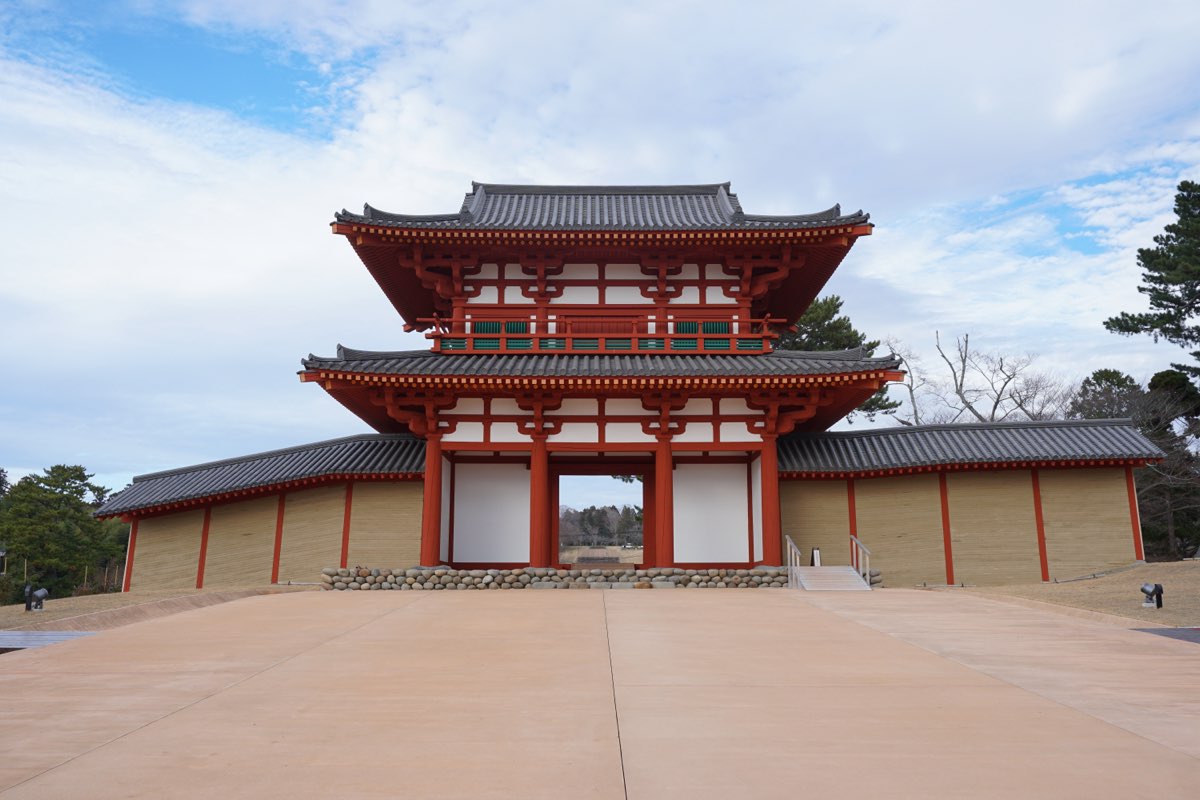
On a low hill looking out over Sendai Bay and the Sendai Plain stood Tagajō, the provincial government of Mutsu Province in the Nara and Heian periods. According to Miyagi Prefecture, it was founded in 724 and served as the administrative center of the province.
In the Nara period it also housed the Chinjufu, the headquarters for military affairs. A Miyagi Prefecture plan for the site describes Tagajō as the political and military center of the ancient state's rule over Tohoku.
This article looks at what Tagajō was, what excavations have revealed, and how its history was tied to the people that the court's records called Emishi.
A government seat on the hill
The Tagajo stele, which stands just inside the outer south gate, records that Tagajō was founded in Jinki 1 (724) by Ōno no Azumahito. According to Miyagi Prefecture, the stele was probably set up to mark a major rebuilding by Fujiwara no Asakari in Tenpyō Hōji 6 (762).
It also gives distances from Tagajō to the capital, to the "land of the Emishi," and to Hitachi Province, among other places. The prefecture says these lines preserve information found in no other written source.
The outer enclosure was an irregular square roughly one kilometer on each side, surrounded by walls with gates on the south, east, and west; a north gate has not been confirmed. Near the center stood the seichō, the main government compound, used for important state business, ceremonies, and banquets.
The seichō was enclosed by a roofed earthen wall measuring 103 meters east to west and 116 meters north to south, with a main hall and other buildings laid out to a plan. Offices for day-to-day administration and quarters for soldiers were spread across the enclosure.
The outer walls were four to five meters high. A pottery vessel found beside the southern wall bears the ink inscription "ōgaki" (great wall), showing that the wall had the same name as the one around the capital, Heijō-kyō.
Four phases of building
Excavations show that the seichō went through four phases, according to Miyagi Prefecture. The first was the original building by Ōno no Azumahito. The second was the major rebuilding of 762.
The third was the restoration after Tagajō was burned in the revolt of Korehari no Kimi Azamaro in Hōki 11 (780). The fourth was the recovery after the great Mutsu earthquake of Jōgan 11 (869). The site's use is thought to have ended around the early eleventh century.
Many of the offices were founded or rebuilt in the third phase, which the prefecture reads as a sign that the system was strengthened in the Heian period. A straight road, later widened, ran from the south gate up to the seichō as the main street of Tagajō.
Beyond the walls lay an attached temple and, from the ninth century, a grid of streets laid out every 100 meters. According to the Tohoku History Museum, the blocks held the large residences of officials such as provincial governors and the homes of many people who worked for Tagajō.
What the finds reveal
The objects dug up at Tagajō bring its daily work into view. Officials used inkstones, small knives, and belts with stone or metal fittings, and senior officials probably owned Chinese celadon and white porcelain.
Soldiers left iron swords, arrowheads, and plates of armor. Miyagi Prefecture says these finds show Tagajō's double character, as the provincial government of Mutsu and as a fortified center (jōsaku) with a military role.
In 2024, the year marking 1,300 years since Tagajō's founding, the Tagajo stele was designated a National Treasure and 1,794 objects excavated at Tagajō and related sites became an Important Cultural Property.
The people called Emishi
Who were the Emishi? The Tohoku History Museum explains that about 1,300 years ago, people called Emishi lived in ancient Tohoku outside the rule of the ritsuryō state. The state's own histories describe them as repeatedly rebelling and being conquered by a powerful state centered on the emperor.
Excavations, the museum says, have also revealed lively exchange with the state. Recent research suggests that the Emishi lived in ways not very different from people under the state, while their graves set them apart, showing the variety of their lives and cultures.
The Aomori Prefectural History stresses that the word "Emishi" was never fixed. Its tone, and the people it referred to, changed over time, and its basic meaning was people living outside the state's direct rule.
After the Taika reforms of the mid-seventh century, the court built forts in the lands of the Emishi and brought those areas under its direct rule. By the early ninth century the area south of a line roughly between present-day Morioka and Akita had been incorporated. The Miyagi and Yamagata areas, absorbed by the end of the Nara period, gradually ceased to be seen as Emishi lands.
Force, negotiation, and exchange
Relations between the state and the Emishi were not only war. The Aomori Prefectural History explains that the governors of Mutsu and Dewa had three special duties: military campaigns, gathering information, and kyōkyū, the hosting of Emishi leaders.
Mostly at the forts, officials held feasts for Emishi chiefs, gave them court ranks and titles, and handed over iron goods and textiles. For the chiefs, such gifts could help secure their authority.
Alliances shifted. In Hōki 7 and 8 (776 and 777), people of Korehari led by Korehari no Kimi Azamaro, a chief who held a court rank, fought on the government side against Shiwa village. In Hōki 11 (780) Azamaro himself rose against the government, and Tagajō was burned.
Emishi groups also fought one another. The Aomori history says the court used this rivalry in a policy of "controlling Emishi with Emishi," which strengthened its influence but may also have intensified struggles for leadership within the groups.
Exchange itself changed over time. What began as tribute answered with gifts gradually became commercial trade. In the Heian period, the history notes, officials posted to Tohoku traded for their own gain and forced unfair terms on the Emishi.
Visiting today
The Tagajō ruins were designated a national Historic Site in 1922 and a Special Historic Site in 1966, and Tagajo City is the managing body. The city invites visitors to the Special Historic Site, the Tagajo stele, and the ruins of the attached temple.
The south gate has been reconstructed. A free guidance facility opened in April 2025, when the reconstruction was completed, with films and digital displays on ancient Tagajō and its finds.
Tagajo City also recommends the Tohoku History Museum as a place to visit together with the ruins. Check the official websites for opening hours and closures before you go.
Sources
- 多賀城跡Miyagi Prefecture, Tagajo archaeological research office
- 多賀城跡の出土遺物Miyagi Prefecture, Tagajo archaeological research office
- 特別史跡多賀城跡附寺跡整備基本計画Miyagi Prefecture
- 蝦夷と律令国家Tohoku History Museum
- 県史テキストデータベース — 3古代の蝦夷社会Aomori Prefectural History
- 多賀城跡解説/周辺敷地図Tohoku History Museum
- 多賀城跡ガイダンス施設Tagajo City
- 多賀城市の観光Tagajo City