Pilgrims in white, wearing sedge hats and carrying wooden staffs, are a familiar sight on the roads of Shikoku. They are walking the Shikoku henro, a circuit of 88 temples linked to the monk Kūkai, known after his death as Kōbō Daishi. The route runs through all four of the island's old provinces: Awa, Tosa, Iyo and Sanuki, today's Tokushima, Kōchi, Ehime and Kagawa.
The Agency for Cultural Affairs counts it, with the Saigoku pilgrimage to 33 Kannon temples, among Japan's representative pilgrimages. This article looks at how the circuit took shape, the paths and stones that still mark it, and the local custom of supporting pilgrims along the way.
A circuit of 88 temples
The 88 temples are, in the words of the four prefectures' council, temples handed down by tradition as places where Kūkai practised. Kūkai (774–835) was born in Sanuki.
Following his footsteps from temple to temple is what is called the Shikoku pilgrimage. The national Historic Site record describes it as a pilgrimage in which people relive the steps of Kōbō Daishi.
The route starts at temple 1, Ryōzenji, in Naruto, Tokushima. It goes on through Kōchi and Ehime and ends at temple 88, Ōkuboji, in Kagawa, a journey of about 1,400 kilometres around the island.
According to the council's list, temples 1 to 23 are in Tokushima, 24 to 39 in Kōchi, 40 to 65 in Ehime and 66 to 88 in Kagawa. Most belong to Shingon Buddhist schools, but not all. Temple 11, Fujiidera, belongs to the Rinzai school, and temple 15, Kokubunji, to the Sōtō school.
Each province has its own name as a stage of training. The Japan Heritage story explains that Awa, where the pilgrimage begins, is the "dōjō of resolve," where pilgrims firm up their commitment. Tosa is the dōjō of ascetic practice, Iyo the dōjō of enlightenment, and Sanuki the dōjō of nirvana, where the vow is fulfilled.
The temples are varied. Some stand on steep mountains that recall the hard training once done there; others stand in towns or among rice fields. Some lie close together, while in other places the next temple is tens of kilometres away.
Uncertain beginnings
How the pilgrimage began is not clear, and the national Historic Site record says so plainly.
The Tokushima Prefectural Museum explains that monks were already travelling around difficult places in Shikoku for training in the Heian period, and that by about the Kamakura period several sacred sites had formed. The Japan Heritage story says the history began with pilgrimages by Heian-period monks and mountain ascetics to holy places where Kōbō Daishi is said to have trained. It adds that the poet-monk Saigyō and the Buddhist teachers Hōnen and Ippen are also said to have visited Shikoku in the Kamakura period.
Firm written evidence is later. A shrine cabinet for the main image at temple 49, Jōdoji, carries an ink inscription dated 1527, naming five fellow pilgrims from Myōdō in Awa.
Another, dated 1571, at Tosa Ichinomiya, then temple 30 (the temple is now the neighbouring Zenrakuji), records a single pilgrim from Yamashiro, the province around Kyoto. From such records, the Agency says, the pilgrimage was being made by the 16th century at the latest, by people from within Shikoku and from other provinces.
Shinnen's guidebook
The first known text to list the 88 temples with numbers is Shikoku Henro Michishirube, written in 1687 by Shinnen, a monk living in Osaka. Shinnen made the pilgrimage many times.
He set up free rest houses for pilgrims, wrote guidebooks and erected signposts. According to the Agency, the pilgrimage then gradually spread among ordinary people.
As more people went, more records were left behind. Pilgrims' travel diaries and the stamp books in which temples record a visit survive, showing which temples were then on the route and how pilgrims moved.
The Tokushima Prefectural Museum explains that in the Edo period, because Shikoku was the birthplace of Kōbō Daishi, 88 temples connected with him were fixed, including the earlier sacred sites. The pilgrims were mainly devout commoners. They were called o-henro-san, wore white clothing, carried a kongōzue staff, and were warmly received by local people.
Interpretations differ
When the pilgrimage spread to ordinary people is described differently by different sources.
Interpretations differ
The council says it spread from the Muromachi period to the beginning of the Edo period. The Japan Heritage story places the spread in the Edo period, when sea transport developed and Shikoku itself came to be seen as holy ground. The Agency's record describes a gradual spread after Shinnen's guidebook of 1687.
The path and its stones
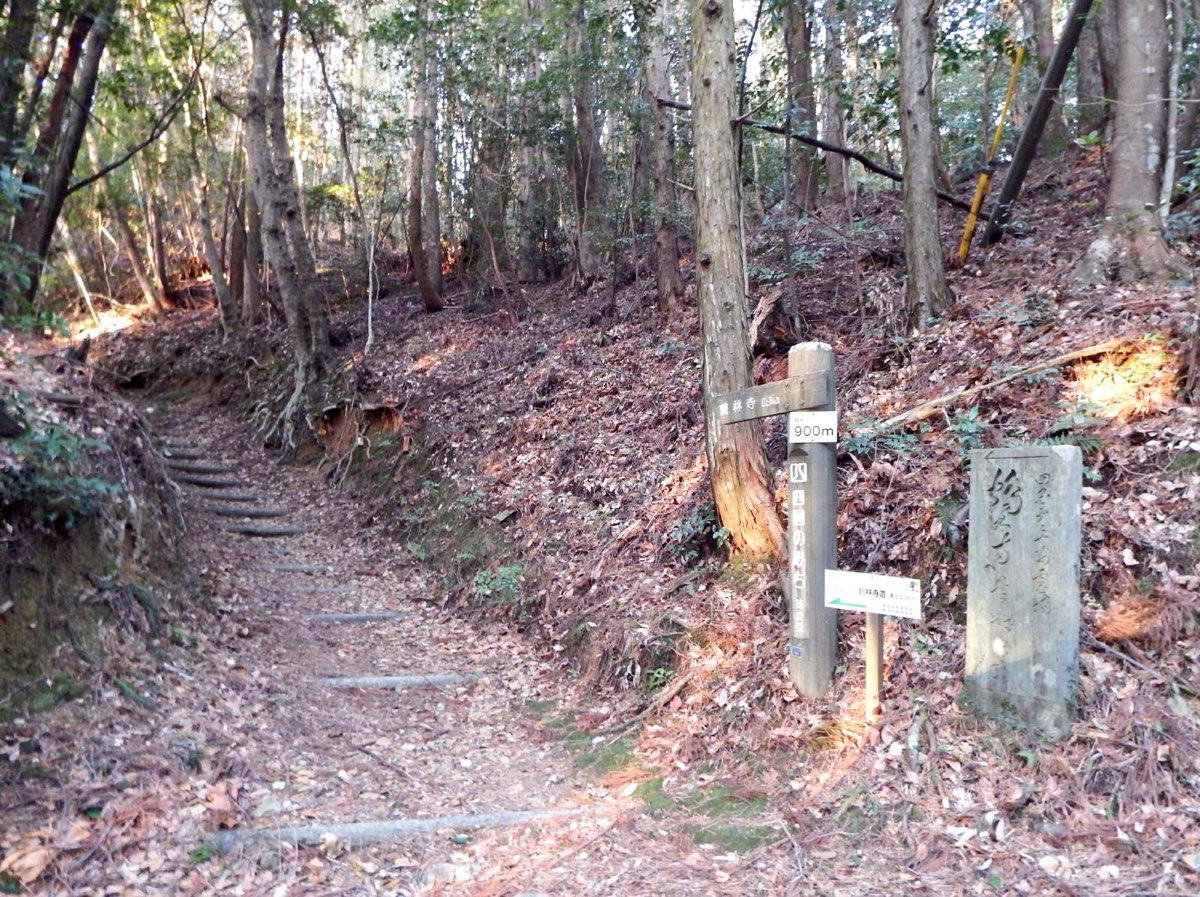
The council notes that henro-michi, the pilgrim paths, were not originally built only for pilgrims. They made use of local roads, farm roads and forest roads, so routes changed over time. Communities maintained them, and guide stones and chō-ishi (distance stones) that led pilgrims on their way still remain in many places.
Some stretches are protected as national Historic Sites. On the Sanuki path between temple 81, Shiromineji, and temple 82, Negoroji, the Agency's record counts 10 signposts and around 40 chō-ishi, among other stone monuments.
The chō-ishi were set about 109 metres apart. Among the dated stones are a pilgrim's grave of 1814, a stone of 1838 recording settai (offerings to pilgrims) and Meiji-era signposts set up by Nakatsukasa Mohei.
In Tokushima, the national Historic Site Awa Henro-michi was first designated on 5 August 2010. According to the prefectural board of education, that first designation covered about 4.5 kilometres of paths around temple 20, Kakurinji, and temple 21, Tairyūji.
In 2012 the national Council for Cultural Affairs recommended adding parts of further paths. Today the site also includes other paths and several temple precincts.
Walking today: dōgyō ninin and osettai
Walking to every temple takes more than 40 days, according to the Japan Heritage story. Pilgrims need not visit all the temples at once. Every temple is treated as equal, and the pilgrimage can begin anywhere.
The story describes several ways of going: in sections over several trips, one province at a time, in reverse order, or in no fixed order. Many people make the pilgrimage more than once, and today some travel by bus, train or car, while many still walk.
The story also says that anyone, regardless of nationality, religion or sect, can become a pilgrim. Pilgrims travel dōgyō ninin, "two travelling together," with Kōbō Daishi as their companion.
A distinctive part of the pilgrimage is osettai. The Japan Heritage story describes people of Shikoku offering pilgrims food, fruit and drinks, a word of encouragement, or directions when they are lost. Some offer zenkon-yado, free lodging, or a bath.
It is said that by giving osettai people entrust their own pilgrimage to the pilgrim, or that the giving is itself a meritorious act. The council notes that this custom continues today.
In fiscal 2015 the Agency for Cultural Affairs recognized "Shikoku Henro" as Japan Heritage. The application came from the four prefectures, with Ehime as the lead, together with 57 municipalities.
Places to visit
Ryōzenji (temple 1), Naruto, Tokushima.* The starting point of the circuit, a temple of the Kōyasan Shingon school.
Awa Henro-michi: the Kakurinji and Tairyūji paths.* Paths around temples 20 and 21 in Tokushima, part of the national Historic Site Awa Henro-michi.
Sanuki Henro-michi: the Negoroji path.* The path between temples 81 and 82 in Kagawa, where signposts and distance stones line the way.
Ōkuboji (temple 88), Sanuki, Kagawa.* The temple where the circuit ends.
The temples are active places of worship. Check access and visiting information on the official websites before you go.
Sources
- 「四国遍路」~回遊型巡礼路と独自の巡礼文化~(日本遺産ストーリー)Agency for Cultural Affairs (Japan Heritage portal)
- 讃岐遍路道Agency for Cultural Affairs (Cultural Heritage Online)
- 常設展示「5 藩政のもとで」Tokushima Prefectural Museum
- 平成27年度認定地域 総括評価・継続審査結果一覧(令和3年7月16日報道発表 別紙2-1)Agency for Cultural Affairs
- 四国遍路とはCouncil for the World Heritage Registration of the Shikoku Pilgrimage (four Shikoku prefectures and municipalities)
- 阿波遍路道Agency for Cultural Affairs (Cultural Heritage Online)
- 「阿波遍路道(鶴林寺道 太龍寺道 いわや道)」の国史跡追加指定と名称変更についてTokushima Prefectural Board of Education
- 金剛峯寺(地域観光資源の多言語解説文データベース)Hashimoto-Ito Regional Tourism Council (text in the Japan Tourism Agency multilingual database)