In 1586 the missionary Luís Fróis, sailing west through the Seto Inland Sea, wrote that on an island in the Geiyo Islands lived "the greatest pirate in Japan" with a large castle, many followers, lands and ships. The Japan Heritage story published by the Agency for Cultural Affairs identifies this "pirate" as the Murakami Kaizoku.
Kaizoku is the Japanese word for pirates, and the Japan Heritage story uses it in that sense when it contrasts the Murakami with outlaws who attack ships at will and loot them. It describes the Murakami instead as people whose livelihood was to guarantee safe passage according to set rules and to support the order of trade in the Inland Sea.
Older books often call them the Murakami Suigun, the "Murakami navy." According to the Murakami Kaizoku Museum in Imabari, suigun is a name used from the Edo period onward.
It was common from the Meiji era to the early Shōwa era, when they were seen as forerunners of the modern navy. Because it cannot express their many activities, the museum explains, the name kaizoku, found in documents of their own time, is now more often used.
A difficult sea and three families
The Geiyo Islands are a dense chain of islands running north to south across the Inland Sea, between Onomichi in Hiroshima Prefecture and Imabari in Ehime Prefecture. In the narrow straits the tide can rise and fall by more than 3 meters at spring tides, and currents reach up to 10 knots, about 18 kilometers per hour. A local fishermen's saying sums it up: "Rather than ride a boat, ride the tide."
The Murakami Kaizoku were three families based on the islands of Innoshima (today part of Onomichi), Noshima and Kurushima (both in Imabari). According to the Japan Heritage story, they shared a strong sense of kinship. The Murakami Kaizoku Museum adds that they repeatedly cooperated and broke apart, and the Yamaguchi Prefectural Archives notes that in practice each family acted on its own.
Each family watched over a different route. The Innoshima Murakami held the route along the Honshu coast, the Noshima Murakami the shortest route through the middle of the islands, and the Kurushima Murakami the route along the Shikoku side. Together, the Japan Heritage story says, they controlled the whole of the Geiyo Islands.
The Murakami first appear in the period of the Northern and Southern Courts. In 1349 the name "Noshima" appears in a record of a group guarding shogunate ships bound for Yugeshima, an estate of the Tōji temple. Later the Innoshima family was ordered to guard ships sailing to Ming China, and the families grew into a major power holding the main routes and ports of the Inland Sea.
Castles on the sea
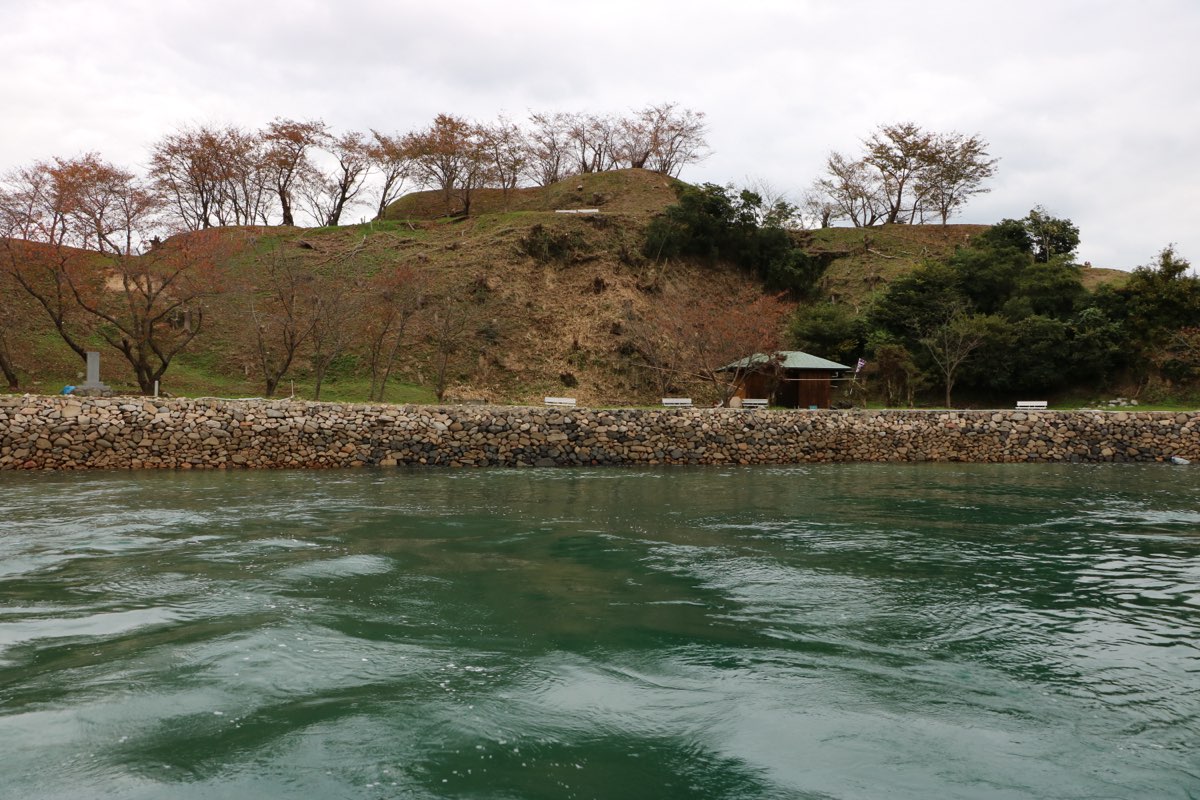
The Japan Heritage story identifies the "large castle" Fróis mentioned with the many sea castles the Murakami built. On the rocky shores of many of them, rows of posts stood out into the sea so that ships could be moored at any state of the tide. Flat areas along the shore served for unloading cargo and for building and repairing ships.
Placed at key points on the routes, the castles worked as checkpoints at sea, through which the Murakami controlled east–west traffic in the Inland Sea.
Imabari City's plan for Noshima Castle describes it as a sea castle built from the middle to late 14th century and used until about the end of the 16th century, made by turning a whole small island into a castle. The national designation of 1953 records many post holes in the shore rocks, recognized as traces of jetties. Excavations found buildings rebuilt many times, plenty of everyday vessels, including fine Chinese ceramics, and many weights for fishing nets, showing that the castle was a permanent place to live.
Guards, pilots and tolls
When Fróis and his companions neared the Geiyo Islands, they asked for safe passage. According to the Japan Heritage story, the Murakami gave them a silk flag bearing their crest and a signature, telling them to show it if they met a suspicious ship. Flags like this were later called kasho-senki, passage permits.
With these flags, or by putting their own men aboard as pilots, the Murakami protected ships from other pirates and dangerous waters in return for tolls. At their height, the Japan Heritage story says, toll ports called fudaura stood at key harbors from northern Kyushu to the Kinai region around Kyoto and Osaka.
The Yamaguchi Prefectural Archives has exhibited one such flag. Made of silk, it bears the character 上, the Murakami emblem, and names a priest of Itsukushima Shrine as its holder.
It is dated the 28th day of the 4th month of Tenshō 9 (1581) and signed by Murakami Takeyoshi, head of the Noshima family. The archives notes that only two such flags were known to survive.
According to the archives, men of the Noshima Murakami boarded ships that had paid and guided and guarded them to their destination. As trade grew and demand outstripped what they could supply, the flags are thought to have been issued instead.
The archives also notes another side: the Noshima Murakami sometimes used force to seize the cargo of ships that did not pay. For them this was a natural way to protect their rights, but for those who suffered it, it was nothing other than piracy.
Between the warlords
In the Sengoku period the families became tied to different powers on land. According to the museum, the Kurushima family served the Kōno, military governors of Iyo, while the Innoshima family served the Ōuchi and later became an important sea force of the Mōri. The Noshima family is considered the most independent, especially under Murakami Takeyoshi.
The Yamaguchi Prefectural Archives explains that the Noshima Murakami kept toll ports in the domains of warlords around the Inland Sea, so siding with one warlord risked losing the ports in an enemy's lands. They therefore avoided being drawn deeply into wars on land and tried to stay on friendly terms with all the warlords.
They still fought at sea. The Japan Heritage story names the first battle of Kizugawaguchi as a leading example.
When Mōri Terumoto set out to carry provisions to the Ishiyama Honganji temple, which was opposing Oda Nobunaga, the three families, as the main force of the Mōri fleet, defeated Nobunaga's ships using gunpowder weapons called hōroku-biya, and the provisions got through. Nobunaga and Hashiba (later Toyotomi) Hideyoshi then tried to win the Murakami over.
The end came from the land. According to the archives, when Toyotomi Hideyoshi took direct control of Nagasaki and set out to secure free shipping between Nagasaki and the Kinai region, he excluded the Noshima Murakami, and their foundation was lost through his so-called ban on piracy. A conservation plan issued by the Imabari City Board of Education in 2020 dates the ban to 1588.
Imabari City's plan dates the end of Noshima Castle to about 1587. The family's documents up to 1599, before it became a retainer of the Mōri, were designated an Important Cultural Property in 2015.
More than warriors
The Murakami also took part in trade. Mijikashima, an island close to Noshima Castle, served as a base where Chinese trade ceramics and Bizen ware were stored for a time.
The Japan Heritage story describes them as cultured people who enjoyed tea and incense like the warlords on land. Their commanders composed linked verse (renga) and offered it at Ōyamazumi Shrine on Ōmishima, praying for success in battle.
On Innoshima, the Mukuura Hōraku Odori, a dance said to have been performed to pray for and celebrate victory, has been handed down to the present. The Murakami were also fishermen.
In 2016 the story of the Murakami Kaizoku was recognized as a Japan Heritage, and a council with members from Imabari and Onomichi works to share it.
Places to visit
The Murakami Kaizoku Museum, run by Imabari City, opened in 2004 in Miyakubo on the island of Ōshima. It displays restored armor handed down in the Noshima Murakami family, a surcoat (jinbaori) said to have been worn by Murakami Takeyoshi and his son Kagechika, and finds from Noshima Castle, and its observation room looks out over the castle site. Check the official website for opening times and fees.
Noshima is an uninhabited island with no regular ferry. Imabari City's plan explains that visitors can land through city events, landing-and-tidal-current cruises or chartered boats, and the city's guide for school groups lists a landing tour. Check current tours with the museum before visiting.
Sources
- “日本最大の海賊”の本拠地:芸予諸島 -よみがえる村上海賊“Murakami KAIZOKU”の記憶-(日本遺産ストーリー)Agency for Cultural Affairs (Japan Heritage portal)
- 村上海賊魅力発信推進協議会Imabari City
- 能島城跡Agency for Cultural Affairs (Cultural Heritage Online)
- 史跡能島城跡整備基本計画 第3章Imabari City
- 施設について(村上海賊ミュージアム)Murakami Kaizoku Museum (今治市村上海賊ミュージアム), Imabari City
- 館内案内(村上海賊ミュージアム)Murakami Kaizoku Museum (今治市村上海賊ミュージアム), Imabari City
- アーカイブズ展示 解説シート(第12回中国四国地区アーカイブズウィーク「その記録と記憶」)Yamaguchi Prefectural Archives (山口県文書館)
- 史跡能島城跡 保存活用計画 第3章 史跡の概要Imabari City Board of Education
- 今治市 修学旅行・教育旅行ガイド(パンフレット)Imabari City (tourism section)