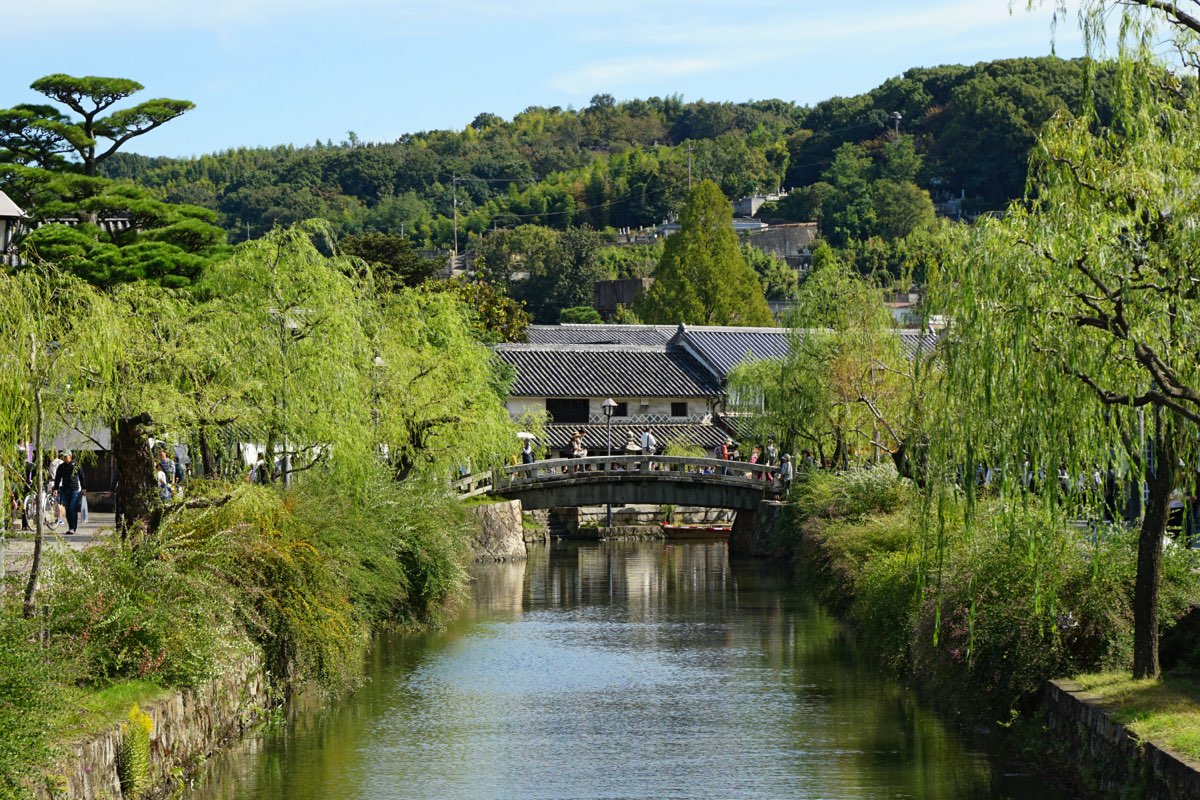
In Kurashiki, white-walled merchant houses and storehouses line a willow-fringed canal, and Western-style buildings from the age of the cotton mills stand among them. According to Kurashiki City, the town's story begins with cotton grown on land reclaimed from the sea. That cotton led to modern spinning mills, school uniforms and jeans, and the wealth it produced shaped the townscape that the city has protected since 1969.
This article follows Kurashiki from a shogunate trading town in the Edo period, through its growth into a "textile town," to the efforts to keep its historic quarter.
Cotton on land from the sea
Until about 400 years ago, according to the city, the plain where Kurashiki now stands was a shallow sea dotted with islands, known as the Kibi no Anaumi. Sediment carried by the Takahashi River made it gradually shallower, and from the early modern period onward reclamation turned it into land.
Newly reclaimed land was too salty for rice. Farmers therefore grew cotton and igusa rush, which tolerate salt, and the city describes these crops as the foundation of its textile industry.
In 1642 Kurashiki became land ruled directly by the shogunate. It served as the political center for the shogunate's lands nearby and as a relay point where goods from southern Bitchū Province were collected and shipped. From the middle of the Edo period, cotton and igusa were grown widely as cash crops on the reclaimed land.
Kurashiki's Japan Heritage story, as published on the Agency for Cultural Affairs' portal, quotes a travel account from the late Edo period saying that more than half of the fields in view were planted with cotton. The Kurashiki River, used as a canal, was busy with wholesalers and brokers who dealt in cotton and other goods.
The port towns of Tamashima and Shimotsui, ports of call for the Kitamaebune trading ships, bought dried sardines and herring meal as fertilizer for the cotton fields and shipped out cotton. At its height, according to the city, Tamashima had as many as 43 wholesale merchants and more than 200 storehouses.
The merchant town on the Kurashiki River
Kurashiki's population grew quickly. The city's history of the district notes that in the roughly 130 years from the Genroku era to the Bunsei era, the population doubled, and powerful merchant landowners appeared.
From this prosperity came the townscape that the district is known for. The townhouses have tiled roofs and plastered walls, and the storehouses have earthen walls.
Typical features include Kurashiki-style windows and lattices, and the city calls the contrast between the white plaster finish and the namako walls beautiful. According to the city, many of the surviving buildings are modeled on the houses of rich merchants of the Kansei era (1789–1801).
Along the river, landing places, stone-paved alleys and stone lanterns that tell of the busy river port still remain, together with the white-walled merchant houses.
When the magistrate's office was abolished in 1868 and society changed with the Meiji Restoration, the city says, the town lost some of its former bustle.
Spinning mills and a textile town
In the Meiji period the government encouraged private spinning. In 1881 Shimomura Spinning in Kojima and Tamashima Spinning in Tamashima opened; the city calls them Japan's first private spinning mills. In 1889 the Kurashiki Spinning Mill, today's Kurabo, was founded on the site of the old magistrate's office, with the latest British machinery and factory buildings.
Mats woven from igusa also became exports. In 1878 Isozaki Minki of Chayamachi invented kinkan'en, a fine mat woven with detailed patterns. It became an important export to Europe, America and other countries, and Chayamachi became the country's leading producer of patterned mats.
Skills in spinning, twisting, weaving, dyeing and sewing moved from tabi socks to school uniforms and work clothes. As Western-style clothing spread from the Taishō period on, the city states, by 1955 Kojima made 70 percent of the school uniforms in Japan. The Japan Heritage story gives a different figure for an earlier time: 90 percent in the early Shōwa period.
Building on these sewing skills, the first jeans made in Japan were produced in 1965, according to the city, and Kojima came to be called the birthplace of Japanese jeans. Today, the city says, Kurashiki is Japan's leading "textile town" by value of textile products shipped.
Ōhara Magosaburō and the Ohara Museum of Art
The Kurashiki Spinning Mill grew into one of the country's leading spinning companies. Its president, Ōhara Magosaburō, used the wealth from spinning for cultural, social and welfare work, including support for the folk craft (mingei) movement and the founding of an agricultural research institute. Western-style buildings such as the red-brick spinning mill and the Ohara Museum of Art, built in the style of a Greek temple, rose among the Edo-period merchant houses.
The museum's own history lists other projects. In 1902 Magosaburō opened a night school for people who worked during the day, and the same year began a series of Sunday lectures for the people of Kurashiki, held 76 times over 23 years. He founded an agricultural research institute in 1914 and the Ohara Institute for Social Research in 1919.
The Ohara Museum of Art was founded in 1930 by Magosaburō in memory of his friend, the painter Kojima Torajirō, who had died the year before. The museum describes itself as the first private museum in Japan centered on Western art. Magosaburō urged Torajirō to travel to Europe three times, and there Torajirō chose works by El Greco, Gauguin, Monet, Matisse and others that, the museum says, still form the core of its collection.
Keeping the historic quarter
According to the city, a member of the business family behind the museum and the other Western-style buildings noticed early how important the townscape was and hoped to make Kurashiki like Rothenburg, the historic German town, but could not carry the idea out at the time. The idea influenced later cultural figures and led to preservation work after the war, from the standpoints of architecture and folk crafts.
After the war, with the backing of Ōhara Sōichirō, Magosaburō's eldest son and president of Kurashiki Kenshoku (today's Kuraray), the Kurashiki Museum of Folk Crafts opened in 1948 as a pioneer of reusing townhouses, and the Kurashiki Archaeological Museum followed in 1950. In 1974 the old Kurabo factory was redeveloped and opened as Kurashiki Ivy Square.
In the early 1960s, the efforts led by these pioneers widened into work by the city and residents. The city passed an ordinance on preserving the traditional townscape in 1968 and in 1969 announced a preservation plan covering 20.7 hectares, naming a special Bikan (scenic) district along the Kurashiki River.
On 21 May 1979 the national government selected 13.5 hectares as an Important Preservation District for Groups of Traditional Buildings, enlarged to 15 hectares in 1998. Repairs of buildings have been carried out every year since fiscal 1979. In 1990 the city passed an ordinance to protect the district's background scenery, which it describes as the first of its kind in Japan.
Places to visit
The Kurashiki Bikan Historical Quarter lies along the Kurashiki River, where boats carry visitors past the willows. Places linked to this story that the city lists in its Japan Heritage story include the Ohara Museum of Art, the former Ōhara family house, the Ōhashi family house, the Kurashiki Museum of Folk Crafts, the Kurashiki Archaeological Museum, Kurashiki Ivy Square and the Kurabo Memorial Hall.
Check each facility's official site for opening hours. The Ohara Museum's own site gives its current hours and closing days.
Sources
- 一輪の綿花から始まる倉敷物語~和と洋が織りなす繊維のまち~Kurashiki City (Japan Heritage Promotion Office)
- 一輪の綿花から始まる倉敷物語(日本遺産ストーリー)Agency for Cultural Affairs (Japan Heritage portal)
- 美観地区の沿革Kurashiki City (Cultural Properties Division)
- 美観地区の保存の歩みKurashiki City
- 倉敷市倉敷川畔(岡山県)重要伝統的建造物群保存地区 紹介資料Kurashiki City (published by the Agency for Cultural Affairs)
- 美術館の歴史Ohara Museum of Art (official site)