Kawagoe, in Saitama Prefecture, grew up around a castle built in the fifteenth century. For about four centuries the castle changed hands, was enlarged, and gained new buildings, while a merchant town took shape beneath it. This article follows the castle from its founding in 1457 to the palace building that survives today, and the town from its Edo-period street plan to its rows of fireproof storehouse shops.
Kawagoe City describes the castle site as the remains of a castle that was contested in the struggle for power over the Kantō region in the late medieval period, and that later stood as a symbol of a commercial town close to Edo.
A castle for the struggle over Musashi
According to Kawagoe City, the castle (written with different characters before the Edo period) began when Ōta Dōshin and his son Dōkan, with others, retainers of Ōgigayatsu Uesugi Mochitomo, built it on his order in Chōroku 1 (1457). The Kawagoe City Museum puts this more cautiously, saying the castle "is said to" have been built by them. The city's preservation-district leaflet adds that this father and son also built Edo Castle.
The city sets the founding against a regional conflict. In Kyōtoku 3 (1454), Ashikaga Shigeuji, the Kamakura kubō, killed the Kantō kanrei Uesugi Noritada and, during the fighting that followed, made his base at Koga in Shimōsa. Mochitomo, whose base was in Sagami, is thought to have built the castle at Kawagoe, in the center of Musashi Province, to secure his control of the southern Kantō.
For about the next eighty years Kawagoe was the residence of six generations of the Ōgigayatsu Uesugi. According to the city, the castle of this period is thought to have consisted of several square residences, each surrounded by a moat.
Under the Hōjō
In Tenbun 6 (1537), Hōjō Ujitsuna attacked Kawagoe, and the Hōjō won the fighting that followed. In Tenbun 15 (1546), in a battle commonly called the "Kawagoe Night Battle," the Hōjō drove back a counterattack by the two Uesugi houses and the forces of the Koga kubō.
For the next fifty years and more, Kawagoe served as a branch castle of Odawara, the Hōjō headquarters, and as one of the supports of Hōjō rule over Musashi. The city says it carried weight both militarily and economically until Tokugawa Ieyasu entered Edo in Tenshō 18 (1590).
The northern guard of Edo
When Ieyasu came to the Kantō in 1590, the Kawagoe domain was created. In the Edo period the castle was enlarged; at its greatest extent, according to the city, its grounds covered about 99,000 tsubo, or about 326,000 square meters.
The Kawagoe City Museum says the castle was valued as the northern guard of Edo, and that its lords were successively senior figures of the shogunate. The city counts twenty-one lords from eight families, all of them shinpan or fudai daimyō (lords related to or long allied with the Tokugawa), who also held offices such as tairō and rōjū, the shogunate's highest posts. They ruled until the end of the shogunate and the Meiji Restoration.
Laying out the castle town
The town's plan was laid out after a disaster. In Kan'ei 15 (1638), a great fire in Kawagoe burned most of the castle and the town below it. The next year Matsudaira Nobutsuna, known as "Chie Izu" ("Izu the Wise"), became lord of Kawagoe and laid out the town as part of its rebuilding.
According to the city, samurai land was placed to the north and south of the castle and along the roads at the entrances to the town. For townspeople, Nobutsuna set up a system of "ten towns and four temple-gate towns": five merchant towns, five artisan towns, and four towns in front of temples. Temples and shrines were deliberately lined up on the north and west, forming an outer line of defense around the townspeople's quarters.
The main streets were planned with T-junctions, crank-shaped turns, and dead ends as well as crossroads. The city says this street pattern still remains strongly in Kawagoe today.
The palace of 1848
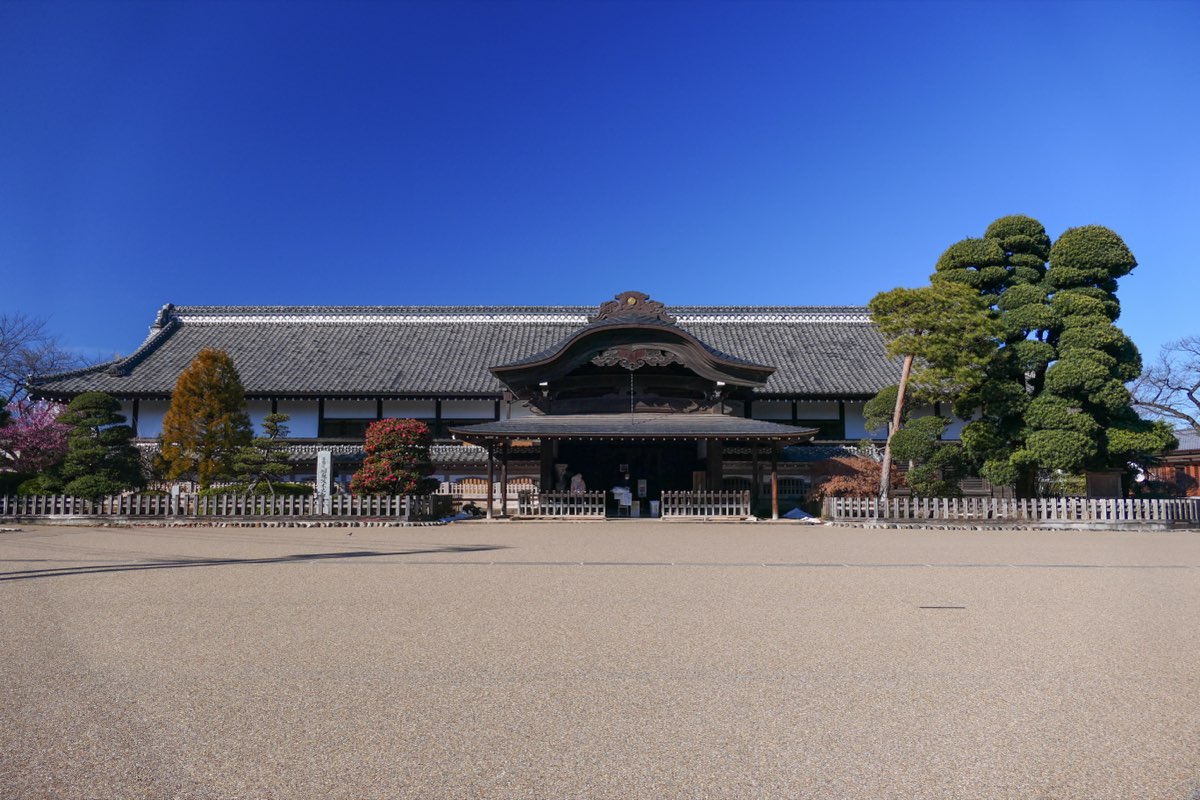
The castle building that survives today is much later than the castle itself. According to Kawagoe City, a copy of the building's ridge tag shows that the Honmaru Goten, the palace of the inner enclosure, was completed in Kaei 1 (1848), when Matsudaira Naritsune was lord.
The palace originally had sixteen buildings with a total floor area of 1,025 tsubo. It was dismantled bit by bit after the Meiji Restoration, and only the entrance and the great hall remain. Behind the large entrance, with its curved Chinese-style gable, lies a great hall of thirty-six tatami mats; the city calls the surviving building a valuable example of early modern palace architecture.
Kawagoe City's page on the castle site states that this is one of only two honmaru palaces left in Japan.
Next to the palace stands the office of the senior retainers (karō). In Meiji 5 (1872) it was sold to the Hoshino family of Fukuoka village (today's Fujimino).
It was moved back and reconstructed in fiscal 1988, about 40 meters east of its original position, and joined to the palace. The city notes that surviving rooms of senior retainers, who in practice ran the domain, are rare nationally.
The castle site has been a Saitama Prefecture historic site since 1925. Besides the palace and the karō office, the city lists Miyoshino Shrine, earthen ramparts, the site of the Fujimi turret, and the sites of the Naka-no-mon gate and its moat as surviving remains.
The storehouse town
The streets the city calls Kawagoe's representative historic townscape come from another fire. In Meiji 26 (1893), a great fire burned more than a third of Kawagoe.
According to the Kawagoe City Museum, merchants had built up wealth since the Edo period through trade with Edo, including by boat on the Shingashi River. They noticed that the buildings left standing after the fire were traditional kura-zukuri buildings, with their main walls coated in earth, and they competed to rebuild their shops in this fireproof style.
The city says they took as their model the Ōsawa house of 1792, the only building on the main street to survive the fire and now an Important Cultural Property. By around the Meiji 40s (1907–1912), a street of storehouse-style shops had formed; at its peak, according to the museum, more than a hundred such buildings stood in the town.
The merchants did not hold rigidly to old methods. The museum notes that they also used new materials such as brick, Ōya stone, and granite.
In 1999 the district was selected as a national Important Preservation District for Groups of Traditional Buildings. It covers about 7.8 hectares, and as of March 2022 the city had identified 136 traditional buildings in it. The city credits town-building led by residents for keeping the atmosphere of the bustling "Koedo" ("Little Edo") alive, and names the Toki no Kane bell tower as the town's symbol.
Visiting today
The Honmaru Goten stands in Kuruwamachi, Kawagoe. According to the Kawagoe City Museum, which manages it, the surviving entrance section of the palace and the reconstructed karō office are open to the public. Check opening hours and fees on the museum's official website before you go.
The preservation district runs from the Fuda-no-tsuji crossing in the north to the Nakachō crossing in the south, and includes the Ōsawa house and the Toki no Kane. The city's Kura-zukuri Museum in the district, housed in a storehouse shop built just after the 1893 fire, was closed for earthquake-proofing work when its page was checked in October 2026; check the official website for its current status.
Sources
- 県指定記念物 川越城跡Kawagoe City
- 川越城本丸御殿とはKawagoe City Museum
- 川越市川越伝統的建造物群保存地区 伝建地区の概要Kawagoe City (Urban Landscape Division)
- 県指定有形文化財 川越城本丸御殿及び家老詰所Kawagoe City
- 開館時間・入館料金・休館日(川越城本丸御殿)Kawagoe City Museum
- 川越に蔵造りの町並みができるまでKawagoe City Museum
- 利用・交通のご案内(川越市蔵造り資料館)Kawagoe City Museum
- 蔵造り資料館Kawagoe City Museum