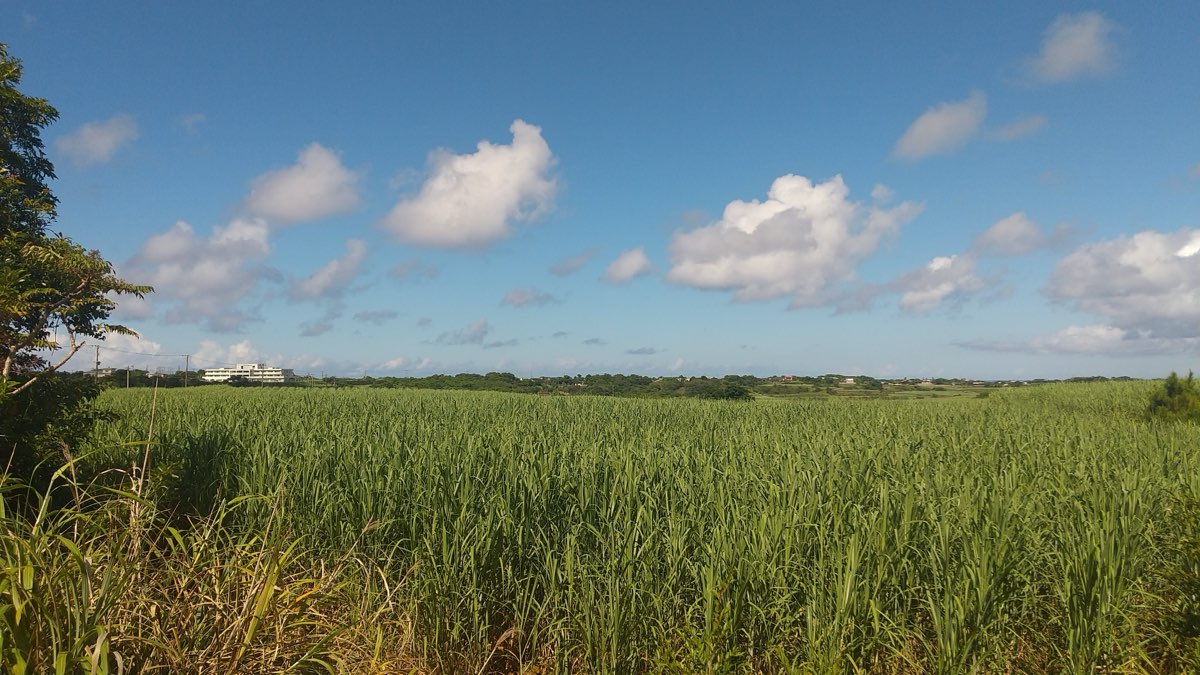
The Amami Islands, part of the Ryukyu island arc, lie about 370 to 560 kilometers southwest of Kagoshima City, with eight inhabited islands. Sugarcane is still one of their main crops.
For about 260 years, from the early seventeenth century, the islands were ruled directly by the Satsuma domain, under which sugarcane became their main crop. After the Second World War, they were separated from mainland Japan until they returned on December 25, 1953.
From Ryukyu to Satsuma
Kagoshima Prefecture describes how Amami's own history is divided into ages. The earliest is called "Amanyu," followed by "Ajiyu," an age of rival local chiefs. The age of rule by the Ryukyu kingdom is called "Nahayu," and the age of Satsuma rule "Yamatoyu."
According to the prefecture, Amami Ōshima came under the Ryukyu kingdom around 1440, Kikaijima in 1464, and Tokunoshima and the islands to its south even earlier.
In 1609, the Shimazu family of Satsuma sent forces against Ryukyu, a campaign Kagoshima Prefecture calls the "Seijō-eki." The Agency for Cultural Affairs and Okinawa Prefecture describe the same events as an "invasion" (shinkō).
As a result, the prefecture and the ministry say, the Amami Islands were separated from Ryukyu and placed directly under Satsuma. Amami City describes the same events as Satsuma's subjugation of Ryukyu, after which Amami became Satsuma territory.
From 1613, Satsuma posted officials to govern the islands. Kagoshima Prefecture writes that until the abolition of the domains in 1871, for about 260 years, the islanders suffered severe restrictions on their freedom under the feudal system. Offices were placed on Amami Ōshima, Kikaijima, Tokunoshima, and Okinoerabujima.
Sugar as tax
Interpretations differ
How sugar-making began in Amami is debated. A Kagoshima Prefecture pamphlet gives two accounts, both from the village of Yamato on Amami Ōshima. One account says a man named Sunao Kawachi learned sugar-making after drifting to China sometime between 1596 and 1614. Another says a man named Miwara went to Ryukyu to learn the technique around 1688 or 1689. According to the pamphlet, the mainstream view today is that sugar developed as an industry from around this time, and both accounts agree that it began at Yamatohama.
Kagoshima Prefecture says sugar became very important from the Genroku era onward. In 1745 (Enkyō 2), the domain decided on "kantō jōnō": taxes owed in rice were converted into brown sugar. The prefecture's pamphlet puts it more directly, saying Satsuma forced the islands to pay in brown sugar.
From then on, sugarcane became the main crop, and the prefecture says this had a serious effect on Amami society. Why did the domain want sugar? According to the pamphlet, Satsuma's finances were near collapse, burdened by flood-control work on the Kiso River ordered by the shogunate and by the costly "enlightenment" policies of Shimazu Shigehide.
At a time when sugar was expensive, brown sugar was an efficient cash crop. As one part of its financial reforms, led by Zusho Hirosato, the domain tightened its monopoly on Amami sugar.
In 1830, the domain began buying up all the brown sugar of Amami Ōshima, Tokunoshima, and Kikaijima. Amami City and the prefectural Amami Library both say that farmers were forced to raise output and lived in hardship.
Kagoshima Prefecture states that this placed a heavy burden on the people of Amami, while the success of the reforms provided funds for Satsuma's later Shūseikan industrial project and for the Meiji Restoration.
A record from exile
Island life under Satsuma rule was recorded in Nantō Zatsuwa, an illustrated ethnography of Amami Ōshima. Its author, Nagoya Sagenta, was a high-ranking Satsuma samurai exiled to the village of Koshuku from 1850 to 1855 after being caught up in a dispute within the domain.
In 1852 he was ordered to map and record the island. According to Amami City, his work describes clothing, food, housing, work, ceremonies, beliefs, and customs in detail, as well as plants and animals.
The prefecture's sugar pamphlet notes that Nantō Zatsuwa shows brown sugar being made by pressing cane and boiling the juice in three pots. The pamphlet also cites a passage calling sugar the islands' foremost product, saying that no islander was not engaged in it and that officials patrolled the cane day and night from the ninth month to the second month. The pamphlet sees in this a sense of how strict the control was.
Experiments with white sugar
At the end of the Edo period, when the price of brown sugar fell, Satsuma planned to make white sugar instead. According to Amami City, the domain invited two British engineers and built factories at four places on Amami Ōshima: Setome, Kaneku, Suko, and Kuji.
The factories closed within five years, because of typhoon damage and a shortage of firewood for fuel. Amami City says fragments of firebricks and building bricks remain at the sites, and the prefecture's pamphlet adds that cut stones from the buildings were reused in houses and in the stone steps of Naze Elementary School.
After the domain
The domains were abolished in 1871, but Kagoshima Prefecture says Amami, being hard to reach, was left under the old system for a while. According to Amami City, the rule over Amami carried on from the Satsuma era, and the prefecture set up a trading company to try to monopolize sales of brown sugar.
Amami City's chronology records a movement in 1877 to petition for the right to sell sugar freely, with fifty-five representatives going to Kagoshima. The city also says that from the middle of the Meiji period Amami was treated as a separate "independent economy," an arrangement that lasted until 1940.
Separation and the reversion movement
After the war, according to Kagoshima Prefecture, a memorandum from the Allied headquarters dated January 28, 1946, separated the Amami Islands from mainland Japan. The Okinawa Prefectural Archives give January 29 as the date on which MacArthur decided to separate the islands south of 30 degrees north from Japan. From February 2, they were placed under the U.S. military government, headquartered in Okinawa, and travel to the mainland was banned.
The prefectural Amami Library says that because the supplies needed for daily life no longer arrived, food shortages grew steadily worse. Some people traveled to the mainland illegally to find work, or to sell brown sugar and bring food home. Amami City's chronology also records that freedom of assembly, speech, and publication was restricted in 1947.
In February 1951, the Amami Ōshima Reversion Council was formed, with the poet and former teacher Izumi Hōrō as its chair. According to the library, Izumi urged that the movement should be peaceful and nonviolent. By May 1951, Amami City says, signatures had been collected from 99.8 percent of residents aged fourteen and over.
In August 1951, Izumi fasted for five days to pray for reversion, and people across the islands joined in group fasts. The library notes that national newspapers reported this under the name "Gandhi of Amami." When the San Francisco Peace Treaty was signed that September, however, the islands south of 29 degrees north remained separated.
Izumi was elected mayor of Naze in 1952. On August 8, 1953, U.S. Secretary of State Dulles announced that the United States was ready to return the Amami Islands. A Japan–U.S. agreement was signed on December 24, and on December 25, 1953, the islands returned to Japan.
Today
December 25 is marked in the Amami Islands as Reversion Day, and Amami City holds a commemorative gathering with local groups each year. In 1954 a special law for the islands' reconstruction was enacted; it has since been renamed and repeatedly extended, according to the national land ministry.
Places to visit
The Amami Museum in Naze, Amami City, keeps manuscript copies of Nantō Zatsuwa, and the city's museum pages introduce objects from the reversion movement, such as badges and armbands. The prefecture's pamphlet lists it among places to learn about brown sugar, along with the Amami City Historical and Folk Museum in Kasari and local museums on other islands.
At Ogamiyama stand the reversion monument and a monument with Izumi Hōrō's poetry. Please check the official websites for opening times before you visit.
Sources
- 奄美群島の概況 第1章 沿革Kagoshima Prefecture (Ōshima Branch Office)
- 黒糖の歴史(パンフレット)Kagoshima Prefecture
- 奄美の歴史③(放送原稿、2015年1月16日)Kagoshima Prefectural Amami Library
- 奄美群島の概要Ministry of Land, Infrastructure, Transport and Tourism
- 奄美群島復帰50周年記念郵便切手Japan Post
- 奄美群島日本復帰60周年Kagoshima Prefecture (Ōshima Branch Office)
- 奄美の歴史概要Amami City Board of Education (Cultural Properties Division)
- 奄美の歴史(年表)Amami City Board of Education (Cultural Properties Division)
- 奄美群島日本復帰関係Amami City (Amami Museum)
- 日本復帰運動(奄美博物館)Amami City (Amami Museum)
- 幕末・維新に大活躍(かごしまキッズサイト)Kagoshima Prefecture
- 浦添城跡Agency for Cultural Affairs (Cultural Heritage Online)
- 琉球王朝文化の華「琉球舞踊」(ぶんかる)Agency for Cultural Affairs
- 歴史概要(沖縄こどもランド)Okinawa Prefecture
- あの日の沖縄 1952年4月28日「対日平和条約」発効Okinawa Prefectural Archives